 info@labtron.com

| Max. application Length | 375 mm |
| Draw down vacuum bed Size | 490 mm×250 mm |
| Draw down vacuum bed Size with hole | 410 mm ×190 mm |
| Adjustable Draw down Speed | 5 mm/s to 500 mm /s |
| Carriage Holder Weight | 500g ×2pcs (1KG or 1.25KG is optional) |
| Method of fixing substrate | Vacuum adsorption |
| Applicating Platform | Hard anodic oxidation aluminum with vacuum holes |
| Total Power | 370 W |
| Power Source | 220V, 50Hz |
| Overall Size | 635mm ×345mm ×340 mm |
| Weight | 46 kg |
Hardened Vacuum Plate
Adjustable Pusher Height
Direct-DC Motorization
Shear Force-Controlled Mode
Low Noise Operation
Automatic Film Applicator LAFA-A11 produce repeatable drawdowns on panels by regulating shear rate and pressure. It plays a key role in packaging and labeling, textile, leather, research and development sectors for applying protecting covering on different materials.
Labtron automatic film applicator delivers lab-grade precision and repeatability with digital speed control. These applicators feature vibration-free, digitally-controlled linear motors for ultra-stable speed and stroke positioning. They are equipped with vacuum or glass beads to ensure sample flatness and adhesion. Our automatic film applicator includes a grease-free stainless-steel blade and safety glass bled, making it ideal for demanding lab and production environments.


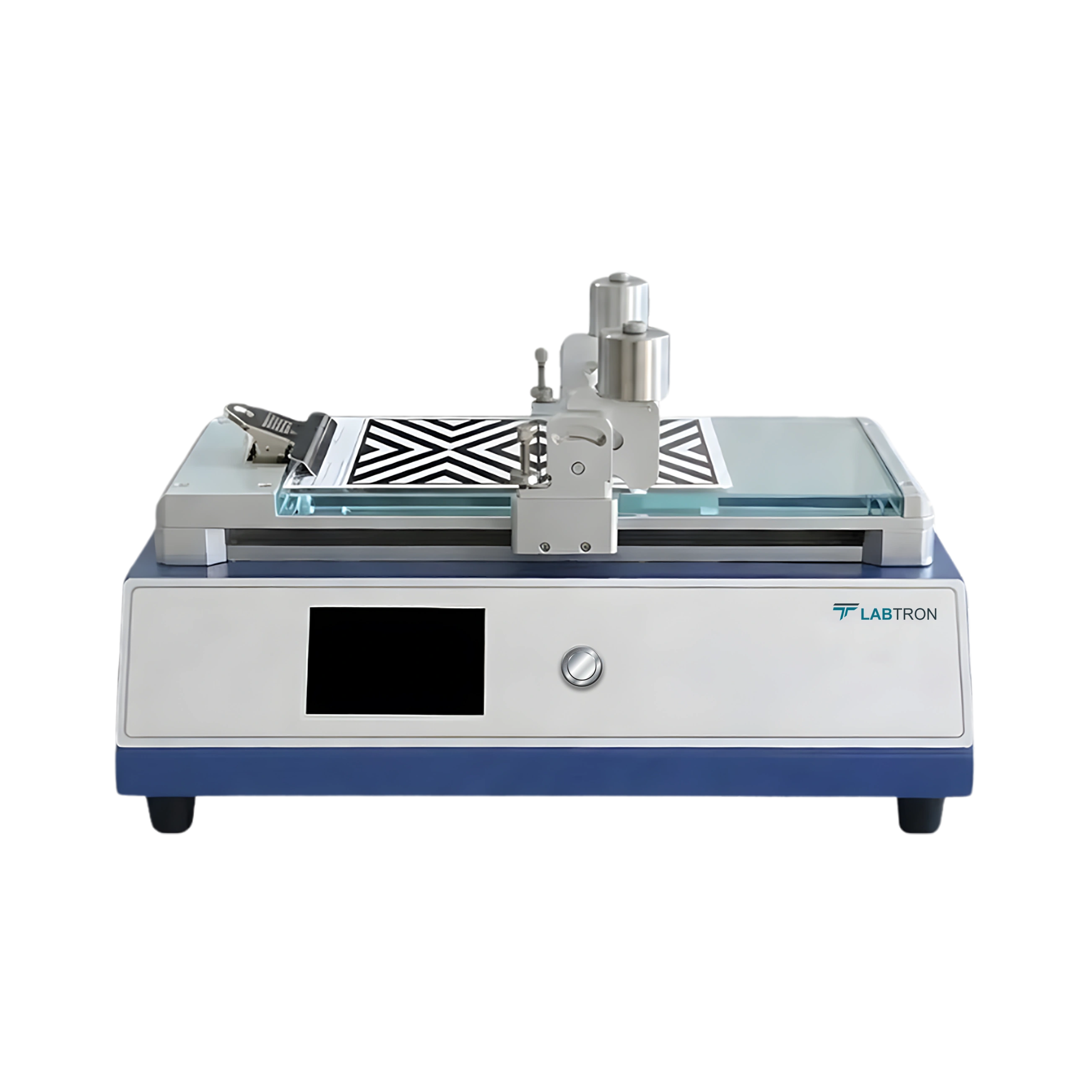
Labtron’s automatic film applicators LAFA-A11 incorporate selectable vacuum zones and clamp beds to match substrates from A4 to A3 or custom sizes. Electronic vacuum zoning allows you to activate only the area under the sample—no tape needed. Clamp-enabled glass beds offer quick transitions between rigid and flexible materials. Some models combine interchangeable glass and vacuum beds, detachable in seconds, enabling efficient cleaning and reduced setup time, particularly helpful in R&D labs processing mixed substrate batches
Labtron supplies automatic film applicator LAFA-A11.Calibration for micrometer-controlled applicators involves placing the blade against a polished glass or granite surface, adjusting the micrometer to zero, and confirming blade contact without gaps under light inspection. Loosen the fixing screws, drop the blade, shine a flashlight through to detect leaks, then tighten and recheck alignment. Annual professional recalibration ensures the accuracy of thickness settings up to 9?mm wet film. Keep records of calibration checks for traceability and quality audits. Proper calibration maintains consistent film thickness, crucial for meeting ASTM or ISO tolerance specifications.
Labtron supplies automatic film applicator LAFA-A11.First, remove the blade by loosening retaining screws and clean both sides and grooves with an appropriate solvent—avoid metal scrapers to prevent damage. Wipe rollers, rails, and carriage components with lint-free cloths and isopropyl alcohol; compressed air can remove dust from sensors and tight grooves Lubricate bearings and micrometer threads with a light oil like WD 40 or equivalent dehumidifier after cleaning. Establish a routine daily wipe downs, weekly sensor care, and quarterly full-service cleanings to prevent film buildup and ensure smooth operation.
Labtron supplies automatic film applicator LAFA-A11.Intelligent control systems in modern applicators continuously monitor parameters such as speed, pressure, and coating thickness in real time. These systems automatically adjust drawdown speed or blade pressure in response to viscosity-induced anomalies, preventing over- or under-coating scenarios. Pre treating materials—through heating, dilution, or mixing—stabilizes viscosity, reducing waste. Regular checks of coating head wear and calibration maintain efficiency by minimizing errors due to mechanical drift. Together, these controls improve repeatability, cost-efficiency, and environmental sustainability of coating processes.
Labtron supplies automatic film applicator LAFA-A11. A consistent vacuum ensures substrates stay flat—essential for uniform films Inspect and clean vacuum ports weekly to prevent clogging. Replace vacuum pump filters quarterly to maintain required suction levels. Similarly, keep linear rails and carriage guides dry and lubricated to prevent speed or alignment variations that could disturb film uniformity. Scheduled maintenance of vacuum and rail systems reduces the risk of defects like edge voids or uneven coverage, especially important for high-precision applications.
Labtron’s automatic film applicator is a precision instrument designed to apply uniform coatings of liquids like paints, adhesives, or inks onto substrates such as glass, metal, or plastic. Unlike manual application, which can introduce inconsistencies due to human error, automatic applicators ensure repeatability by controlling parameters like speed, pressure, and direction. This consistency is crucial for accurate testing of properties like gloss, thickness, and adhesion. The automation minimizes variability, leading to more reliable and reproducible results.
Labtron’s automatic film applicator typically comprises a motorized carriage that moves the applicator tool (e.g., bar coater or blade) across the substrate at a controlled speed. It includes a flat application bed, which may be a glass plate or a vacuum table to hold the substrate firmly. The system allows for adjustable parameters such as speed, pressure, and stroke length. Advanced models may feature touch-screen interfaces, programmable settings, and heating elements for specific applications.
Labtron supplies premium model of automatic film applicator. A vacuum bed secures the substrate firmly during the coating process, preventing any movement that could lead to uneven film application. This is especially beneficial when working with thin or flexible substrates that might otherwise shift or wrinkle. By ensuring the substrate remains flat and stationary, the vacuum bed contributes to the uniformity and consistency of the applied film, which is essential for accurate testing and analysis.
Labtron’s Automatic film applicators are compatible with various applicator tools, including bar coaters (Mayer rods), doctor blades, and gap applicators. The choice of tool depends on the desired film thickness and the viscosity of the coating material. For instance, Mayer rods are suitable for low-viscosity coatings, while adjustable gap applicators can handle higher-viscosity materials. The versatility in tool compatibility allows users to tailor the application process to specific testing requirements.
Labtron supplies premium model of automatic film applicator. The speed at which the applicator tool moves across the substrate influences the thickness and uniformity of the coating. A slower speed allows the coating material more time to flow and level out, potentially resulting in a smoother film. Conversely, a faster speed may lead to thinner coatings and can be beneficial for quick-drying materials. Adjusting the speed setting enables users to optimize the application process based on the properties of the coating material and the desired film characteristics.
Post your question?
Our experts are here to help!
Labtron Equipment Ltd., Quatro House, Lyon Way, Camberley, Surrey GU16 7ER United Kingdom
Email: info@labtron.com Whatsapp: +44 73 4441 2688 Phone: +44 2080 043608