 info@labtron.com

| Stirring Speed | 1500 ± 15 rpm |
| Ambient Temperature | RT to 35 °C |
| Relative Humidity | ≤ 85 % |
| Temperature Controlling Range | RT to 99.9 °C |
| Temperature Controlling Accuracy | ± 1 °C |
| Power Supply | AC 220 V ± 10 %, 50 Hz |
| Dimension | 740 × 510 × 680 mm |
Our Demulsibility Characteristics Tester is used in laboratories and industrial settings to evaluate the separation efficiency of oil and water mixtures in various petroleum and chemical applications.
Download catalog for
Demulsibility Characteristics Tester LDCT-A11 Catalog


Labtron Demulsibility Characteristics Tester provide measurement of stability and breaking tendency of emulsion into its basic parts, usually oil and water. They are equipped with temperature control to simulate various environmental conditions affecting stability. Their stirring mechanism ensures uniform mixing of samples before separation assessment begins. They feature visual indicators that includes graduated cylinders, for easy observation of phase separation. Our Demulsibility Characteristics Tester is suitable for evaluation in petroleum, food and pharmaceuticals industries.
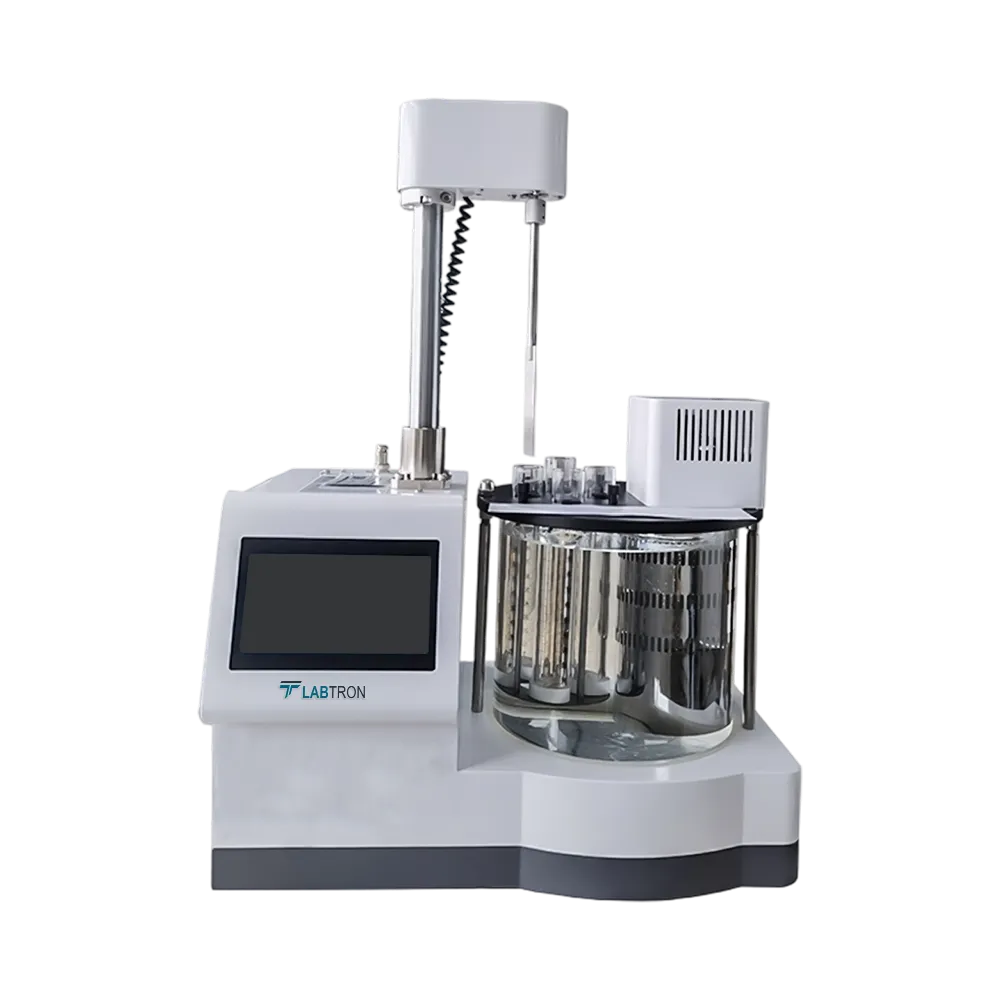
The Demulsibility Characteristics Tester LDCT-A11 features an automatic stirring system that operates at a fixed speed of 1500 ±15 rpm, ensuring uniform mixing of oil and water samples during the test. This consistency is crucial because improper agitation can result in inaccurate or non-repeatable emulsion separation results. By automating this step, it removes user-dependent variability, improving reliability across multiple tests. It also allows operators to focus on monitoring and recording results rather than manually stirring.
Labtron's Demulsibility Characteristics Tester LDCT-A11 features a transparent bath design that allows clear visual observation of the oil-water separation process during and after stirring. This is important because emulsion breakdown needs to be visually assessed as part of ASTM D1401 testing procedures. Users can directly observe phase clarity, interface level, and the formation of the water layer without removing the sample. It also helps in training and quality assurance by letting operators cross-check digital results with real-time visual changes.
Our Demulsibility Characteristics Tester LDCT-A11 uses clear cylindrical glass test vessels placed in a transparent water bath, allowing users to directly observe oil-water interface formation and layer separation over time. This visual clarity is important for detecting when the sample reaches the defined break point according to the standard method. The stationary setup minimizes sample disturbance, ensuring a true visual representation of phase clarity. This design supports both qualitative and quantitative evaluation of emulsion behaviour.
The Demulsibility Characteristics Tester LDCT-A11 is optimized for lubricating oils, turbine oils, and synthetic fluids commonly used in industrial applications. Samples with extremely high viscosity, non-petroleum-based emulsions outside the ASTM D1401 scope, or substances that react dangerously at elevated temperatures should not be tested. Testing such incompatible fluids may lead to inaccurate results or potential damage to the device. For non-standard fluids, preliminary evaluation and careful parameter adjustments are necessary to avoid system strain or safety hazards.
The Demulsibility Characteristics Tester LDCT-A11 includes internal safeguards such as overheating protection circuits and thermal cutoffs in the heating element. These features automatically shut off the heating system if temperature limits are exceeded, preventing damage to the unit or unsafe lab conditions. The instrument also has insulation and component shielding to protect the electronics from prolonged exposure to heat and humidity. These built-in protections ensure long-term operational safety and reduce service-related downtime.
Post your question?
Our experts are here to help!
Labtron Equipment Ltd., Quatro House, Lyon Way, Camberley, Surrey GU16 7ER United Kingdom
Email: info@labtron.com Whatsapp: +44 73 4441 2688 Phone: +44 2080 043608