info@labtron.com

| Gel Plate Dimensions (W × L) | 200 × 200 mm |
| Gel Dimensions (W × L) | 162 × 175 mm |
| Gel Thickness | 1.0 mm |
| Number of Gels | 1 to 2 pcs |
| Maximum Buffer Volume | 10 L |
| Sample Throughput | 1 to 70 |
| Dimension (L × W × H) | 458 × 230 × 285 mm |
| Weight | 23.0 kg |
| Gross Weight | 33 kg |
In-situ gel casting
Integrated gradient gel maker
Micro buffer circulation pump
Side-opening safety lid
Real-time parameter display
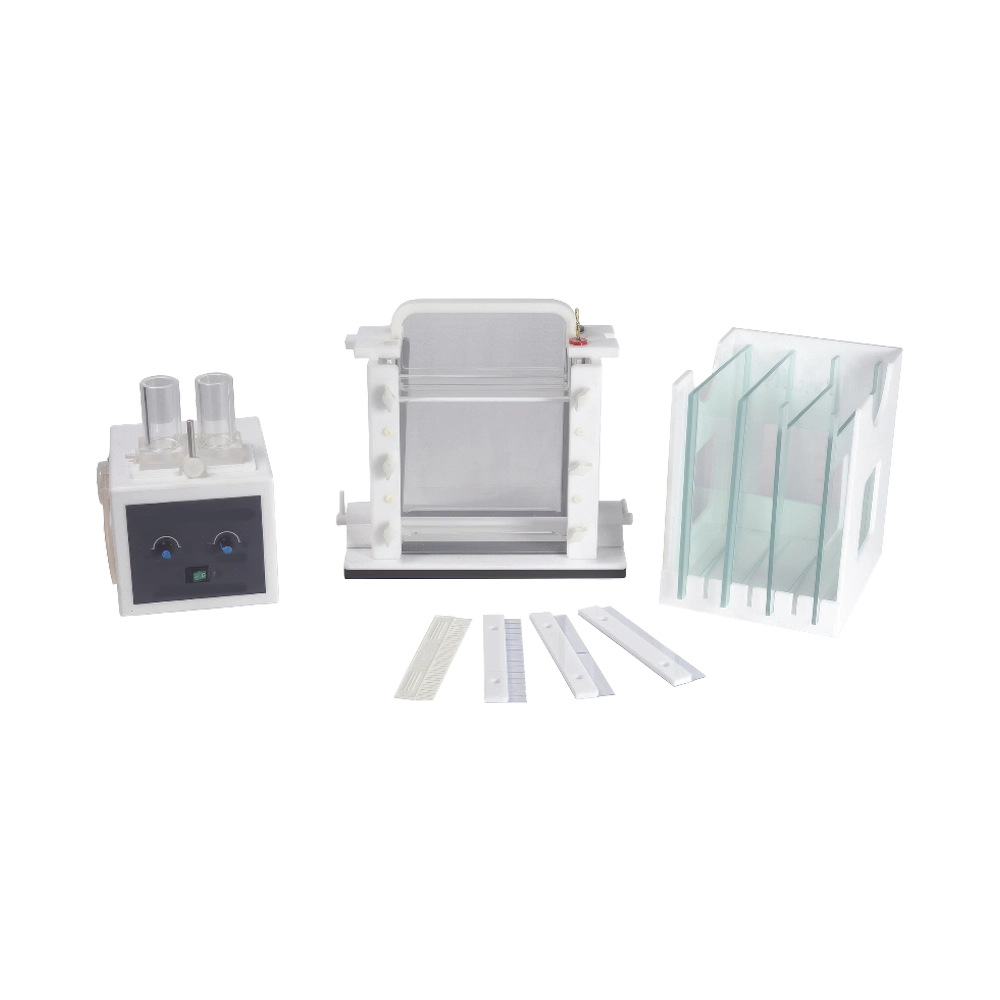
Denaturing Gel Electrophoresis LDGE-A10 separates nucleic acids or proteins by breaking their secondary structures, ensuring separation based on size. It is used in molecular biology, genetic research, and protein analysis for mutation detection, and denatured protein studies.
Download catalog for
Denaturing Gel Electrophoresis LDGE-A10 Catalog
Denaturing Gel Electrophoresis requires specific denaturants to break down secondary structures. For proteins, sodium dodecyl sulfate (SDS) is most commonly used in SDS-PAGE, ensuring that all proteins carry a uniform negative charge and migrate based on molecular weight. For nucleic acids, urea and formamide are commonly used in polyacrylamide and agarose gels to prevent secondary structures from forming. Heat is also used in some protocols to further denature biomolecules. Labtron’s electrophoresis systems are compatible with a variety of denaturing agents, ensuring precise and reproducible separation of biomolecules.
Denaturing Gel Electrophoresis separates biomolecules based on size alone, while Native Gel Electrophoresis retains the natural conformation, charge, and activity of the biomolecules. In denaturing conditions, secondary and tertiary structures are disrupted using heat and chemical agents like SDS (for proteins) or urea/formamide (for nucleic acids). In contrast, native gels do not use these denaturants, preserving biological activity and enabling the study of interactions or conformational states. Labtron’s electrophoresis systems support both native and denaturing conditions, allowing researchers to choose the best approach based on their study requirements.
SDS (Sodium Dodecyl Sulfate) is a detergent that binds to proteins and imparts a uniform negative charge, ensuring that migration occurs solely based on molecular weight rather than shape or charge. Without SDS, proteins may migrate unpredictably due to differences in their native charge or structure. SDS disrupts non-covalent bonds and helps proteins unfold into linear structures, leading to accurate molecular weight estimation. Labtron’s SDS-PAGE systems are optimized to provide consistent and high-resolution protein separation, making them ideal for proteomic studies and molecular biology research.
Temperature plays a crucial role in Denaturing Gel Electrophoresis, as heat helps maintain denatured conditions. For RNA electrophoresis, heating samples before loading prevents secondary structure formation. In SDS-PAGE, samples are typically heated at 95°C for a few minutes to ensure complete protein denaturation before loading. If the temperature is not properly controlled, reannealing or incomplete denaturation may lead to inconsistent band migration. Labtron’s electrophoresis systems incorporate temperature control features to ensure optimal conditions for consistent and high-quality results.
Yes, Denaturing Gel Electrophoresis is commonly used for RNA analysis to ensure accurate size estimation and to check for RNA integrity. RNA molecules tend to form secondary structures, which can affect migration patterns if not properly denatured. Denaturing gels for RNA typically use formaldehyde, glyoxal, or urea to prevent secondary structure formation. Labtron’s electrophoresis systems support high-quality RNA analysis by providing consistent gel conditions and optimized protocols for accurate nucleic acid separation.
Distorted or fuzzy bands may result from improper polymerization of the gel, poor buffer quality, or uneven voltage application. Using high-purity reagents, freshly prepared gels, and a stable power supply can help resolve these problems. Uneven migration or smiling effects often occur due to heat generation, so using an appropriate buffer and maintaining proper cooling can improve band resolution. Labtron’s electrophoresis systems are designed to minimize such errors by offering stable voltage control, optimized gel preparation conditions, and efficient heat dissipation, ensuring reliable and high-quality results in molecular biology and proteomics research.
Post your question?
Our experts are here to help!
Labtron Equipment Ltd., Quatro House, Lyon Way, Camberley, Surrey GU16 7ER United Kingdom
Email: info@labtron.com Whatsapp: +44 73 4441 2688 Phone: +44 2080 043608