info@labtron.com

| Transmission Dimensions (W × L) | 120 × 120 mm |
| Dimensions (L × W × H) | 300 × 200 × 120 mm |
| Weight | 4.2 kg |
Visible Light Operation
Eco-Friendly Fluorescent Dye
EB Dye Alternative
User-Safe Staining Method
Simple Teaching Operation
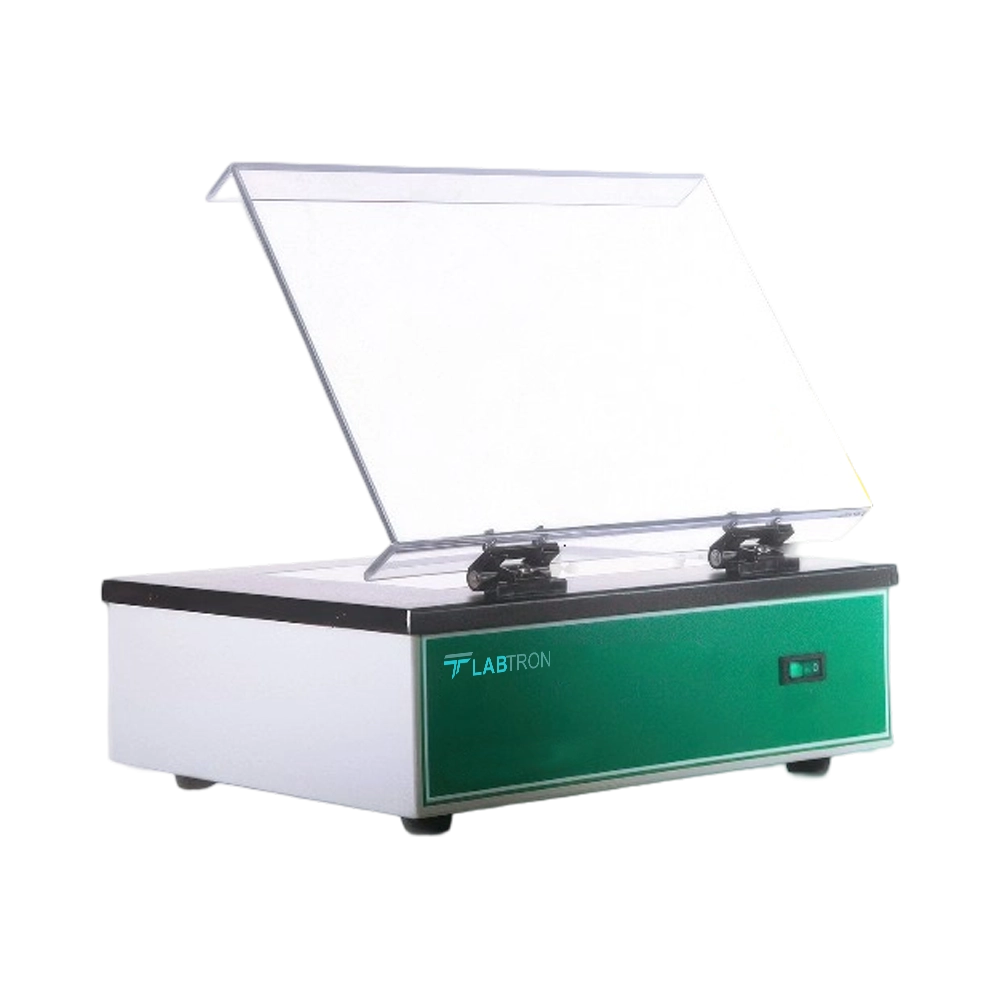
Gel Imaging System LGIS-A10 is an advanced laboratory device for visualizing, capturing, and analyzing DNA, RNA, or protein bands in electrophoresis gels. It is in molecular biology, genomics, and proteomics for accurate documentation, quantification, and analysis of gel results.
Accessories Name | Quantity |
Mainframe | 1 |
SA Insurance Tube | 1 |
Power Cord | 1 |
Download catalog for
Gel Imaging System LGIS-A10 Catalog
Labtron Gel Imaging System incorporates a non-hazardous fluorescent stain designed to minimize health risks during gel electrophoresis while maintaining high staining performance. These environmentally safe dye compositions are for regular lab use without contributing to chemical waste concerns, ensuring user and environmental safety. Their visual detection capability enables researchers to observe DNA, RNA, or protein bands with sharp contrast, even in low-exposure settings. They have visible band visualization that supports accurate documentation for reliable experimental outcomes. Our gel imaging system has energy-efficient illumination, reduces heat output and power usage, and extends the lifespan of the light source, contributing to sustainable lab practices.

Gel imaging systems are built to work with a wide range of staining agents. Common compatible stains include fluorescent dyes like Ethidium Bromide, SYBR Green, GelRed, and SYBR Safe, which are primarily used for DNA and RNA visualization. For proteins, dyes like Coomassie Brilliant Blue and Silver Stain are often used. Labtron gel imaging systems come with both UV transilluminators for ethidium bromide-stained gels and blue-light options for safer imaging with non-toxic dyes like SYBR Safe. This compatibility ensures researchers can choose the most suitable and safest staining method for their work without compromising on clarity or sensitivity.
No, with Labtron’s advanced gel imaging systems, a darkroom is not required. These systems are equipped with light-sealed imaging chambers, which allow users to operate them under standard laboratory lighting conditions. The enclosed design not only protects the gel from ambient light interference but also ensures user safety during UV exposure. This self-contained structure eliminates the need for additional infrastructure and provides greater convenience for routine and high-throughput laboratory workflows, allowing for seamless image acquisition and documentation.
Yes, quantification is a key feature of modern gel imaging systems. Labtron’s systems come with sophisticated image analysis software that allows users to perform densitometry the measurement of band intensity to estimate the quantity of DNA, RNA, or protein in a sample. The software can also generate standard curves using molecular weight ladders, compare band intensities across samples, and calculate relative or absolute concentrations. This functionality is especially valuable for applications like gene expression studies, cloning verification, or protein purification analysis where accuracy and reproducibility are essential.
Captured images can be saved in multiple file formats such as TIFF, JPEG, PNG, and BMP, depending on whether high resolution or file size optimization is needed. Labtron’s imaging software provides an intuitive interface that allows users to adjust contrast, add annotations, crop, and overlay data before saving. These images can then be exported directly to USB drives, networked computers, or cloud storage. This ensures easy sharing for publications, presentations, or internal records. The flexibility in data handling enhances lab efficiency and ensures data integrity across collaborative projects.
Yes, many gel imaging systems are designed to be modular and upgradeable. Labtron offers a range of compatible camera upgrades, LED or UV light source enhancements, and advanced software modules that allow researchers to scale their system as their needs evolve. For example, upgrading to a higher-resolution camera can improve band clarity and enable low-light detection, while adding a blue-light module can expand dye compatibility. This upgrade-friendly design provides long-term value, allowing users to keep pace with advancing technologies without needing to replace the entire system.
Post your question?
Our experts are here to help!
Labtron Equipment Ltd., Quatro House, Lyon Way, Camberley, Surrey GU16 7ER United Kingdom
Email: info@labtron.com Whatsapp: +44 73 4441 2688 Phone: +44 2080 043608