 info@labtron.com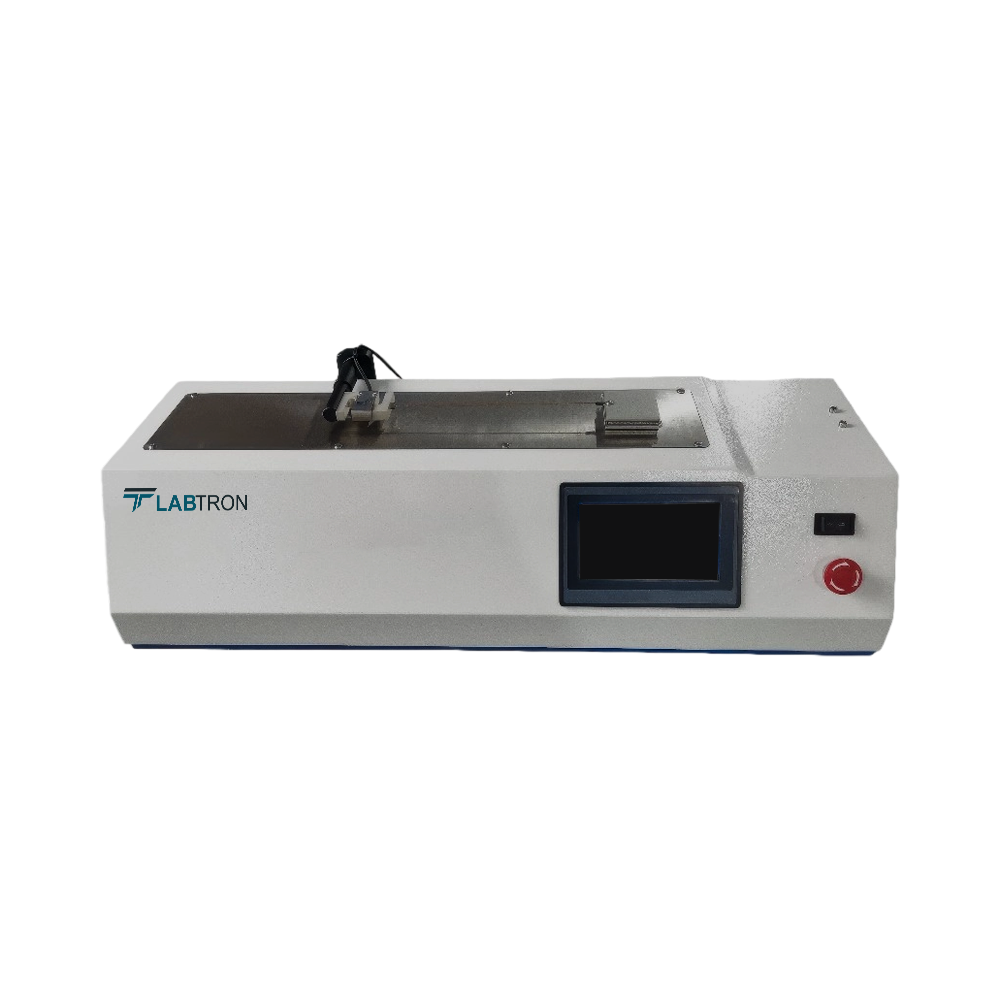

| Test Angle | 180° |
| Display Method | Infra-red voltage tester with digital readout |
| Signal Output | Oscillating type |
| Data Frequency | 0.5 seconds at a time |
| Test Range | 10V~19.99kV;1V~1999V(other voltage ranges available) |
| Test Distance | 30mm(between the measured and detected parts) |
| Power Supply | DC9V Alkaline angle type dry cell |
| Measurement Speed | 0.01-15000mm/min Adjustable |
| Effective Stroke | 450mm |
| Specimen Width | Larger than 150mm |
| Test Method | Tear film and voltmeter synchronized action operation |
| Test Results | Force results, force curves, instantaneous voltage values, etc. |
| Shutdown Method | Upper and lower limit safety settings, test piece breakpoint sensing |
| Motor Drive | Servo motor drive |
| Machine Drive | Ball Screws + Linear Guide way |
| Machine Power | 400W |
| Machine Dimensions | 1050 mm (W) × 420 mm (D) × 365 mm (H) |
| Use of Power | 220V (50 Hz) |
Lightweight
Multiple operation modes
LCD display
LED for distance measurement
Resistant ionized airflow condition
Our Peel Strength Tester LTPS-A10 has an Infra-red voltage tester with a digital readout, allowing a great range of distance measurement. Our peel strength tester is designed to test the voltage of the sample during the peeling of the protective film.
USB communication cable
A software
Ring-type initial adhesion jig
Steel plate (computer self-contained)
Sensors (10N, 20N, 50N, 100N, 200N, 500N, 1KN)
Download catalog for
Peel Strength Tester LTPS-A10 Catalog
Labtron provides Peel Strength Testers designed to test the voltage of samples during the peeling of their protective films. The testers are equipped with LCD display that constantly displays the reading and LED lights for distant analysis. Their structure is compact, and desktop design makes it easy to move has a measurement range from 25 mm to +/- 1mm gives quite a range. These devices have the latest and fastest response time of up to 1 second. Our Peel strength testers are designed to test the voltage of the sample during the peeling of protective film, mostly wires.

Labtron’s Peel Strength Tester LTPS-A10 evaluates the electrostatic charge accumulated on plastic films during tearing or separation. It’s crucial for packaging and electronics industries where static discharge can damage components or attract dust. The tester measures voltage in kilovolts (kV) and helps identify whether antistatic treatments are required. Proper grounding, consistent environmental conditions, and calibrated sensors are essential for accurate and repeatable results during testing of various film types.
Labtron’s Peel Strength Tester LTPS-A10 is better alignment for long, flexible, or heavy specimens such as wires, tapes, and films. They reduce sagging and misalignment caused by gravity, leading to more accurate force measurements. These testers are easier to integrate into production lines and can accommodate large or automated sample handling systems. Their robust design and flexibility make them ideal for continuous quality control in manufacturing environments where space and orientation flexibility are important.
Static voltage is measured using non-contact sensors that detect the electric field generated as the film tears. The film is placed and torn under controlled conditions while the sensor records the peak voltage. This data helps manufacturers understand electrostatic behavior, especially in high-speed packaging lines. Accurate measurements depend on film type, tearing speed, ambient humidity, and distance from the sensor. Results guide decisions on antistatic agents, film selection, and packaging safety protocols.
Labtron’s Peel Strength Tester LTPS-A10 evaluates the adhesive bond strength between two materials, typically films, laminates, or adhesive tapes. It measures the force required to peel one material from another at a constant angle, usually 180° or 90°. This is crucial for assessing seal integrity and adhesive quality in packaging, automotive, and electronics. Horizontal configuration supports flexible or elongated specimens and provides better control of peeling direction, ensuring accurate and consistent test results.
Accuracy is achieved by proper specimen preparation, environmental control (especially humidity for static tests), and regular equipment calibration. For tensile and peel testing, alignment, grip selection, and standardized test speeds (per ASTM or ISO methods) are key. For static voltage tests, the sensor’s distance, angle, and environmental charge neutrality are crucial. Using certified materials, maintaining a clean testing area, and training operators also improve consistency and reduce variability in results.
Post your question?
Our experts are here to help!
Labtron Equipment Ltd., Quatro House, Lyon Way, Camberley, Surrey GU16 7ER United Kingdom
Email: info@labtron.com Whatsapp: +44 73 4441 2688 Phone: +44 2080 043608