info@labtron.com

| Illuminating Geometry | 8/d |
| Measuring Aperture | Φ8 mm |
| Color Spaces | CIE L× a × b ×C ×h, CIE XYZ, CIE RGB, CIE L × u × v, CIE L × C × h |
| Color Difference Formula | ΔE × ab, ΔL ×a ×b, ΔE ×C ×h, ΔE C1E94, ΔE Hunter |
| Illuminant | D 65, D50 A |
| Repeatability | Standard Deviation within ΔE × ab 0.06 |
| Error Between Each Equipment | ≤ 0.40 ΔE× ab |
| Charging Time | 2 hours |
| Measurement Time Before Charging | 3000 times |
| Operating Temperature | 10 to 40°C |
| Humidity Range | 0 to 85% |
| Storage | 100Pcs Standard, 20000 Pcs Sample |
| Power Supply | 3.7V at 3200mAh |
| Dimension | 205 × 70 ×100mm |
| Weight | 500g |
Automatic Shut-Off Mode
Advanced Color Matching Algorithms
Real-Time Data Analysis
Voice Assisted Guidance
Standard Library Storage
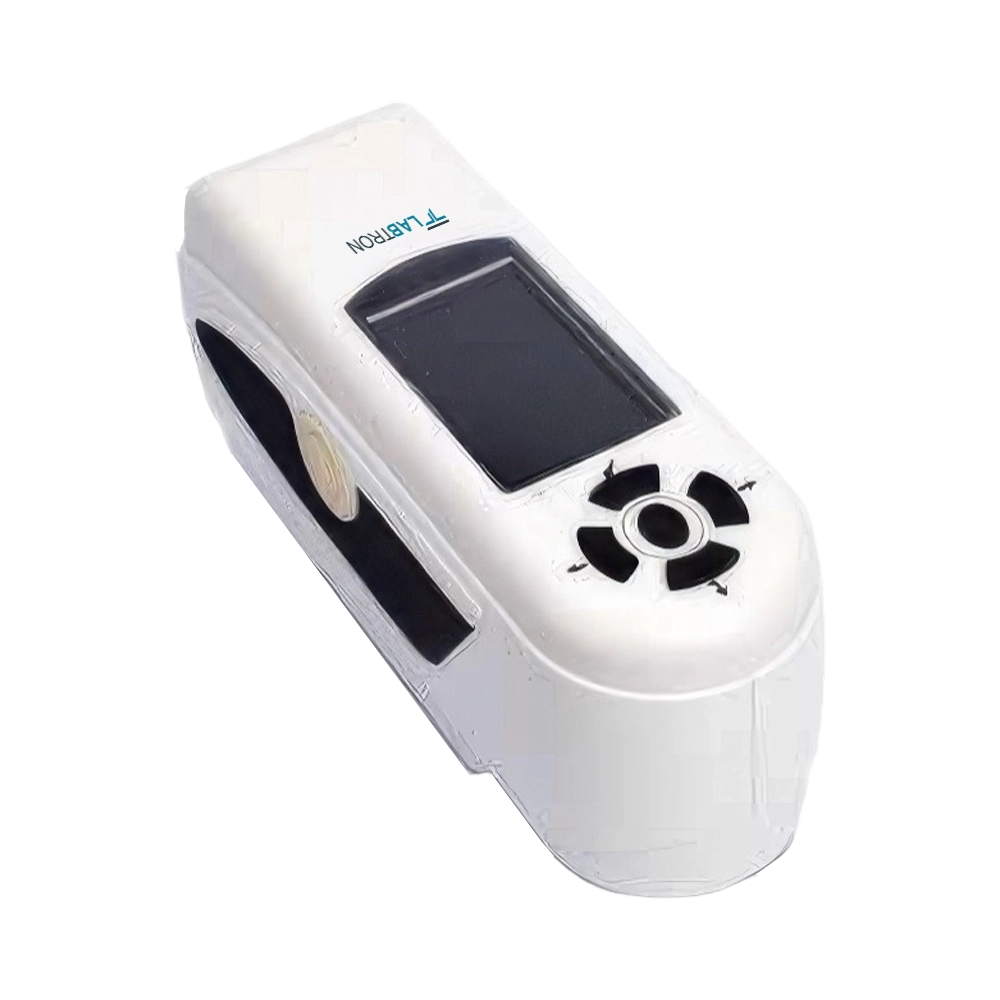
Portable Colorimeter LPCO-B11 is a handheld device that measures the color of objects or samples with high accuracy. It offers a key role in plastics and cosmetics in measuring color accuracy of products and its quality control.
Download catalog for
Portable Colorimeter LPCO-B11 Catalog


Labtron Portable colorimeters are compact devices used for quick and accurate color measurement in various samples. They feature user-friendly interfaces, digital displays, and rechargeable batteries for easy field use. These calorimeters offer high precision, fast results, and memory storage for multiple readings. They come with pre-set calibration and are often waterproof and lightweight. Our portable colorimeters are used in water quality testing, food and beverage analysis, chemical research, and environmental monitoring. Their portability and ease of use make them ideal for on-site testing in remote locations.


Labtron’s Portable Colorimeters are equipped with internal calibration mechanisms and light source stabilization to minimize the impact of temperature, humidity, and ambient light on readings. High-quality models use LED light sources with controlled wavelengths and built-in reference standards to auto-correct deviations. Advanced algorithms in the firmware help compensate for minor environmental fluctuations. Some units also feature sealed optical chambers to block external light interference. Users are advised to calibrate the device before each session for best accuracy. In fieldwork, using protective covers can further ensure stable measurements. Routine maintenance and calibration logs enhance consistency over time. Always follow manufacturer guidelines for operation under extreme weather conditions.
Yes, Labtron’s advanced Portable Colorimeters are capable of accurate quantitative analysis. They measure the absorbance of specific wavelengths, which, based on Beer-Lambert's Law, is directly proportional to the concentration of an analyte. Using calibration curves generated with known standards, users can determine exact concentrations in unknown samples. This makes them suitable for applications like water quality monitoring, chemical assays, and food additive measurements. However, accuracy depends on factors like sample clarity, consistent preparation, and proper calibration. High-end models often support multi-point calibration and can store multiple methods. They're a reliable alternative to full benchtop spectrophotometers in many scenarios.
Labtron supplies premium Portable Colorimeters to simultaneously capture measurements at multiple wavelengths, which significantly enhances their ability to analyze complex samples. For instance, a multichannel system can measure absorbance across a range of wavelengths that correspond to different components in a sample, allowing for more comprehensive chemical analysis. By using multiple detectors or a single photodetector array, these systems can capture data at several distinct points in the spectrum without needing to scan each one individually. This reduces analysis time and increases efficiency in high-throughput scenarios. Multichannel capabilities also allow for more accurate identification of overlapping or coexisting spectral features, providing higher fidelity measurements in multi-component systems like food or pharmaceutical formulations.
Labtron’s advanced Portable Colorimeters can integrate with spectrophotometric techniques like reflectance, transmittance, and absorbance spectroscopy to provide highly precise measurements of both surface and internal sample properties. Some portable devices combine these techniques with fluorescence spectroscopy to analyze sample behavior under specific excitation conditions. For instance, when measuring highly reflective surfaces or transparent liquids, specialized optical components like beam splitters, optical fibers, and diffraction gratings are used to ensure accurate data capture. These colorimeters may also include automatic baseline correction, which compensates for environmental variations, improving long-term measurement consistency. Combining spectrophotometric techniques with powerful data analysis software helps resolve complex issues like sample heterogeneity and light scattering.
Labtron supplies advanced Portable Colorimeter which are utilized in many sectors. In the food and beverage industry, portable colorimeters are widely used for quality control, particularly for assessing the color consistency of products like juices, sauces, dairy, meat, and confectionery. These instruments help ensure that products meet industry standards for color, which is often linked to consumer perception and quality. For example, colorimeters measure hue, saturation, and lightness values to assess if the final product falls within the required color range. In fruits and vegetables, color analysis can indicate ripeness or freshness. Portable colorimeters are also useful for measuring caramelization levels or Maillard reactions in food products. Many food processors use the colorimeter for standardization and to meet regulatory color requirements, helping avoid discrepancies between batches and ensuring that products maintain their desired appearance.
Labtron’s Portable Colorimeters have high-end functions.Temperature sensitivity can greatly impact the accuracy of colorimetric measurements, as many colorimetric reactions are temperature-dependent. To ensure high precision in temperature-sensitive applications, portable colorimeters often include internal temperature sensors to continuously monitor and compensate for fluctuations in ambient temperature. Some models feature automatic temperature correction algorithms that adjust readings based on the detected temperature, ensuring consistent results across varying environments. Additionally, thermoelectric cooling systems or temperature-controlled sample holders are used to maintain the sample at a stable temperature during measurement, minimizing the risk of temperature-induced errors. This is particularly important in applications like biochemical assays, where reaction rates can be highly sensitive to temperature changes.
Post your question?
Our experts are here to help!
Labtron Equipment Ltd., Quatro House, Lyon Way, Camberley, Surrey GU16 7ER United Kingdom
Email: info@labtron.com Whatsapp: +44 73 4441 2688 Phone: +44 2080 043608