info@labtron.com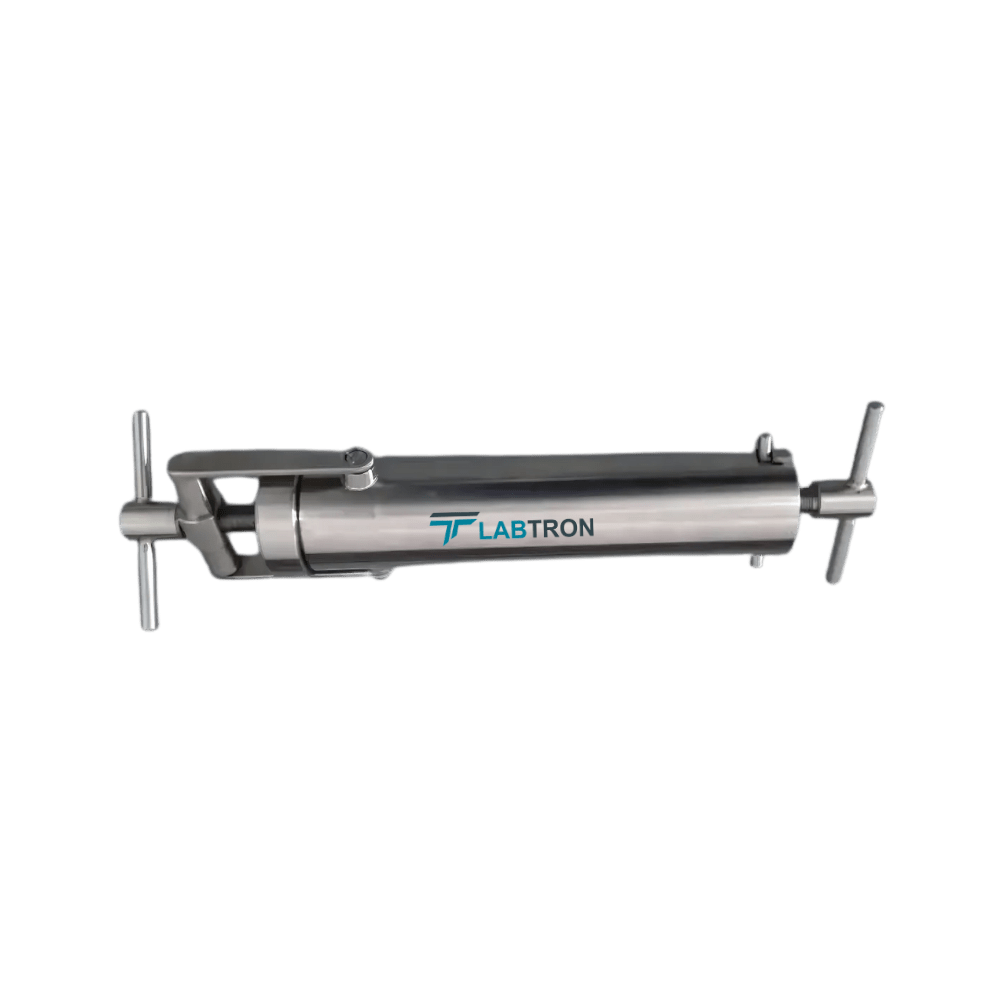

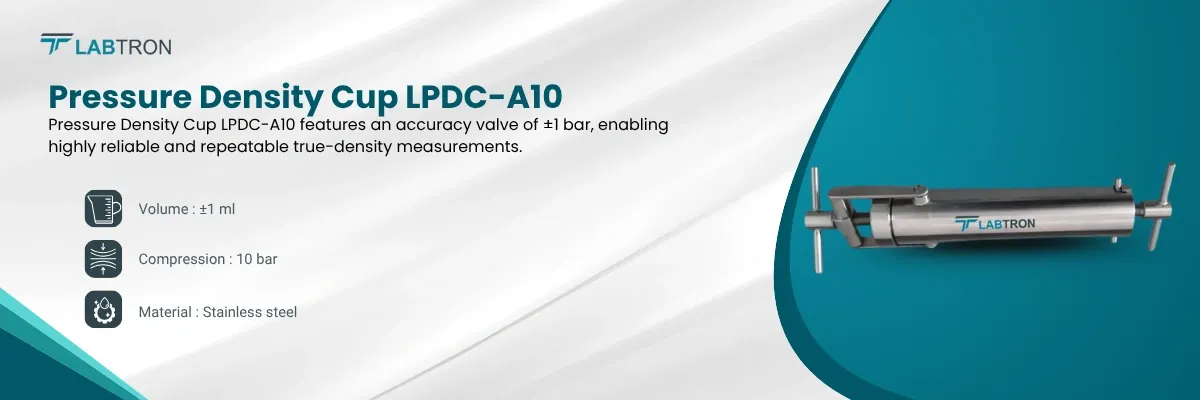
| Accuracy Valve | ±1 bar |
| Volume | ±1 ml |
| Compression | 10 bar Volume: 100 ml |
| Material | Stainless steel |
| Gross Dimension | 450 × 290 × 100 mm |
| Net Weight | 1200 g |
| Gross Weight | 2 Kg |
High-Compression Pressure
Leak-Proof Sealing
Temperature Calibration Mode
High Valve Accuracy
Pressure Release Mechanism
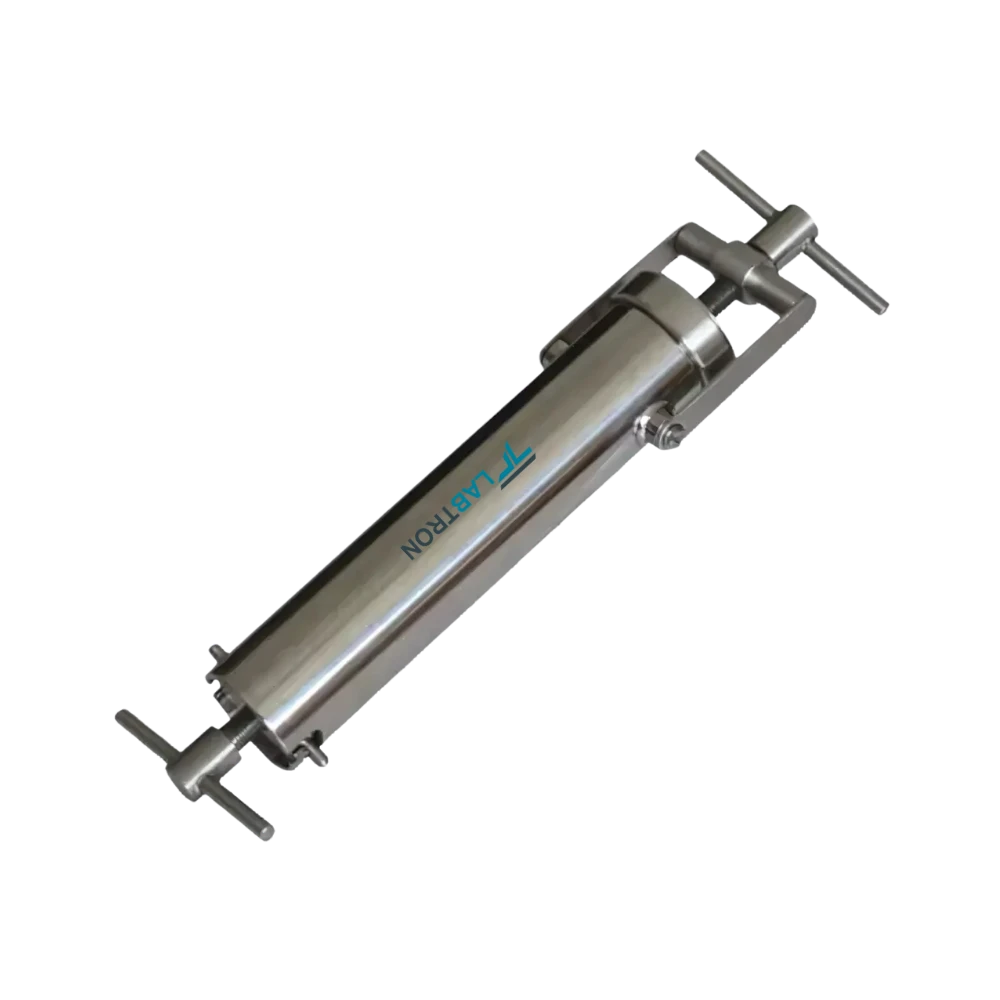
Pressure Density Cup LPDC-A10 is a stainless-steel pycnometer that compresses liquid samples, eliminating entrapped air by applying pressure. It is widely utilized in paint, lacquers, coatings, adhesives, cosmetics, QC labs, and emulsions for accurate density control.
Download catalog for
Pressure Density Cup LPDC-A10 Catalog
Labtron Pressure Density Cup accurately measures the density or specific gravity of liquids. They feature a stainless-steel cup with a screw-driven piston, minimizing the entrapped air bubbles for reliable measurements. These density cup have a leak-proof sealing system to ensure airtight integrity during pressurization. Their high-pressure compression mode delivers contamination-free density measurements. Our pressure-density cup offers an advanced overflow mechanism that automatically removes excess liquid.
When a sample is pressurized within the cup of LPDC-A10, entrapped air bubbles are either dissolved into the liquid or significantly compressed, diminishing their volume. This compressive effect reduces buoyancy and false volume added by air, ensuring the weighed mass represents only the liquid. The outcome is a density value that more accurately reflects the true composition of the sample, improving repeatability. Eliminating variable air content is especially crucial for consistency between samples. This principle is widely adopted in quality control for coatings and varnishes.
Labtron’s pressure density cup LPDC-A10 employs a plunger and spring-loaded release cap mechanism, allowing controlled venting of excess sample when pressurization is reached. This design minimizes exposure to potentially hazardous fluids and ensures stable containment during testing. The cylindrical stainless-steel housing is robust, preventing leaks or ruptures under operational conditions. Its desktop holder secures the device upright for safe handling throughout the process. Manufacturers also often supply calibration certificates to document safety compliance and functional integrity.
After venting, excess sample should be rinsed away from the top of the LPDC-A10 before disassembly. The stainless-steel components—plunger, seals, and cap—should be cleaned using solvent or detergent suitable for the sample matrix. Brushes are often supplied for thorough removal of viscous or sticky residues. After cleaning, all parts must be fully dried to avoid contamination or weighing errors. Replace seals if any wear is observed, and reassemble only after drying to maintain volume integrity. This prevents cross-sample contamination and preserves measurement accuracy.
Labtron supplies advanced models of pressure density cup LPDC-A10. Relevant guidelines instruct users to preliminarily homogenize viscous or unstable samples to ensure even distribution before testing. The protocol requires filling the cup slowly to avoid turbulence and entrapping additional air. Standards specify allowing time for entrapped air to rise and escape before sealing. Pressure is applied gradually until venting begins, thereby compressing any residual bubbles effectively. Post-test, calibration checks validate consistent cup volume and valve function. These measures ensure reproducible, compliant testing across labs.
Yes, when correction factors are applied, results are comparable to those obtained via pycnometers or other gravimetric methods. While pycnometers are sensitive to temperature and bubble entrapment, pressure cups compensate for those variables. Standards often allow cross-validation between methods, noting volume equivalence under defined conditions. This compatibility supports instrument qualification for broader analytical protocols. However, differences in sample handling and compressibility effects must be carefully accounted for in comparative studies.
Labtron’s pressure density cup works by compressing a defined volume of a liquid sample to diminish or dissolve entrapped air. This process removes volumetric distortions caused by bubbles, ensuring that the measured mass truly represents the liquid. The operator then determines density by dividing the mass of the evacuated sample by the cup’s known volume. This approach enhances precision by eliminating errors tied to entrapped gases. By standardizing this procedure within a sealed environment, measurement repeatability is significantly improved.
Labtron’s pressure density cups are designed according to established international standards governing liquid density measurements by pressurized displacement. They specify proper sample handling, compression procedures, and calibration routines, ensuring consistent results. These standards mandate use of calibrated volumes, defined valve pressure characteristics, and specific testing protocols. Instruments often include traceable calibration documentation to verify compliance. Adherence to these regulations ensures reliability across different laboratories and testing environments.
. Labtron supplies premium models of pressure density cups. To ensure accurate results begin by thoroughly cleaning and drying the vessel and plunger parts, ensuring no residues remain. Assemble the cup and equilibrate it to the test environment before filling. Carefully introduce the sample, seal the vessel, and slowly apply pressure until the venting mechanism activates to release excess fluid. Maintain pressure until equilibrium is achieved, then gently disassemble the cup. Clean the exterior, weigh the sample-containing cup, subtract the tare weight, and calculate density using the known volume.
Temperature fluctuations affect both liquid density and the volumetric behavior of the stainless-steel vessel. Testing should be performed within a controlled temperature range to avoid errors due to thermal expansion. Equilibration prior to filling ensures the sample and instrument are at the same temperature. Deviations between instrument and sample temperature can skew results. Maintaining stable environmental conditions also improves reproducibility and consistency of measurements.
Labtron supplies premium models of pressure density cups. The tool is ideally suited for viscous or aerated liquids—such as coatings, paints, emulsions, adhesives, and polymer dispersions—that trap air during mixing. It effectively compresses or dissolves gas pockets, providing accurate density data for these challenging fluids. Its robust design handles varied viscosities while preserving test integrity. This makes it a standard choice in quality control for formulation industries where reliability of density data is essential.
Post your question?
Our experts are here to help!
Labtron Equipment Ltd., Quatro House, Lyon Way, Camberley, Surrey GU16 7ER United Kingdom
Email: info@labtron.com Whatsapp: +44 73 4441 2688 Phone: +44 2080 043608