 info@labtron.com

| Lamp Power | 300W |
| Light Source Classification | A+A+A+ xenon light |
| Power Adjustment Range | 150W to 300W continuously adjustable |
| Average Optical Output Power Density | 5 to 15 Sun (1 Sun = 1000W/m²), adjustable |
| Radiant Output | 50W |
| Spectral Output | 300nm to 2500nm |
| Working Spot Diameter | >60mm, continuously adjustable |
| Optical Output Form | Circular light spot, free rotation along axis |
| Input Power | 300W (range: 180W to 320W) |
| Working Current | 21A (range: 10A to 22A) |
| Working Voltage | 14V (range: 13V to 16V) |
| UV Output (<390nm) | 2.6W |
| IR Output (>770nm) | 28.8W |
| Visible Output (390 to 770nm) | 5000 Lumens |
| Light Bulb Window | 25.4mm |
| Bulb’s Lifetime | 1000H (limit: 6000H) |
| Parallel Light Divergence Angle | Average 5° |
| Power Supply | 220V 50Hz / 110V 60Hz |
| Dimension | 640 × 400 × 350 mm |
| Packaging Dimension | 740 × 480 × 430 mm |
| Weight | 20 Kg |
| Gross Weight | 28.8 Kg |
Fast electro-optical conversion
Quick-change filter system
Modular design
Compatible with multiple filter and lens
Solar Simulator LSS-A10 is used in a variety of fields, including material testing, biological research, environmental testing, photovoltaic testing, and space and aerospace.
Accessories Name | Qty (pcs) |
Professional adjustable power source system | 1 |
Bulb | 1 |
Imported lamp source | 1 |
90° steering lens (reflector lens included) | 1 |
220V AC cable | 2 |
Dust proof lens | 1 |
Accessories Name | Qty (pcs) |
300W Short Arc Xenon Bulb | 1 |
1cm × 1cm Condenser Lens Converter Head | 1 |
Φ5mm × 1m, quartz Optical Fiber | 1 |
54mm Condenser Lens | 1 |
AM1.5G + Total reflection filter Simulated Sunlight Filter | 1 |
UVCUT420 Cut-off Filter | 1 |
365nm, 405nm, 450nm, 475nm, 500nm, 550nm, 600nm, 650nm, 700nm, 750nm Band Pass Filters | 1 |
Alloy material Water Cooler for Xenon Bulbs | 1 |
Download catalog for
Solar Simulator LSS-A10 Catalog
Download manual for
Solar Simulator LSS-A10 Manual
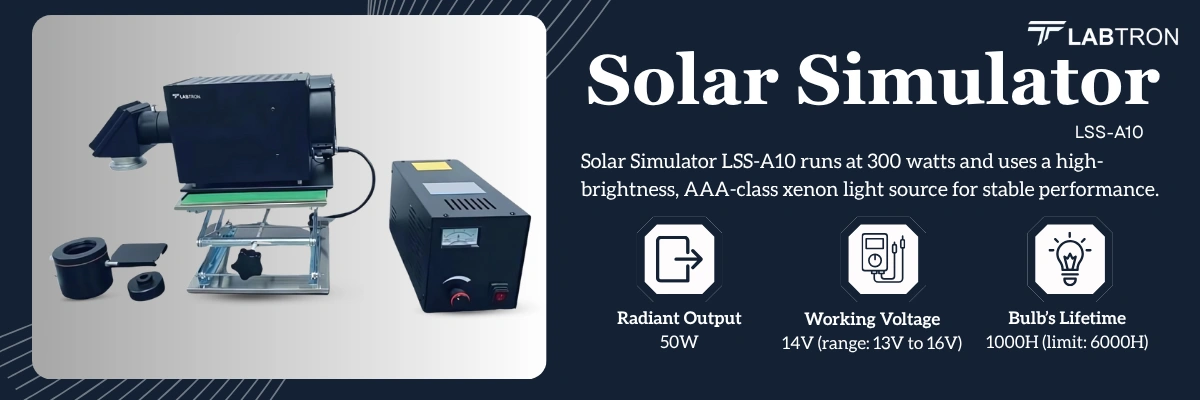

Labtron Solar simulators offer high-intensity, uniform, and stable illumination across a wide spectrum. These systems are widely used in testing solar panels, materials, and photovoltaic cells. Their key features include adjustable light intensity, long lamp life, and precise spectral matching. Our Solar simulators support research, product development, and quality control in solar energy and material science. They are essential tools in laboratories and industrial testing facilities.
The Labtron Solar Simulator is highly versatile, making it ideal for a wide range of applications like material testing, biological research, environmental studies, and photovoltaic testing. One of the key reasons for this flexibility is its adjustable power range between 150 to 300 watts. This allows users to fine-tune the light intensity based on specific experimental needs. Additionally, the simulator provides a consistent and high-quality light source using a AAA-class xenon lamp, which closely mimics natural sunlight. Its spectral output covers a wide range from 300nm to 2500nm, including ultraviolet, visible, and infrared light, making it perfect for simulating different real-world lighting conditions.
The Labtron Solar Simulator uses a high-brightness xenon light source known for its stable performance. The light bulb is integrated with a reflector in a compact design, which ensures that the maximum amount of light is efficiently directed to the testing area. This design not only improves light utilization but also maintains uniformity in illumination. The simulator provides a circular light spot that can be rotated freely along its axis, with a spot diameter of over 60mm. This makes it easier to align and focus the light precisely where it is needed, ensuring reliable results in every experiment.
The xenon bulb used in the simulator typically has a standard lifespan of around 1000 hours, but it can last up to 6000 hours under optimal conditions. This extended life is made possible by advanced heat dissipation technology. The simulator is equipped with imported heat dissipation modules that effectively manage the heat generated during operation. By keeping the temperature under control, these modules reduce wear on the bulb and other internal components, helping users save on maintenance and replacement costs over time.
Yes, the Labtron Solar Simulator is designed with a modular structure, which makes it easy to customize or upgrade. It supports a quick-change filter system, allowing users to swap filters depending on the required wavelength or experimental conditions. Additionally, it is compatible with multiple lenses and filters, making it adaptable to a variety of research setups. This modularity is particularly useful in labs where different types of tests are performed regularly, allowing the equipment to be tailored for specific applications without needing a complete overhaul.
The Labtron Solar Simulator is built with user-friendly and safe operation in mind. It operates on standard power supplies (220V 50Hz or 110V 60Hz) and allows continuous adjustment of both voltage and current within safe limits. The average current is around 21A and the working voltage stays between 13V to 16V, providing a stable electrical input. The system also features fast electro-optical conversion, which means it responds quickly when power settings are changed. These features make the simulator safe and simple to use, even for users who may not have extensive technical experience.
Post your question?
Our experts are here to help!
Labtron Equipment Ltd., Quatro House, Lyon Way, Camberley, Surrey GU16 7ER United Kingdom
Email: info@labtron.com Whatsapp: +44 73 4441 2688 Phone: +44 2080 043608

