 info@labtron.com

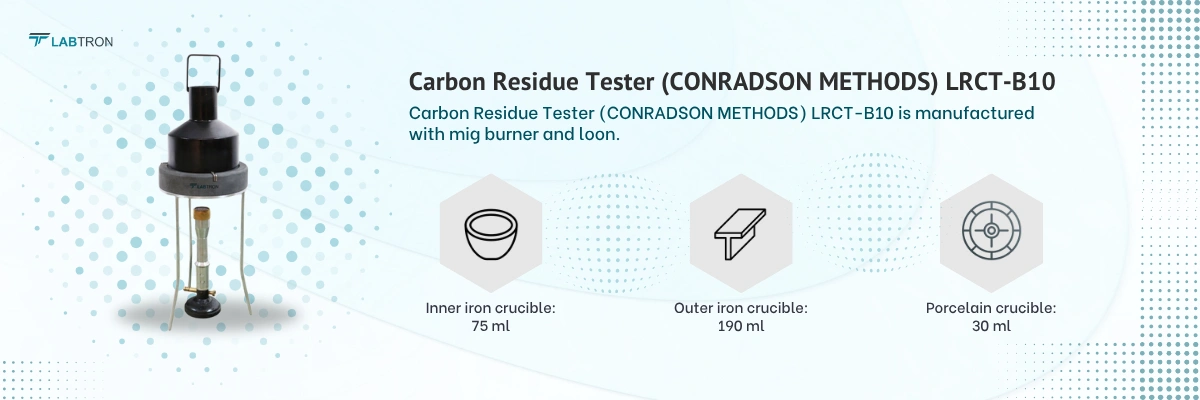
| Porcelain crucible | 30 ml |
| Inner iron crucible | 75 ml |
| Outer iron crucible | 190 ml |
| Bore Diameter | Ø130 ± 5 mm |
| Upper Port Diameter | Ø90 ± 2 mm |
| Lower Port Diameter | Ø82 ± 2 mm |
| Height | 250 ± 10 mm |
| Lower Section Height | 50–53 mm |
| Central Cone Height | 25 ± 2 mm |
| Burner | Mig Burner |
| Dimensions | 400 x 380 x 270 mm |
| Packaging Dimensions | 480 x 200 x 250 mm |
| Net weight | 3.5Kg |
| Gross weight | 4Kg |
Simple design
Includes Loon
MiG burner
Household fuel gas testing
Carbon Residue Tester (Conradson Method) LRCT-B10 is used to measure the carbon residue left after petroleum products undergo evaporation and pyrolysis, and it also indicates their tendency for coke foaming.
| Standard Accessories | Quantity |
| Porcelain crucible | 2 Nos. |
| Inner iron crucible | 1 No. |
| Outer iron crucible | 2 Nos. |
| Tripod | 1 No. |
| Flame shield | 1 No. |
| Round cover | 1 No. |
| Blowtorch | 1 No. |
Download catalog for
Carbon Residue Tester (CONRADSON METHODS) LRCT-B10 Catalog

Labtron Carbon Residue is equipped with a digital PID temperature controller and operates in electric heating mode, ensuring precise temperature regulation and energy efficiency. These furnaces adopt a detachable receiver, allowing for easy maintenance and handling. Their system monitors the gas flow rate, ensuring optimal performance and enhanced safety. They have a two-stage pressure stabilization system and maintain consistent pressure levels for reliable operation. Our carbon residue has high-temperature operation and delivers stable and consistent performance even under extreme conditions.


The Carbon Residue Tester (CONRADSON METHODS) LRCT-B10 heats and decomposes the sample, after which the remaining carbon residue is collected and weighed. This residue weight is compared to the original sample weight to determine the percentage of carbon residue. The accuracy of the result depends on proper sample handling, precise flame control, and consistent heating duration as outlined in ASTM D189. It provides a standardized crucible system and stable burner operation to help minimize variability and ensure reliable measurements.
The Carbon Residue Tester (CONRADSON METHODS) LRCT-B10 uses a mig burner for direct heating. If you require more automation, better temperature regulation, or data logging, switching to models with programmable features is recommended. However, it remains ideal for users who prefer a cost-effective, manual approach with reliable performance.
Our Carbon Residue Tester (CONRADSON METHODS) LRCT-B10 achieves repeatability through standardized crucible dimensions, consistent burner output, and strict adherence to fixed heating and cooling protocols. Users are encouraged to precondition the crucibles and use uniform sample volumes to minimize result variation. The layered crucible system creates a stable thermal enclosure that ensures even heat distribution throughout the test cycle. When operated in accordance with the defined ASTM method, the tester consistently delivers reproducible results across multiple runs.
The Carbon Residue Tester (CONRADSON METHODS) LRCT-B10 requires active monitoring during the heating phase since it operates with an open flame and manual timing. The operator must light the burner, adjust flame intensity, and ensure uniform heating as per test requirements. After the heating cycle, the system should be allowed to cool before the residue is collected and weighed. This manual approach gives users greater control but also demands attentiveness and familiarity with standard procedures.
Labtron's Carbon Residue Tester (CONRADSON METHODS) LRCT-B10 typically operates using a mig burner fueled by liquefied petroleum gas (LPG) or natural gas, depending on regional availability and lab setup. LPG offers a strong and controllable flame, making it ideal for achieving uniform and reliable sample heating. To ensure consistent thermal performance and prevent soot buildup, it is essential to use high-purity gas. Proper flame stability is maintained by regulating the gas supply with a two-stage pressure regulator throughout the test cycle.
The Carbon Residue Tester (CONRADSON METHODS) LRCT-B10 helps predict how much solid carbonaceous material may form during fuel combustion or refining, serving as a key indicator of fuel cleanliness and performance. In fuel production, this data supports refining process adjustments and accurate product classification. It also plays a vital role in quality assurance protocols by identifying high-residue samples that could contribute to engine deposits or catalyst fouling. It is a valuable tool for maintaining consistent fuel standards and minimizing downstream performance issues.
Post your question?
Our experts are here to help!
Labtron Equipment Ltd., Quatro House, Lyon Way, Camberley, Surrey GU16 7ER United Kingdom
Email: info@labtron.com Whatsapp: +44 73 4441 2688 Phone: +44 2080 043608

