info@labtron.com

| Working Temperature Range | -40℃ to 200℃ |
| Temperature Control Accuracy | ±0.5℃ |
| Temperature Display | 7-inch LCD screen |
| Display Resolution | 0.01 |
| Cooling Water Temperature Range | 10 to 33℃ |
| Ambient Temperature Range | 5 to 35℃ |
| Cooling Capacity at -200℃ | 6000 W |
| Cooling Capacity at 100℃ | 6000 W |
| Cooling Capacity at 25℃ | 4500 W |
| Cooling Capacity at -10℃ | 4200 W |
| Cooling Capacity at -20℃ | 3200 W |
| Cooling Capacity at -30℃ | 2000 W |
| Cooling Capacity at -40℃ | 1100 W |
| Cooling Method | Air cooling / Water cooling |
| Heating Power | 3000 W |
| Cooling Water Flow Rate | 3.0 m³/h |
| Cooling Water Interface | R₂3/4 |
| Circulating Pump Max. Pressure | 1.0 bar |
| Circulating Pump Max. Flow Rate | 30 L/min |
| Outer Circulation Interface Size | R₂3/4 |
| Noise Level | 68 dB(A) |
| Protection Grade | IP20 |
| Refrigerant | R404 A |
| Heat Transfer Fluid Filling Volume | 10 L |
| Maximum Viscosity of Heat Transfer Fluid | 30 mm²/s |
| Communication Interfaces | USB, RS485, Pt100 |
| Power Supply | 3 to 380V, 50Hz |
| Power Consumption | 11100 W |
| Dimensions (W × D × H) | 750 × 1100 × 1420 mm |
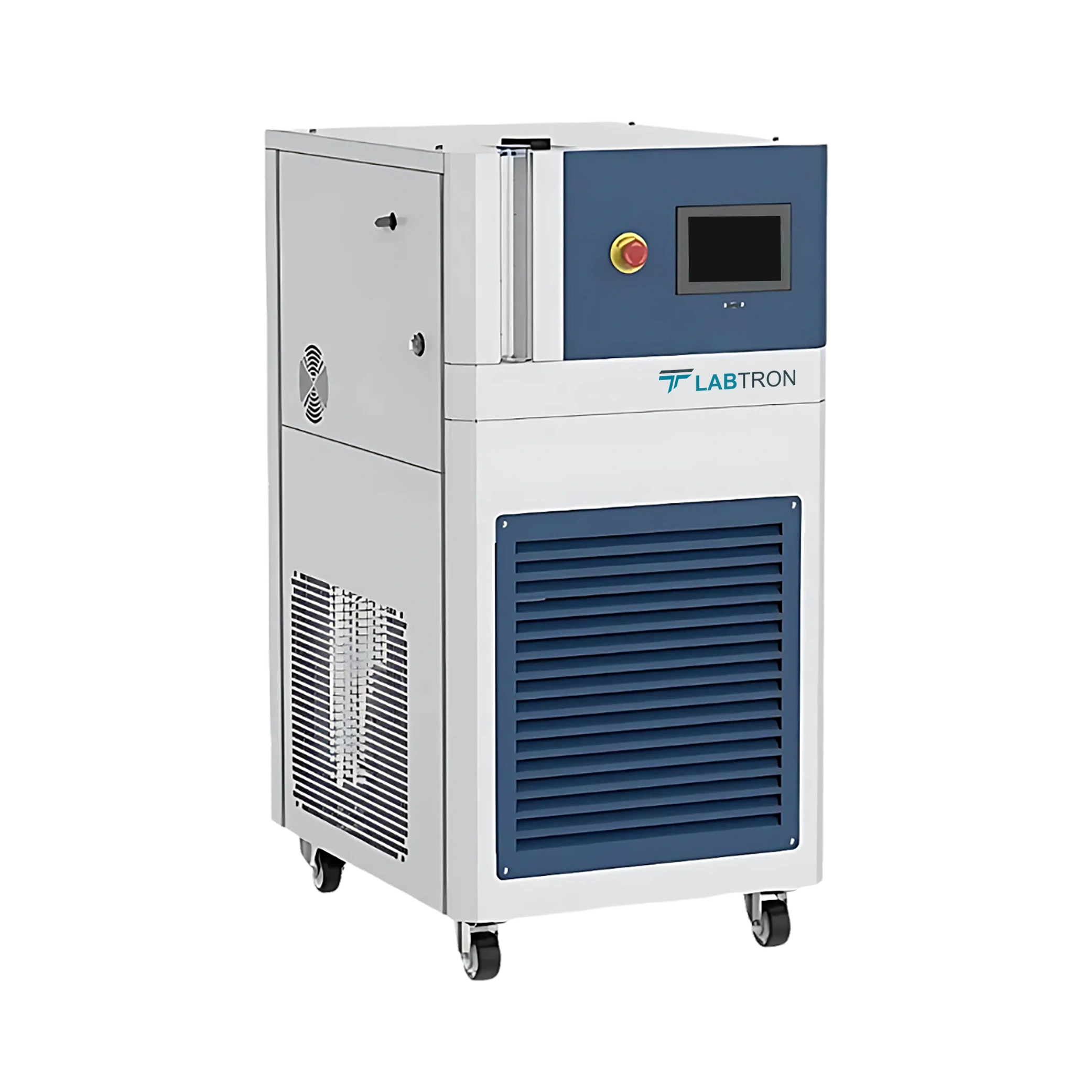
Dynamic Temperature Control System LDTC-A13 is used to regulate fluid flow and thermal conditions during reactor-based chemical processes. This setup allows controlled reaction environments to be maintained even under fluctuating process demands or batch transitions.
Dynamic Temperature Control System with a wide working temperature range ensures reliable thermal management across varied industrial environments. They include a compressor delay start to protect internal components. Their multi-mode operation supports flexible control strategies across various temperature-sensitive applications. These units feature built-in safety protections to ensure secure and stable performance. Our Dynamic Temperature Control System is used in applications such as thermal testing platforms for new energy battery packs.


Our Dynamic Temperature Control System LDTC-A13 allows users to select between material temperature, inlet temperature, or outlet temperature as the control reference point. This flexibility is crucial in systems where different stages experience varying thermal sensitivities. For example, in reactors or fermenters, control might be needed at the outlet to prevent overheating. This targeted regulation prevents unbalanced heat distribution across the loop. The user can switch between these control modes without stopping the system. This makes it easier to adapt the unit to different substances or batch conditions. It enhances responsiveness without altering the hardware. The result is better thermal accuracy across varying process demands.
The Dynamic Temperature Control System LDTC-A13 is designed with multiple protection layers that actively respond to electrical instability. From compressor delay protocols to over-current safeguards, the system ensures that power inconsistencies don’t harm key components. This feature is particularly useful in facilities where voltage spikes are frequent. It delays startup until all parameters stabilize, reducing wear from forced cycling. During ongoing operations, its internal systems continue to monitor current and phase status. Such features make the unit resilient in demanding industrial setups. It reduces unplanned service interruptions. This structural safeguard helps preserve long-term system integrity.
The Dynamic Temperature Control System LDTC-A13 supports batch-based workflows by allowing operators to store and reuse temperature programs for consistent thermal performance. This is highly useful in pilot food lines where multiple cycles of heating and cooling are executed. By eliminating the need for reprogramming between batches, downtime is minimized. Its closed-loop fluid path ensures no leftover media interferes with subsequent batches. This feature supports processes like beverage or dairy testing, where temperature deviation could alter taste or texture. The system keeps the control sequence steady across production shifts. It brings operational continuity while handling frequent recipe changes.
Our Dynamic Temperature Control System LDTC-A13 integrates digital communication interfaces that support centralized monitoring across wider laboratory environments. With USB and RS485 connectivity, operators can remotely access, adjust, and monitor system performance in real time. This is especially advantageous in large-scale research facilities or pilot units with multiple active thermal processes. The system can feed thermal data into control software, enabling remote supervision without direct access to the unit. It also supports data export for temperature tracking and audit purposes. Such connectivity reduces the need for on-site adjustment. It streamlines multi-unit temperature control from a central hub.
The Dynamic Temperature Control System LDTC-A13 delivers stable thermal regulation in vacuum environments, where heat behaves differently due to low air density. It maintains control without sudden thermal changes that might interfere with vaporization or condensation behavior inside the chamber. This stability is particularly valuable in test simulations involving pressure-sensitive materials or vacuum-based drying. Its slope control avoids quick temperature rises that can disrupt sensitive samples. With real-time adjustment across all thermal points, it allows greater reproducibility of conditions. The system integrates smoothly with chambers used for altitude or environmental simulation. It ensures clean and consistent temperature application without manual correction.
The Dynamic Temperature Control System LDTC-A13 is well-suited for controlled ramp testing, where gradual heating or cooling is vital to observe material stress responses. Its slope-based programming allows thermal changes to follow a steady gradient, mimicking natural environmental transitions. This is especially helpful when testing polymers, composites, or insulation materials for fatigue or expansion behaviour. The unit’s graphical interface allows visual tracking of how the material responds across the temperature curve. Researchers gain insight into critical thresholds without abrupt transitions that could cause false failure. This function aids in developing and validating temperature-sensitive products. It supports extended testing without overshooting target zones.
Post your question?
Our experts are here to help!
Labtron Equipment Ltd., Quatro House, Lyon Way, Camberley, Surrey GU16 7ER United Kingdom
Email: info@labtron.com Whatsapp: +44 73 4441 2688 Phone: +44 2080 043608