info@labtron.com

| Working Temperature Range | -30℃ to 200℃ |
| Temperature Control Accuracy | ±0.5℃ |
| Temperature Display | 7-inch LCD screen |
| Display Resolution | 0.01 |
| Cooling Water Temperature Range | 10 to 33℃ |
| Ambient Temperature Range | 5 to 35℃ |
| Cooling Capacity at -200℃ | 12000 W |
| Cooling Capacity at 100℃ | 8500 W |
| Cooling Capacity at 25℃ | 6000 W |
| Cooling Capacity at -10℃ | 4700 W |
| Cooling Capacity at -20℃ | 3400 W |
| Cooling Capacity at -30℃ | 2000 W |
| Cooling Method | Air cooling / Water cooling |
| Heating Power | 12000 W |
| Cooling Water Flow Rate | 4.0 m³/h |
| Cooling Water Interface | R₂3/4 |
| Circulating Pump Max. Pressure | 1.4 bar |
| Circulating Pump Max. Flow Rate | 45 L/min |
| Outer Circulation Interface Size | R₂3/4 |
| Noise Level | 68 dB(A) |
| Protection Grade | IP20 |
| Refrigerant | R404 A |
| Heat Transfer Fluid Filling Volume | 12 L |
| Maximum Viscosity of Heat Transfer Fluid | 30 mm²/s |
| Communication Interfaces | USB, RS485, Pt100 |
| Power Supply | 3 to 380V, 50Hz |
| Power Consumption | 18000 W |
| Dimensions (W × D × H) | 750 × 1100 × 1420 mm |
| Net Weight | 350 kg |
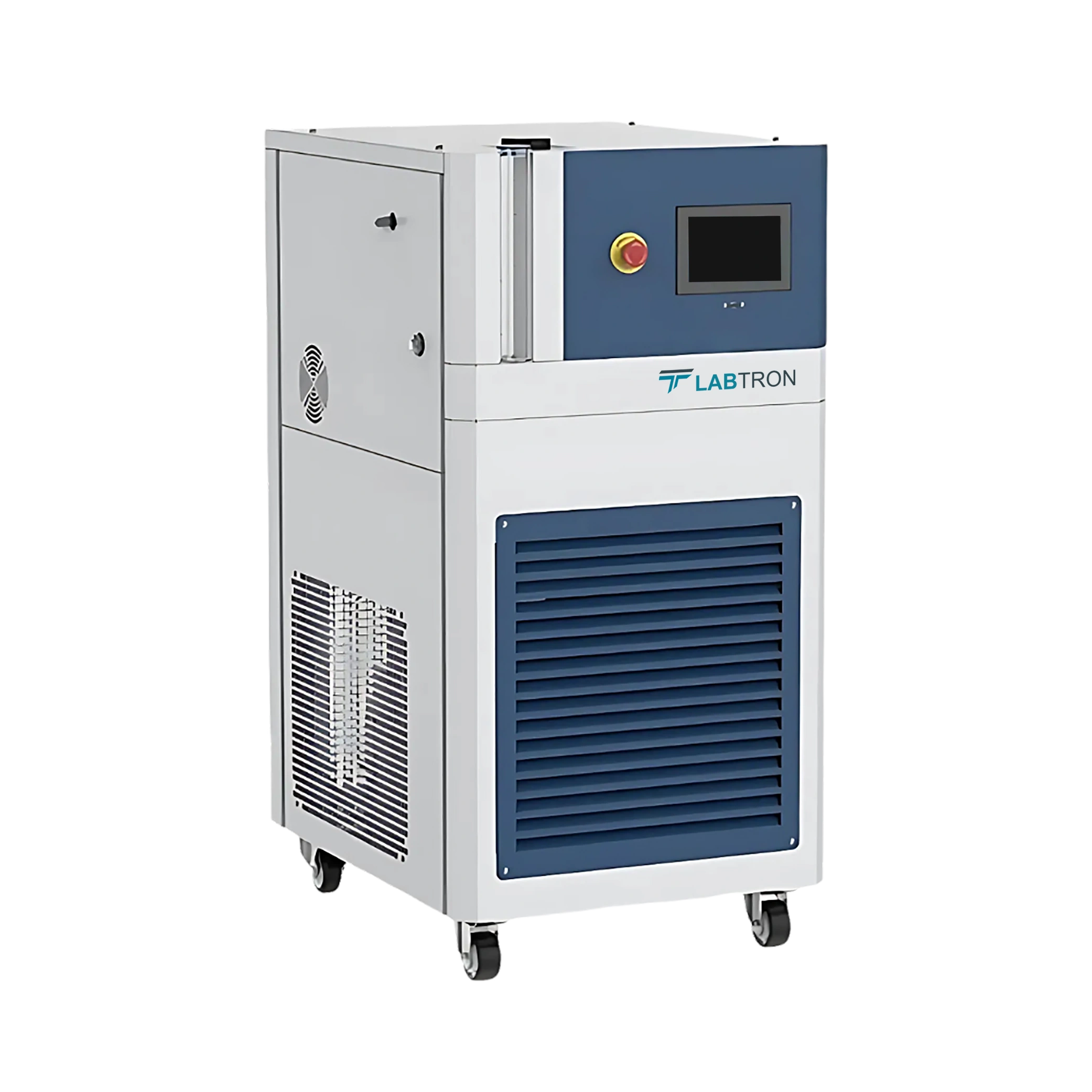
Dynamic Temperature Control System LDTC-A14 is designed for regulating temperature in pilot-scale pharmaceutical and chemical processes. This supports stable heating and cooling during formulation, testing, or controlled reactions.
Dynamic Temperature Control System with a wide working temperature range ensures reliable thermal management across varied industrial environments. They include a compressor delay start to protect internal components. Their multi-mode operation supports flexible control strategies across various temperature-sensitive applications. These units feature built-in safety protections to ensure secure and stable performance. Our Dynamic Temperature Control System is used in applications such as thermal testing platforms for new energy battery packs.


Dynamic Temperature Control System LDTC-A14 allows users to select between multiple sensing modes, including material temperature, inlet, and outlet fluid temperatures. This helps match the system to specific thermal processes, whether you're working with direct-contact heating or circulating through external devices. Each sensing point provides a different way to measure and control heat response. The flexibility to choose enhances control precision without physical changes to the system. Users can manage heating behaviour based on application needs instead of hardware limitations. This is especially useful in multi-stage workflows like material testing or fermentation trials. The system adapts to varied thermal dynamics across devices. It ensures tighter alignment with experimental or production goals.
Our Dynamic Temperature Control System LDTC-A14 includes built-in USB and RS485 ports that enable real-time thermal data transfer to connected platforms. This makes it easier to track performance across extended runs or monitor changes without manual logging. Researchers can link the system with broader control networks or individual monitoring setups. The captured data supports compliance, audits, and long-term trend review. It also eliminates the risk of data loss during fast-paced thermal transitions. The interfaces provide flexibility in both industrial and laboratory settings. The ability to observe and retrieve data remotely ensures continuous oversight. It enhances reliability in temperature-critical experiments.
The Dynamic Temperature Control System LDTC-A14 uses a fully enclosed circulation path to keep the heat transfer fluid sealed off from environmental exposure. This containment helps preserve the chemical structure of the fluid over time, reducing oxidation and contamination. The sealed design ensures long-lasting performance in extended-use scenarios such as batch fermentation or material stress tests. By keeping moisture and air out, the unit avoids fluctuations caused by evaporation or pressure change. This setup reduces maintenance downtime for fluid replacement. It also limits internal deposits that can form under unstable conditions. The result is more consistent system output. Thermal performance stays steady across repeated usage cycles.
The Dynamic Temperature Control System LDTC-A14 features integrated protections that actively monitor for faults during ongoing thermal processes. With leakage detection, over-current cutoff, and compressor delay functions, the system prevents damage before it affects operations. It also includes electrical phase protection to ensure safe startups in varying voltage conditions. These safeguards work together to maintain thermal control without operator intervention. Whether used continuously or intermittently, the unit remains responsive to internal or external issues. This adds confidence for users running heat-sensitive tasks. It reduces downtime caused by common mechanical risks. The system stays stable even during longer or unattended runs.
Our Dynamic Temperature Control System LDTC-A14 supports controlled thermal ramping, which is especially useful in beverage and dairy pilot environments. During heating and cooling cycles, the gradual slope control prevents shock to delicate mixtures or proteins. This ensures consistency in small-batch fermentation, blending, or heat treatment tests. The ability to follow programmable temperature sequences reduces variation between trials. It allows users to replicate commercial conditions on a smaller scale. The unit connects easily with processing tanks or filling equipment. Its stable performance helps maintain uniformity across development batches. It provides repeatable outcomes without requiring external temperature correction.
Labtron’s Dynamic Temperature Control System LDTC-A14 is built to manage fluids with higher viscosity, which are often used in advanced research and industrial formulation work. Its circulation system maintains steady flow and heat transfer even with denser media like botanical extracts or concentrated solutions. The unit ensures uniform temperature without causing blockages or pressure drops. This allows researchers to run complex processes involving non-standard fluids. Applications like high-resistance oil testing or viscous mixture processing benefit from the system’s consistent delivery. It avoids uneven heating zones that can affect sensitive results. The system adapts without needing changes to pump settings or hardware. ?
Post your question?
Our experts are here to help!
Labtron Equipment Ltd., Quatro House, Lyon Way, Camberley, Surrey GU16 7ER United Kingdom
Email: info@labtron.com Whatsapp: +44 73 4441 2688 Phone: +44 2080 043608