info@labtron.com

| Working Temperature Range | -30℃ to 200℃ |
| Temperature Control Accuracy | ±0.5℃ |
| Temperature Display | 7-inch LCD screen |
| Display Resolution | 0.01 |
| Cooling Water Temperature Range | 10 to 33℃ |
| Ambient Temperature Range | 5 to 35℃ |
| Cooling Capacity at -200℃ | 12000 W |
| Cooling Capacity at 100℃ | 8500 W |
| Cooling Capacity at 25℃ | 6000 W |
| Cooling Capacity at -10℃ | 4700 W |
| Cooling Capacity at -20℃ | 3400 W |
| Cooling Capacity at -30℃ | 2000 W |
| Cooling Method | Air cooling / Water cooling |
| Heating Power | 12000 W |
| Cooling Water Flow Rate | 4.0 m³/h |
| Cooling Water Interface | R₂3/4 |
| Circulating Pump Max. Pressure | 1.4 bar |
| Circulating Pump Max. Flow Rate | 45 L/min |
| Outer Circulation Interface Size | R₂3/4 |
| Noise Level | 68 dB(A) |
| Protection Grade | IP20 |
| Refrigerant | R404 A |
| Heat Transfer Fluid Filling Volume | 12 L |
| Maximum Viscosity of Heat Transfer Fluid | 30 mm²/s |
| Communication Interfaces | USB, RS485, Pt100 |
| Power Supply | 3 to 380V, 50Hz |
| Power Consumption | 18000 W |
| Dimensions (W × D × H) | 750 × 1100 × 1420 mm |
| Net Weight | 340 kg |
Dual-stage cooling circuit
Microprocessor-based control system
Touchscreen navigation interface
Leak detection sensor integration
Overheat protection with cutoff
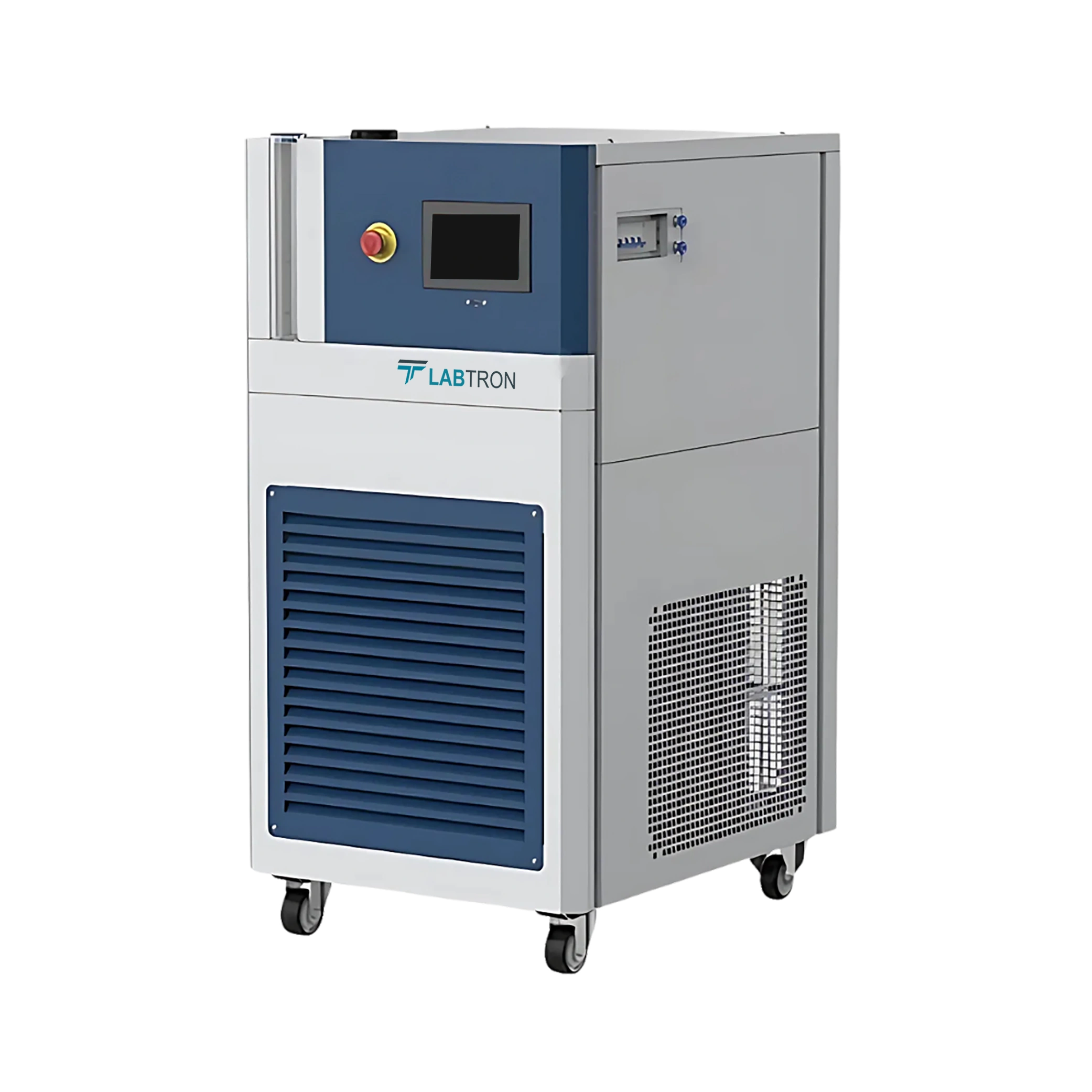
Dynamic Temperature Control System LDTC-A20 offers a wide thermal range from –30°C to 200°C with capability for both heating and cooling tasks in laboratory and industrial operations. This makes it effective for critical processes such as chemical reactions, biotechnological research and pilot-scale thermal workflows that demand consistent temperature conditions.
Dynamic Temperature Control System with a wide working temperature range ensures reliable thermal management across varied industrial environments. They include a compressor delay start to protect internal components. Their multi-mode operation supports flexible control strategies across various temperature-sensitive applications. These units feature built-in safety protections to ensure secure and stable performance. Our Dynamic Temperature Control System is used in applications such as thermal testing platforms for new energy battery packs.


Dynamic Temperature Control System LDTC-A20 supports three distinct modes that allow users to select how temperature is managed based on specific process needs. It can control material temperature directly or focus on the inlet and outlet fluid conditions independently. This flexibility allows smooth transitions between heating and cooling without system changes. Users can also implement programmed sequences to match multi-stage processing tasks. The system supports slope adjustments, letting processes ramp up or down gradually. It adapts well to experiments that require complex or shifting temperature profiles. Each mode can be activated without hardware modifications. This makes it suitable for dynamic laboratory applications.
Dynamic Temperature Control System LDTC-A20 features a closed-loop circulation design that protects heat transfer fluid from oxidation, evaporation, or contamination. By isolating the fluid from air and moisture, it reduces breakdown and keeps thermal properties consistent. This is especially important in long-term or continuous operation where fluid stability directly affects results. It eliminates the need for frequent fluid replacement, saving costs and preventing downtime. The closed system also supports specialty fluids without risking degradation. Fluid performance remains intact across temperature cycles. This approach is ideal for research environments where consistency is essential. It ensures reliable fluid behaviour over time.
Dynamic Temperature Control System LDTC-A20 enables users to define how quickly the temperature rises or falls through slope-based programming. This control helps protect sensitive samples from damage due to sudden changes in thermal conditions. Gradual transitions are critical in applications like fermentation, biological reactions, or protein studies. Operators can build custom temperature ramps that reflect natural conditions or experimental demands. These features improve process stability and reproducibility. Delicate materials are less likely to degrade or behave unpredictably. The system avoids overshoot or lag by managing temperature pace precisely. It is well-suited for gentle, progressive heating or cooling cycles.
Dynamic Temperature Control System LDTC-A20 is equipped with over-temperature shutdown, compressor delay, leakage monitoring, and phase protection to prevent system failures. These built-in layers operate independently, so no single fault compromises performance. This is particularly helpful during long operations or when supervision is limited. The protection system also includes overcurrent and thermal overload sensors that respond immediately to fluctuations. With automatic checks in place, operational risks are minimized. These features preserve internal components and external applications alike. Even under variable input conditions, safety functions continue to operate. It’s engineered for high dependability in sensitive thermal environments.
Dynamic Temperature Control System LDTC-A20 includes a display interface that shows temperature progression in graphical format, offering immediate feedback during every phase. This helps users understand how their process behaves over time without the need for external monitoring tools. Curve tracking lets users detect instability or make real-time corrections. With clear trend visualization, operational adjustments become more intuitive. It is especially useful during testing, calibration, or quality review stages. Operators can evaluate how different settings influence process outcomes. The display also reduces reliance on manual tracking. Visual feedback enhances decision-making while improving process transparency.
Dynamic Temperature Control System LDTC-A20 offers thermal control functions that are compatible with simulation setups used in electronics, battery testing, and semiconductor trials. It supports ramping functions to replicate charge-discharge or environmental cycles accurately. This allows researchers to simulate operating conditions and test component durability under temperature stress. Stable thermal behavior ensures accurate measurements during long-duration tests. The system’s ability to shift temperatures at a defined pace helps mimic real-world scenarios. It plays a vital role in pre-launch testing and thermal validation. By regulating environmental changes, it contributes to safer, more predictable product development. It's reliable for electronics-focused applications.
Post your question?
Our experts are here to help!
Labtron Equipment Ltd., Quatro House, Lyon Way, Camberley, Surrey GU16 7ER United Kingdom
Email: info@labtron.com Whatsapp: +44 73 4441 2688 Phone: +44 2080 043608