 info@labtron.com

| Maximum Sample Feed | 1500 to 2000 ml/h |
| Minimum Sample Volume | 20 to 30 ml |
| Temperature range of Inlet air | 30℃ to 280℃ |
| Temperature range of Outlet air | 40℃ to 120℃ |
| Precision of temperature | ±1℃ |
| Dryer time | 1.0 to 1.5 s |
| Speed of squirmy pump | 30 to 2000 ml/h |
| Consume of dryer air | 0 to 330 m³/h |
| Maximum Pressure | 686 Pa |
| Consume of spray air | 0 to 4.2 m³/h |
| Nozzle Jet | 0.7mm standard (0.5/1.0 /1.5 /2.0 /2.5 mm) |
| Nozzle Type | Two liquid nozzles |
| Spray Direction | Downwards co-current |
| Spray Chamber Material | Borosilicate Glass |
| Power | 3.5 KW |
| Voltage | 220 V |
| Dimension (L × W × H) | 650 mm ×500 mm ×1550 mm |
| Weight | 120 kg |
Easy Cleaning Assembly
Oil‑Free Compressor
Low Noise Operation
PID Temperature Control
Self‑Contained Ready Unit
Lab Spray Dryer LLSD-A12 transforms liquid solutions or emulsions into fine powders by rapidly atomizing droplets into inert gas stream. It is widely used in processing of beverage, milk and egg products, plant and vegetable extracts and synthetics heat sensitive materials.
Download catalog for
Lab Spray Dryer LLSD-A12 Catalog
Labtron Lab Spray Dryer offers 30ml to 100ml capacity to convert liquid solution into dry powder. They utilize pump to deliver liquid feed consistently into spray drying chamber. Their atomizer generates fine droplets, ensuring uniform particle size and efficient desiccating processes occur. Their inlet air heater maintains optimal temperature for efficient evaporation of moisture. Our Lab Spray Dryer is essential for pharmaceuticals, food science, nutraceuticals, biotechnology, cosmetics and material science.
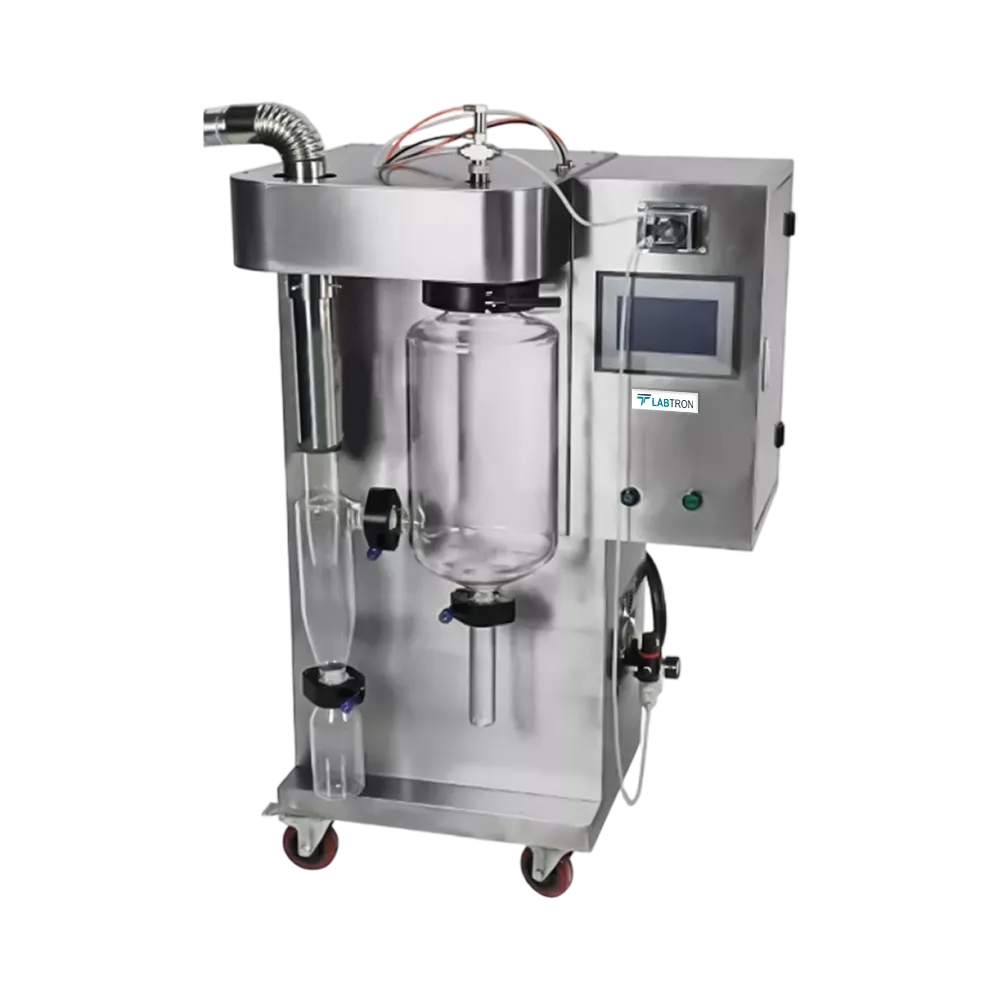
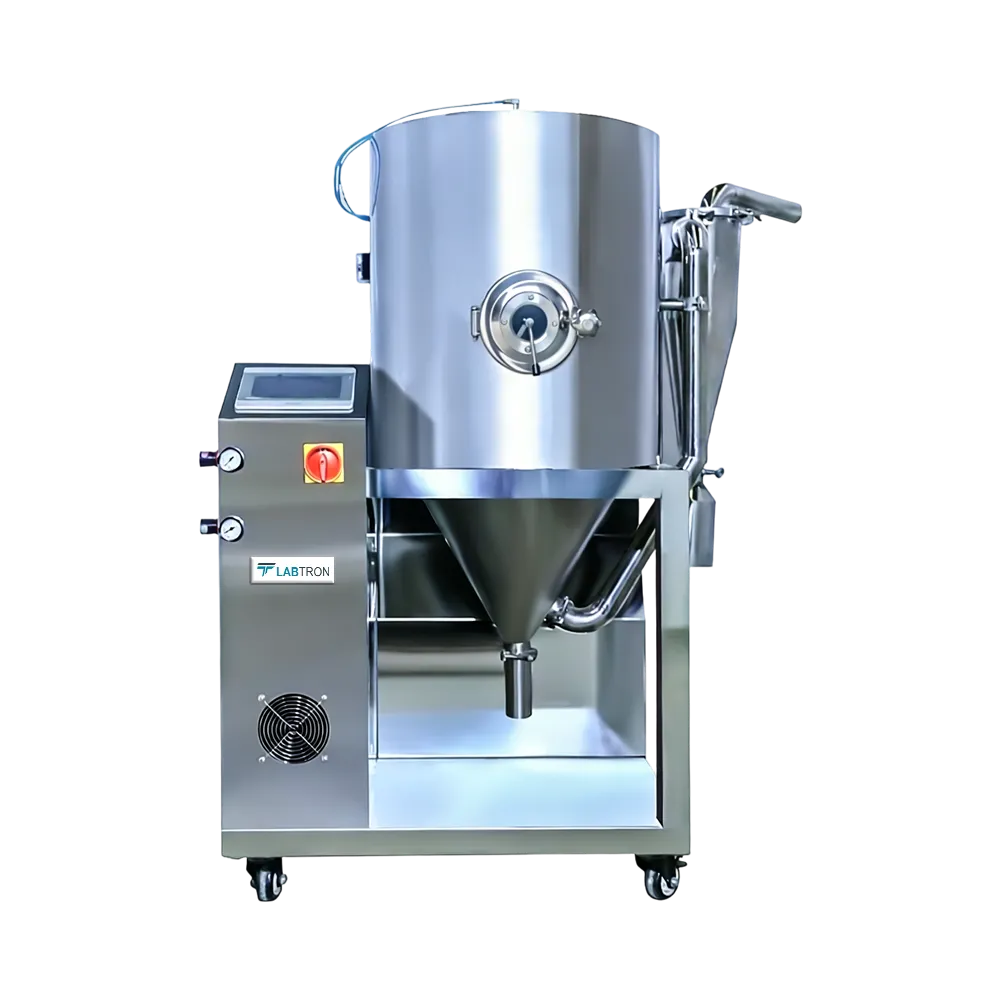
Labtron’s lab spray dryer LLSD-A12 transforms a liquid feed into a dry powder by atomizing the liquid into fine droplets and introducing them into a hot drying chamber. The rapid evaporation of moisture from these droplets results in the formation of dry particles, which are then collected from the bottom of the chamber or through a cyclone separator. This method is particularly effective for heat-sensitive materials, ensuring minimal thermal degradation and preserving the integrity of the final product.
Labtron supplies advanced models of lab spray dryer LLSD-A12. Several critical parameters impact the efficiency of spray drying, including inlet and outlet temperatures, feed rate, atomization pressure, and airflow rate. The inlet temperature affects the rate of moisture evaporation, while the outlet temperature indicates the final moisture content of the product. The feed rate must be balanced to prevent overloading the system, and atomization pressure influences droplet size, affecting drying time and particle characteristics. Proper control of these parameters ensures optimal drying efficiency and product quality.
Common challenges in spray drying include nozzle clogging, uneven particle size distribution, and product sticking to the chamber walls. Nozzle clogging can result from high-viscosity feeds or particulate matter and can be mitigated by proper feed preparation and regular cleaning. Uneven particle sizes may arise from inconsistent atomization, which can be addressed by maintaining stable operating conditions. Product sticking often occurs due to inadequate drying or improper chamber design; optimizing temperature profiles and using appropriate wall materials can alleviate this issue.
Labtron’s Spray dryer LLSD-A12 and freeze drying are both dehydration techniques but differ significantly in their processes and outcomes. Spray drying is a rapid process suitable for large-scale production, producing fine powders ideal for applications like pharmaceuticals and food additives. However, it may not be suitable for highly heat-sensitive materials. Freeze drying, on the other hand, involves sublimating frozen water under low pressure, preserving the structural integrity and bioactivity of delicate substances, making it preferable for high-value products like vaccines and probiotics.
Labtron supplies advanced models of lab spray dryer LLSD-A12. Regular maintenance is crucial to ensure the longevity and efficiency of a lab spray dryer. Key practices include routine cleaning of the drying chamber and nozzles to prevent residue buildup, inspection and replacement of worn parts, calibration of sensors and controls, and verification of airflow and temperature settings. Implementing a preventive maintenance schedule helps in early detection of potential issues, minimizing downtime and ensuring consistent product quality.
Post your question?
Our experts are here to help!
Labtron Equipment Ltd., Quatro House, Lyon Way, Camberley, Surrey GU16 7ER United Kingdom
Email: info@labtron.com Whatsapp: +44 73 4441 2688 Phone: +44 2080 043608
