info@labtron.com

| Viewing Angle | 2°and 10° |
| Measure Angle | 45° Receiver: 45 as - 15°, 45 as 15°, 45 as 25°, 45 as 45°, 45 as 75°, 45 as 110° 15°Receiver: 15as- 45°, 15as- 15° 15as 15°,15 as-30°,15as 45°,15 as 80° Standard: ASTM D2244, E308, E1164, E2194, E2539, DIN5033, 5036,6174,6175-1, 6175-2, 1SO 7724, 11664-4, SAE J1545 |
| Sensor | 256 Images Element Double Array CMOS Image Sensor |
| Spectral Range | 400 to 700nm |
| Wavelength Interval | 10nm |
| Semiband Width | 10nm |
| Measurement Range | 0 to 600 % |
| Measurement Aperature | Illumination Size: Φ23mm Measurement Spot: 9 × 12mm |
| Measurement Time | 1 s for one Angle 12s for all Angles |
| Measurement Geometry | 12 Measurement Angles 7 Illumination Sources, 2 recievers |
| Illuminant | 360 to 780 nm Xenon lamp |
| Optical Geometry | Reflect : D/8 Transmission: D/0 |
| Repeatability | Standard Deviation: 0.08 % Chromaticity Value: ΔE × ab 0.02 |
| Reproducibility | ΔE × < 0.10, ΔE × < 0.25 |
| Illuminants | D 65, A, C, D50, D55, D75, F1, F2, F3, F4, F5, F6, F7, F8, F9, F10 (TPLS), F11 (TL84) F12 (TL83/U30) |
| Color Spaces | CIE LAB, XYZ, Yxy, LCh, Bxy, DIN Lab99 |
| Color Difference | ΔE × ab, ΔE × 94, ΔE × cmc (1:1), ΔE × 00, DIN Δ E99, ΔE DIN6175 |
| Inter- Instrument Error | 0.18 ΔE × 00 |
| Data Storage Capacity | Standard : 1000 Pcs Sample : 4000 Pcs |
| Power Consumption | 7V,5000 mAh |
| Dimensions ( L × W×H) | 195 × 83 × 128 mm |
| Weight | 1kg |
Low Noise Detection
Multiple Calibration Options
Automated Sample Identification
Digital Signal Processing
3D Color Mapping
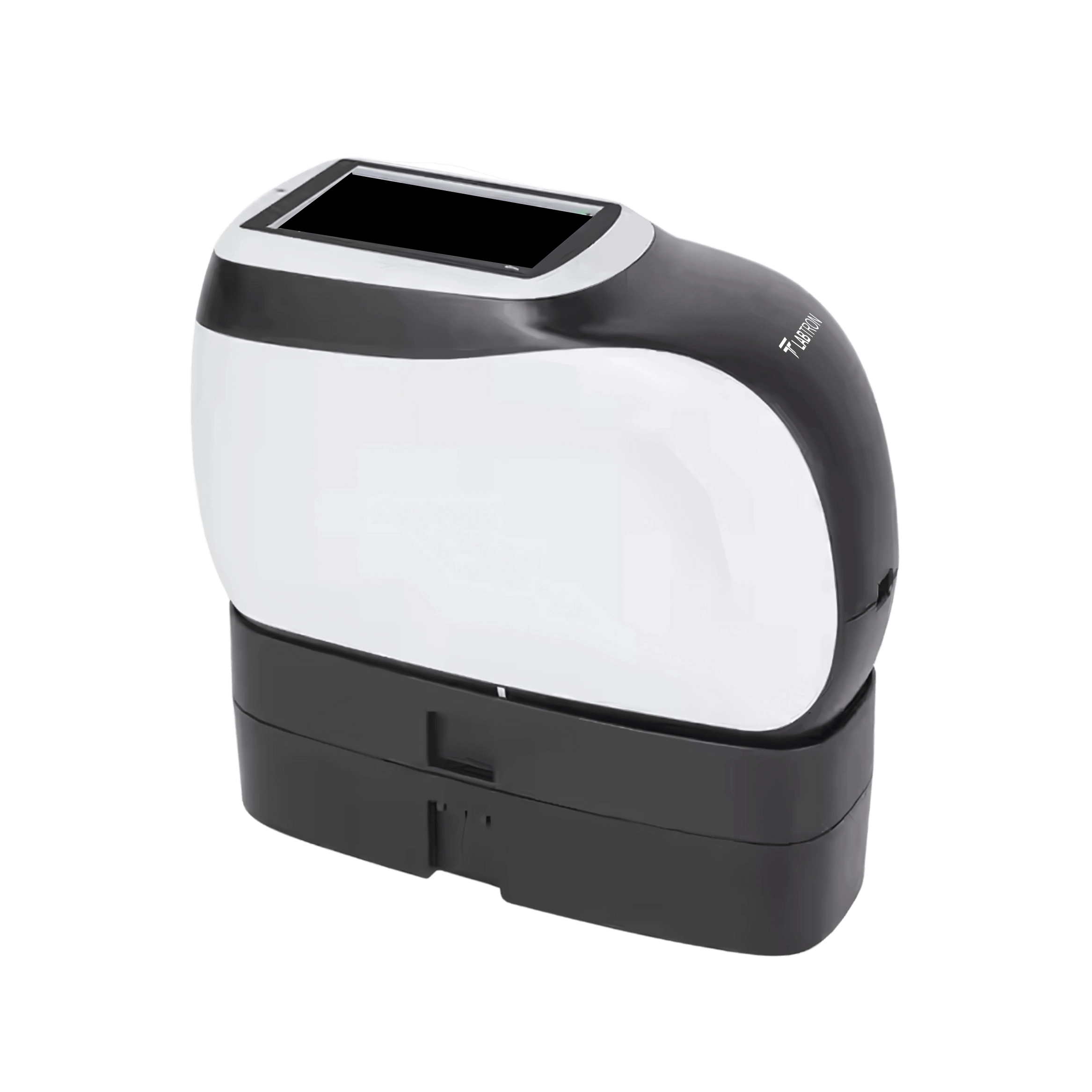
Multi Angle Spectrophotometer LMASP- A12 is an analytical instrument which captures angle-dependent color data. It is applied in fields of pharma research and biotechnology for tablet coating and quality control of the pharma products.
Accessories Name | Quantity |
Power Adapter | 1 |
USB Cable | 1 |
Calibration Board | 1 |
Black Light Trap | 1 |
Protective Cap | 1 |
Wrist Band | 1 |
Download catalog for
Multi Angle Spectrophotometer LMASP-A12 Catalog
Labtron Multi Angle spectrophotometer delivers high resolution sample analysis with advanced multi angle measurement. These include features like Blue Enhancement CMOS Technology, enhancing blue light sensitivity for precise color analysis. These have advanced sensors which captures fine spectral details, ensuring precise color measurements on complex surfaces. The system is integrated with built-in camera, improving accuracy by offering real-time visual guidance for precise sample alignment. Our spectrophotometer has temperature control option to ensure accurate color measurement under varying environmental conditions.


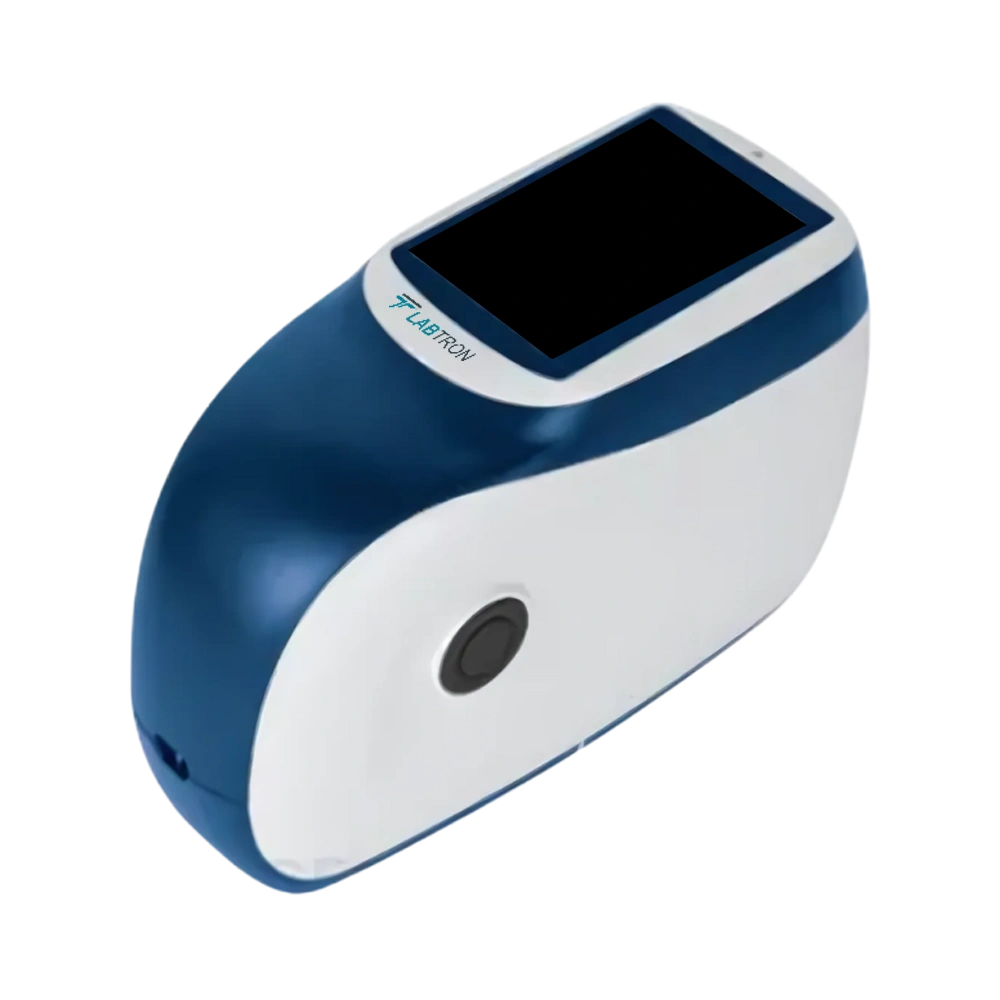

Labtron manufactures advanced Multi Angle Spectrophotometer, the advanced devices use multi-point white/black tile standards with traceable certification (e.g., NIST). Angle-specific calibration corrects for reflectance response at each geometry. Internal algorithms compensate for drift and detector aging. Some models use self-calibrating optics and reference diodes. AI-based auto-tuning identifies deviations. Remote calibration via cloud-based platforms enables decentralized labs to sync standards. Hybrid calibration adjusts for both colorimetric and gloss response. In-situ calibration validates the system before critical production runs.
Labtron’s Multi Angle Spectrophotometers typically measure reflectance, but some models can also analyze transmission if equipped with dual-beam configurations. For semi-transparent materials like tinted plastics, coatings, or films, reflectance varies significantly with background and illumination geometry. Advanced instruments compensate for this by using adjustable backgrounds or sample holders. Measuring multiple angles helps isolate surface effects from internal scattering. By analyzing both transmitted and reflected light across angles, a more complete optical profile is built. This supports applications in automotive interiors, displays, packaging, and decorative films. Manufacturers can simulate how materials will look when backlit or layered over substrates. The output can guide both aesthetic and functional decisions in product design.
Labtron’s Multi Angle Spectrophotometer are integrated with advanced features, some instruments can detect when a surface is too rough for accurate measurement and suggest alternate methods. Rotating or tilting the sample can reveal the most consistent angular reflectance points. Specialized optics and spatial filters help isolate usable signals from noise. High-resolution measurement heads capture more localized color data, which can be averaged or mapped. In some cases, multi-point scanning is used to cover an entire surface profile. Advanced systems may offer 3D topography correlation to adjust for surface geometry. These approaches are essential in industries like textured plastics, leather, and embossed films.
Labtron supplies premium Multi Angle Spectrophotometer with advanced features, temperature and humidity can impact electronic stability, light source intensity, and sample behavior. Advanced multi-angle spectrophotometers feature internal temperature compensation, sealed optical paths, and real-time environment monitoring. High-end models auto-correct readings based on internal sensor feedback. In highly sensitive applications, temperature-controlled measurement chambers are used. Humidity can affect both the sample. Data trends over time can highlight when environmental drift affects results. Some QA protocols require acclimatizing the sample and device before measurement. For portable units, ruggedized enclosures and calibration checks mitigate field variability.
Labtron manufactures Multi Angle Spectrophotometer with advanced designs, each layer may have different refractive indices, scattering properties, and pigment compositions. Multi-angle readings capture how these layers interact with light at varying depths. For example, a top gloss layer may amplify flop, while a base layer defines undertone. Advanced analysis deconvolutes this data to isolate layer contributions. Some systems integrate with layer thickness gauges or microscopy for full characterization. Applications include smart textiles, decorative laminates, and multi-coat automotive systems. The goal is to ensure visual consistency and predict performance across entire material stacks.
Labtron’s Multi Angle Spectrophotometer cannot directly measure gloss, texture, or depth, these require additional sensors or tools. Curved or highly irregular surfaces challenge repeatability. Dark or highly reflective materials may exceed detector range. Operator handling can affect alignment and pressure. To overcome this, manufacturers use calibration standards, custom fixtures, and trained technicians. Some limitations are addressed by combining technologies—e.g., adding glossmeters, 3D scanners, or hyperspectral cameras. Software improvements help correct for environmental drift or geometric distortion. In-line systems reduce human error through automation. While not one-size-fits-all, multi-angle spectrophotometer remain the most robust solution for angular color evaluation.
Post your question?
Our experts are here to help!
Labtron Equipment Ltd., Quatro House, Lyon Way, Camberley, Surrey GU16 7ER United Kingdom
Email: info@labtron.com Whatsapp: +44 73 4441 2688 Phone: +44 2080 043608