
Labtron Pfund Cryptometer assesses the opacity and hiding power of coatings. They include wedge angle constant for calculating the minimum film thickness necessary to obscure the black and white division. They comprise of dual scale base plate along with metal support for accurate hiding power and coverage calculations. Their fine-scale resolution allows precise detection of film thickness changes. Our pfund cryptometer uses a minimal sample volume, making it ideal for quality control applications.
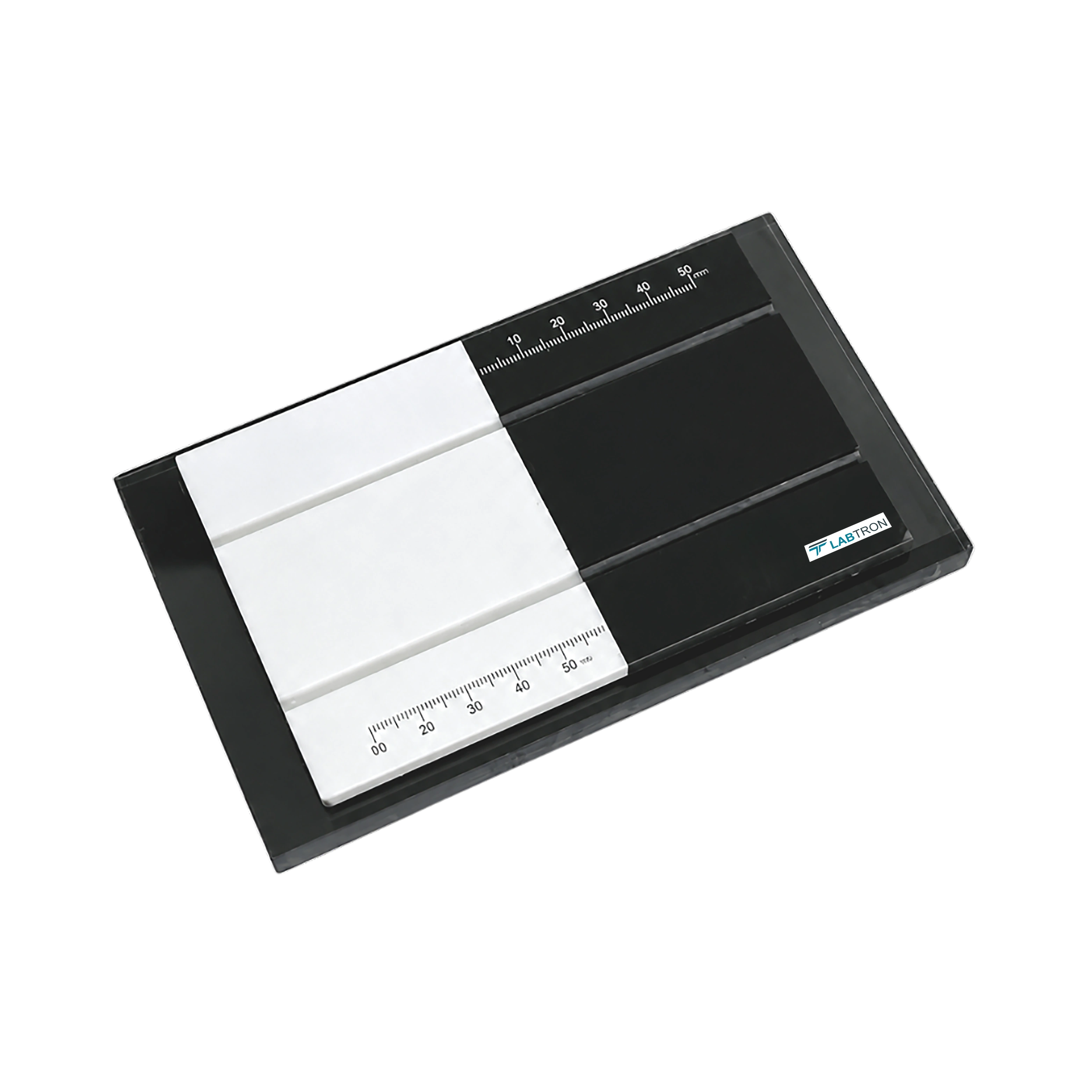
Reflectance of White Part: 80±2
Reflectance of Black Part: ≤2
Dimension (L×W×H): 100mm×170mm×20mm
Weight: 1 KG
Labtron Pfund Cryptometer is a precision glass wedge instrument designed to evaluate the wet hiding power of pigmented coatings by determining the minimum wet-film thickness required for full opacity. A small paint sample (3–5?ml) is placed between the black-and-white base and the wedge-shaped top plate. As the plate is gently pressed and slid, the point where the black-white demarcation disappears is noted on a scale. This numerical reading is then multiplied by the plate’s wedge constant (K) to calculate the wet film thickness in millimeters. That thickness is typically converted into coverage values—such as m²/L or ft²/gal—using manufacturer-provided tables, offering a quick and reliable QC metric. Compact and user-friendly, the cryptometer is widely used for routine quality control and formulation comparisons. Its simplicity, speed, and material efficiency make it particularly well-suited for laboratory environments that handle multiple coatings.
First, select the appropriate top plate based on expected opacity; common K-values range from 0.002 to 0.008, with choices tailored for light or dark paints. Deposit a 3–5?ml paint sample near the central black-white line. Carefully position the top plate (edge on the white or black side depending on plate used) and apply even pressure to form a wedge without trapping air bubbles. Slowly slide the plate back and forth until the transition line disappears, then note the scale position. Multiply this value by the wedge constant to determine wet-film thickness. Finally, use conversion tables to translate thickness into coverage values. After the test, clean the plates thoroughly, and for consistency, perform at least three replicates and calculate an average.
Top plates for the Pfund Cryptometer come with wedge constants of K = 0.002, 0.0035, 0.004, 0.007, and 0.008, each representing a different wedge angle. Select K = 0.008 for low-opacity or light-color coatings to allow a long wedge range, and opt for K = 0.004 or 0.002 with high-opacity or darker formulations so the opacity point falls within the readable mid-scale (10–40?mm). Proper constant selection ensures precision and keeps readings within the optimal resolution window. After selecting, consistently use the same K plate for comparable tests on the same paint to enhance repeatability and comparability across batches.
Labtron Pfund Cryptometer operates efficiently with only 3–5?ml of coating, making it extremely economical and reducing waste for costly materials. This low volume also speeds up cleaning and allows for faster sample throughput-ideal for high-turnover labs. However, despite the efficiency gains, care must be taken to ensure the sample fully spans the wedge without air pockets or uneven distribution. Improper placement or trapped air can lead to measurement errors, under-reporting thickness, or inconsistent results. Thus, while material efficiency is maximized, consistent technique remains critical to accuracy.
Errors typically arise from air bubbles, misplacement of the top plate, uneven applied pressure, or inaccurate scale reading. To minimize these, always deposit the paint centrally, place the top plate gently and evenly, and slide it at a controlled and steady pace. Clean both plates before each use to avoid optical distortions from residue or dust. To improve reproducibility, perform at least three test replicates per sample and calculate an average. Keeping the test environment stable regarding temperature and humidity also reduces variability. Developing and following a standard operating procedure (SOP) ensures operational consistency even across multiple technicians.
Post your question?
Our experts are here to help!
Labtron Equipment Ltd., Quatro House, Lyon Way, Camberley, Surrey GU16 7ER United Kingdom
Email: info@labtron.com Whatsapp: +44 73 4441 2688 Phone: +44 2080 043608
 info@labtron.com