 info@labtron.com

| Measuring Range | 0 to 500 N |
| Elongation | 1250% |
| Test Speed | 0 to 500 mm/min (continuously variable speed) |
| Displacement Accuracy | ± 0.5% |
| Accuracy | 0.5 level |
| Force Measurement | 0.01 N |
| Effective Experimental Itinerary | 800 mm |
| Power | 1000 W |
| Power supply | AC 220 V/ 50 Hz |
| Dimension | 650 × 650 × 1300 mm |
| Net Weight | 75 kg |
Sealing, peeling, and heat-sealing function
Tearing and elastic modulus measurement
Automated data processing
Compliance with international standards
Our Vertical Tensile Tester LVTT-A10 is used in research institutions and quality control laboratories to assess material strength and durability. It is essential for manufacturing industries to ensure compliance with international testing standards.
Name | Quantity |
Drawing fixture | 1 set |
Puncture fixture | 1 set |
Professional software | 1 set |
Power cord | 1 piece |
Sampling plate | 1 piece |
Note: User must ensure a computer and printer for Vertical Tensile Tester TP-B21 to operate.
Download catalog for
Vertical Tensile Tester LVTT-A10 Catalog
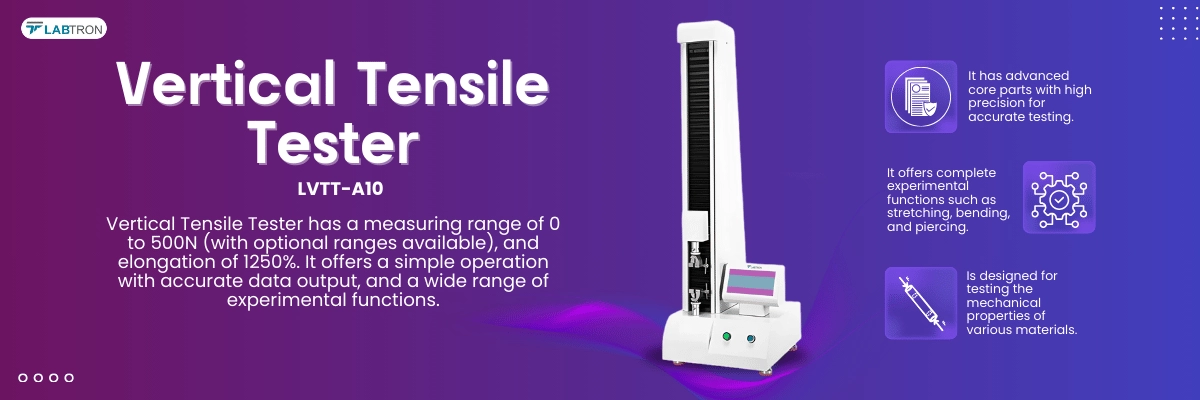

Vertical tensile tester provides the ability to evaluate the tensile strength, elongation and other physical attributes of a material. The mechanism used in testing material is vertically pulling the material until it breaks or tears. Their structure consists of vertical frame with upper and lower grips to hold the specimen. These testers also have load cell to measure force, with motorized load system. Our Vertical tensile testers are used to test plastics, textiles, etc in quality control and research laboratories.


Labtron’s Vertical Tensile Tester is designed to test various materials, including plastic film, rubber sheets, paper, non-woven fabric, and aluminum-plastic composite film. It evaluates mechanical properties such as tensile strength, peeling, tearing, puncture resistance, and bending.
Our Vertical Tensile Tester converts the force signal generated during testing into an electrical signal using an electronic sensor. This data is then processed by a computer to analyze key mechanical characteristics such as tensile strength, elongation, and force measurement.
This Vertical Tensile Tester has a measuring range of 0 to 500N (with optional ranges available) and a force measurement accuracy of 0.01N. The displacement accuracy is within ±0.5% of the indicated value, ensuring precise and reliable test results.
Yes, our Vertical Tensile Tester allows for adjustable test speed (0 to 500 mm/min) and customizable fixture distances. These settings can be modified based on user requirements to accommodate different types of material testing.
This Vertical Tensile Tester is widely used in research institutions, quality control laboratories, and manufacturing industries. It is essential for sectors involved in packaging, plastics, rubber, and composite materials to ensure product quality and compliance with international standards.
Vertical tensile testers are versatile and commonly used to test materials like plastics, rubber, metals, textiles, films, and paper. Their upright design is ideal for sheet materials and molded specimens that require precise alignment and gravitational balance. These testers support a wide range of standards like ASTM D638 for plastics or ISO 37 for rubber, making them suitable for research, quality control, and production environments across multiple industries.
Specimen alignment is critical and maintained through precise grip placement and rigid frame structure. Vertical testers use self-aligning or pneumatic grips that center the specimen automatically, minimizing stress concentration or bending. Manual alignment guides and digital position indicators further help ensure the sample remains centered along the test axis. Proper alignment ensures accurate tensile strength, elongation, and modulus readings, and prevents premature sample failure due to misalignment.
Vertical tensile testers come in a range of load capacities, from as low as 1 N for delicate films or fibers to over 500 kN for metals and composites. Laboratory-scale machines are often used for small samples, while industrial-grade models handle high-strength materials. Load cell selection should match the sample’s expected force for best accuracy. Modular systems also allow interchangeable load cells for testing a variety of materials on a single machine.
Vertical tensile testers often use clip-on extensometers, video extensometers, or non-contact laser extensometers to measure strain. Clip-on types are common for rigid materials, while video or laser extensometers are preferred for fragile or highly elastic specimens. The choice depends on sample deformation, accuracy requirements, and testing standards. Accurate strain measurement is crucial for calculating modulus, yield point, and elongation, making extensometer integration a key aspect of vertical tensile testing.
Yes, vertical tensile testers can be equipped with automation features like auto-gripping, barcode scanning, and robotic sample loading. These systems increase testing throughput and minimize human error, especially valuable in high-volume quality control. Advanced software also allows batch testing, auto-reporting, and integration with laboratory information systems (LIMS).
Post your question?
Our experts are here to help!
Labtron Equipment Ltd., Quatro House, Lyon Way, Camberley, Surrey GU16 7ER United Kingdom
Email: info@labtron.com Whatsapp: +44 73 4441 2688 Phone: +44 2080 043608