 info@labtron.com


| Measuring Range | 0 to 300 N |
| Accuracy | ± 1% |
| Force Resolution | 0.001 N |
| Displacement Resolution | 0.01 mm |
| Stretching Speed | 0 to 500 mm/min, infinitely variable adjustable |
| Stretching Distance | 800 mm |
| Human-Computer Interface | LCD display, curve display |
| Print Out | Modulated integrated thermal printer |
| Permissible Temperature | 20 ± 10℃ |
| Permissible Humidity | Up to 85% |
| Dimension | 460 × 400 × 1030 mm |
| Net Weight | 55 kg |
High-precision core components
Stepless speed regulation
Integrated thermal printer for output
Touchscreen operation
Durable small-screw design
Compliance with the international standards
Our Vertical Tensile Tester LVTT-A12 is used for testing the mechanical properties of materials like plastic films, rubber sheets, paper, and tapes by measuring tensile strength, peeling, heat sealing, and tearing resistance. It is widely applied in quality control, research institutions, and industries such as packaging, pharmaceuticals, and material production.
Drawing fixture × 1 set
Puncture fixture × 1 set
Power cord × 1 piece
Download catalog for
Vertical Tensile Tester LVTT-A12 Catalog
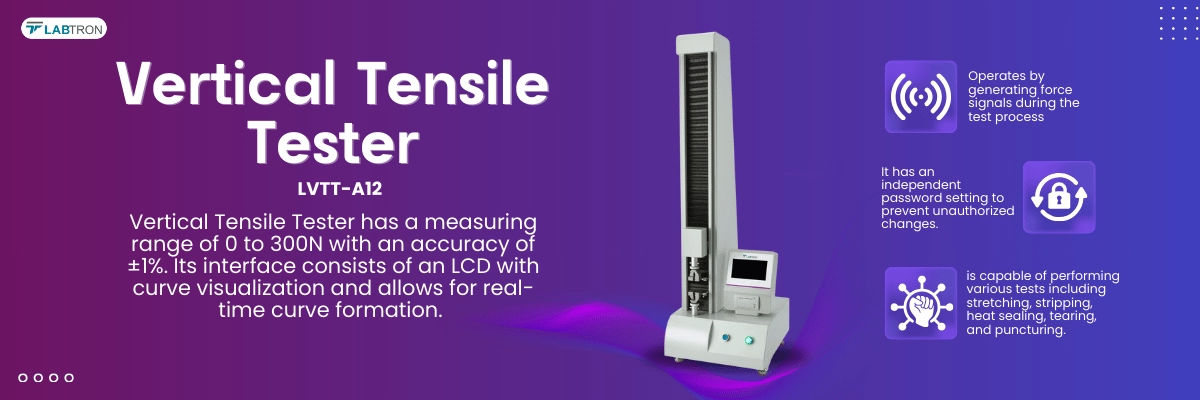

Vertical tensile tester provides the ability to evaluate the tensile strength, elongation and other physical attributes of a material. The mechanism used in testing material is vertically pulling the material until it breaks or tears. Their structure consists of vertical frame with upper and lower grips to hold the specimen. These testers also have load cell to measure force, with motorized load system. Our Vertical tensile testers are used to test plastics, textiles, etc in quality control and research laboratories.


Labtron’s Vertical Tensile Tester can test a variety of materials, including plastic films, rubber sheets, paper, non-woven fabrics, aluminum-plastic composite films, and tapes. These materials are widely used in industries such as packaging, pharmaceuticals, and manufacturing. The machine helps assess properties like tensile strength, elongation, tearing resistance, and heat seal performance, making it essential for quality control and research applications.
Our Vertical Tensile Tester applies a controlled force to a sample, gradually stretching it until it breaks. An electronic sensor converts the force into an electrical signal, which is then processed by the built-in software. The software calculates key parameters such as tensile strength, elongation, and displacement. With a force resolution of 0.001 N and a displacement resolution of 0.01 mm, the machine ensures precise and reliable test results, making it ideal for various industrial applications.
Yes, our Vertical Tensile Tester is widely used in the packaging industry for quality control. It helps manufacturers evaluate the strength and durability of packaging materials such as plastic films, laminated sheets, and tapes. By performing tests like tensile strength, peel strength, and heat seal strength, companies can ensure that their materials meet industry standards and consumer safety requirements. This helps prevent product failures, reduce material waste, and maintain high-quality production.
No, this Vertical Tensile Tester is designed to be user-friendly. It features a touchscreen display and intuitive software, making it easy for operators to set test parameters, adjust speeds, and view real-time data. The machine also includes a safety protection device and an independent password system to prevent unauthorized setting changes. Even users with minimal technical experience can efficiently conduct tests with little training. Additionally, the machine comes with a detailed user manual and technical support for troubleshooting.
Labtron’s Vertical Tensile Tester benefits industries such as packaging, food processing, pharmaceuticals, textiles, and materials research. It is particularly useful for testing flexible packaging materials, ensuring they meet strength and durability standards before being used for sealing or wrapping products. Research institutions and universities also use this machine for studying material properties, making it an essential tool for both commercial and scientific applications.
Vertical tensile testers are versatile and commonly used to test materials like plastics, rubber, metals, textiles, films, and paper. Their upright design is ideal for sheet materials and molded specimens that require precise alignment and gravitational balance. These testers support a wide range of standards like ASTM D638 for plastics or ISO 37 for rubber, making them suitable for research, quality control, and production environments across multiple industries.
Specimen alignment is critical and maintained through precise grip placement and rigid frame structure. Vertical testers use self-aligning or pneumatic grips that center the specimen automatically, minimizing stress concentration or bending. Manual alignment guides and digital position indicators further help ensure the sample remains centered along the test axis. Proper alignment ensures accurate tensile strength, elongation, and modulus readings, and prevents premature sample failure due to misalignment.
Vertical tensile testers come in a range of load capacities, from as low as 1 N for delicate films or fibers to over 500 kN for metals and composites. Laboratory-scale machines are often used for small samples, while industrial-grade models handle high-strength materials. Load cell selection should match the sample’s expected force for best accuracy. Modular systems also allow interchangeable load cells for testing a variety of materials on a single machine.
Vertical tensile testers often use clip-on extensometers, video extensometers, or non-contact laser extensometers to measure strain. Clip-on types are common for rigid materials, while video or laser extensometers are preferred for fragile or highly elastic specimens. The choice depends on sample deformation, accuracy requirements, and testing standards. Accurate strain measurement is crucial for calculating modulus, yield point, and elongation, making extensometer integration a key aspect of vertical tensile testing.
Yes, vertical tensile testers can be equipped with automation features like auto-gripping, barcode scanning, and robotic sample loading. These systems increase testing throughput and minimize human error, especially valuable in high-volume quality control. Advanced software also allows batch testing, auto-reporting, and integration with laboratory information systems (LIMS).
Post your question?
Our experts are here to help!
Labtron Equipment Ltd., Quatro House, Lyon Way, Camberley, Surrey GU16 7ER United Kingdom
Email: info@labtron.com Whatsapp: +44 73 4441 2688 Phone: +44 2080 043608