info@labtron.com

| Optical Geometry | 45/0(45°Ring Shaped Illumination, Vertical Viewing) |
| Sphere Size | Φ48 mm |
| Sensor | 256 Image Element Double Arrays CMOS Image Sensor |
| Wavelength Range | 400 to 700 nm |
| Wavelength Pitch | 10nm |
| Half Bandwidth | 10nm |
| Reflectance Range | 0 to 200% |
| Measurement Aperature | Φ 20 mm |
| Color Spaces | CIE LAB, XYZ, Yxy, LCh, CIE LUV, Hunter LAB, Bxy |
| Color Difference Formula | ΔE × ab ΔE × uv, ΔE × 94, ΔE × cmc (2:1), ΔE ×cmc (1:1), ΔE × 00, ΔE (Hunter) |
| Other Indices | WI (ASTM E313, CIE/ ISO, AATCC, Hunter) YI (ASTM D1925, ASTM 313) MI (Metamerism Index) |
| Observer Angle | 2°/ 10° |
| Illuminants | D 65, A, C, D50, D55, D75, F1, F2 (CWF), F3, F4, F5, F6, F7 (DLF), F8, F9, F10 (TPLF), F11(TL84) F12 (TL83/ U30) |
| Measurement Time | 1.5 second |
| Repeatability | Spectral Reflectance: MAV / SCI Standard Deviation: 0.1% (400 to 700 nm) Chromaticity Value: Standard Deviation ΔE × ab 0.04 |
| Inter – Instrument Agreement | ΔE × ab 0.2 |
| Data Storage | Standard: 1000 Sample: 30000 |
| Measurement Mode | 2 to 99 times |
| Battery Performance | 5000 Measurement within 8 hrs |
| Working Environment | Temperature: 0 to 40°C Humidity: 0 to 85% (No Condensation) Altitude: Less than 2000 m |
| Storage Environment | Temperature: 20 to 50°C Humidity: 0 to 85% (No Condensation) |
| Power Consumption | DC 24V, 3A |
| Dimensions (L× W× H) | 184 × 77 × 105 mm |
| Weight | 600g |
PC Software Integration
Reflective Film Evaluation
Standard White Calibration
Multiple Colorimetric Indices
Minimizing Stray Light
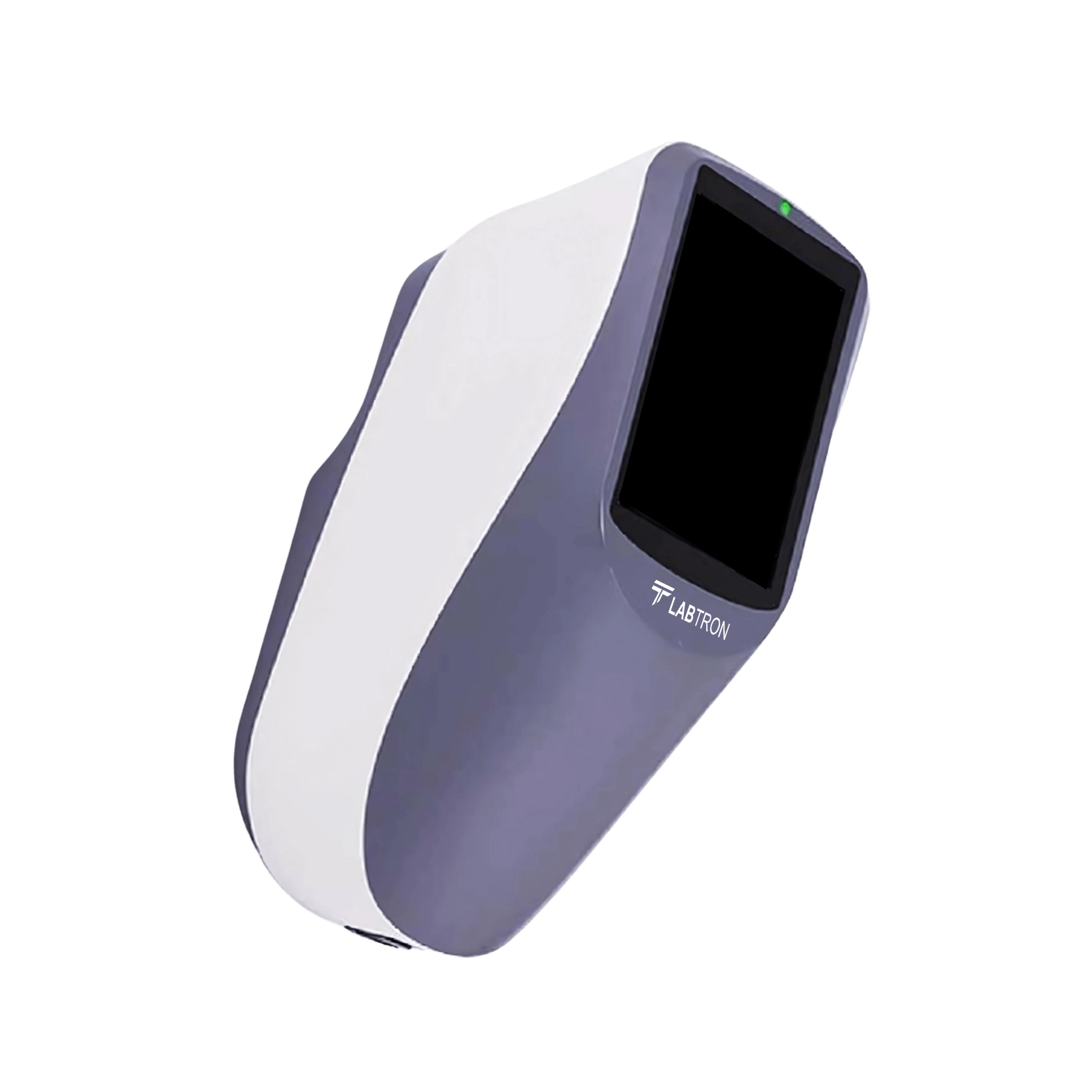
Diffraction Grating Spectrophotometer LDGS-A10 is an analytical instrument that uses a grating to split light into wavelengths for accurate analysis. It is widely used in the pharma and laboratories, ensuring precise color in tablets and packaging for quality control.
Accessories Name | Quantity |
Power Adaptor | 1 |
USB Cable | 1 |
Built-in li-ion Battery | 1 |
Protective Cover | 1 |
White and Black Calibration Cavity | 1 |
Management Software | 1 |
Download catalog for
Diffraction Grating Spectrophotometer LDGS-A10 Catalog
Labtron Diffraction Grating Spectrophotometer delivers precise spectral analysis for accurate color matching and material identification. This offers automatic wavelength calibration, ensuring stable measurements. These devices feature advanced noise reduction, providing reliable results. They support dual monochromators to enhance wavelength precision and reduce stray light. Our diffraction grating spectrophotometer is made of high-quality aluminum alloys, improving strength and corrosion resistance.


Labtron supplies premium Diffraction Grating Spectrophotometer. Most gratings are designed for specific polarization states, and if the light is not polarized correctly, the grating’s diffraction efficiency can drop, leading to weaker signals. The grating may diffract polarized light more efficiently in one direction compared to another. Polarization effects are more significant when using high-resolution gratings, as small changes in polarization can lead to noticeable shifts in spectral peaks. Polarizers or polarization-maintaining optical components can control the light's polarization state, ensuring more accurate measurements. Proper calibration for polarization ensures consistency across different setups and measurements.
Labtron’s Diffraction Grating Spectrophotometer have advanced features. Temperature has a critical role in performance. As temperature increases, materials within the optical system—such as the grating or mirrors—expand or contract, leading to shifts in the diffraction angles. Thermal effects also influence the detector’s sensitivity, causing fluctuations in the recorded signal. Advanced systems often include thermal compensation mechanisms, such as temperature-controlled stages or cooling systems, to mitigate these effects. Without proper thermal control, spectral data may drift, reducing the reliability of measurements over time. Regular calibration checks are essential to ensure that thermal influences do not compromise the accuracy of spectral readings.
Labtron manufactures advanced Diffraction Grating Spectrophotometers. Excessive light intensity may lead to nonlinear diffraction responses, resulting in distorted spectral data. This is especially problematic when working with narrow spectral lines, as intense light can induce higher-order diffraction or scattering effects, complicating analysis. Specialized gratings with high power tolerance are designed to handle intense light without damage. Filters or attenuators are often used to reduce the light intensity entering the system, protecting the grating from damage. Long-term exposure to high-energy sources can also degrade grating performance, requiring regular maintenance and recalibration. Ensuring proper management of light intensity is crucial to preserve grating efficiency and maintain accurate spectral measurements.
Labtron’s Diffraction Grating Spectrophotometer supports advanced features. Additionally, detectors often have reduced sensitivity at extreme ends of the UV and IR spectrum, further lowering the SNR. In the visible range, where the detector is most sensitive, the SNR is typically better. Grating efficiency plays a key role in ensuring a strong signal, but at higher diffraction orders, the signal tends to weaken, leading to a reduced SNR. External factors like thermal noise, electrical interference, and stray light can also degrade SNR. Signal processing techniques, such as signal averaging or digital filtering, can improve the SNR. Calibration of the spectrophotometer for stray light and noise sources is essential for obtaining reliable and reproducible data.
Labtron supplies different models of Diffraction Grating Spectrophotometers. Optical aberrations such as spherical, chromatic, and coma distort light paths, leading to blurred spectral peaks and reduced resolution. These distortions affect the diffraction efficiency and the clarity of the final spectrum, especially at higher diffraction orders where precision is critical. High-quality optical components such as aspheric lenses and minimizing geometrical imperfections can reduce the impact of aberrations. Proper alignment techniques are vital to ensure accurate spectral measurements, especially in high-resolution setups. Regular checks and calibration can correct for minor aberrations that accumulate over time. For certain applications, advanced correction algorithms in the system software can also compensate for these optical imperfections.
Yes, Diffraction Grating Spectrophotometers can be used for both transmission and reflection measurements. In transmission mode, light passes through the sample and grating, with the diffracted light being analyzed. In reflection mode, the light is reflected off the grating surface, and the diffracted light is measured. The grating's design and angle of incidence determine how the light interacts, making it versatile for different setups. Different optical components, like beamsplitters, may be used depending on the measurement type. Calibration ensures that both modes provide accurate spectral data. Spectrophotometers are often designed to switch between modes for various applications.
Post your question?
Our experts are here to help!
Labtron Equipment Ltd., Quatro House, Lyon Way, Camberley, Surrey GU16 7ER United Kingdom
Email: info@labtron.com Whatsapp: +44 73 4441 2688 Phone: +44 2080 043608