 info@labtron.com

| Volume | 30 L |
| Vacuum Degree | 0.098 MPa |
| Stirring Speed | 0 to 450 rpm |
| Stirring Motor Power | 120W1/3 |
| Power Supply | 220V/50 Hz |
| Dimensions (W×D×H) | 610 × 520 × 1600 mm |
| Weight | 38 kg |
Dual-function process chamber
Integrated speed regulation circuit
Compact vertical space footprint
Motor thermal cut-off protection
Drainage-ready bottom assembly
Glass Liquid Separator LGLS-A12 is designed for the extraction and separation of immiscible liquid phases across chemical, pharmaceutical, and laboratory workflows. It enables the controlled removal of each distinct liquid layer following reaction completion and phase settling.
Glass Liquid Separator features high borosilicate glass construction for strong resistance to temperature shifts and chemical reactions. They use a frequency-controlled motor for steady stirring, enhancing liquid-liquid separation and mixing. Their Teflon and rubber discharge valve ensures controlled outflow and chemical compatibility. These separators include ceramic bearings and mechanical seals that perform reliably under high-temperature use. Our Glass Liquid Separator supports liquid-liquid extraction in chemical research, pharmaceuticals, and academic labs.
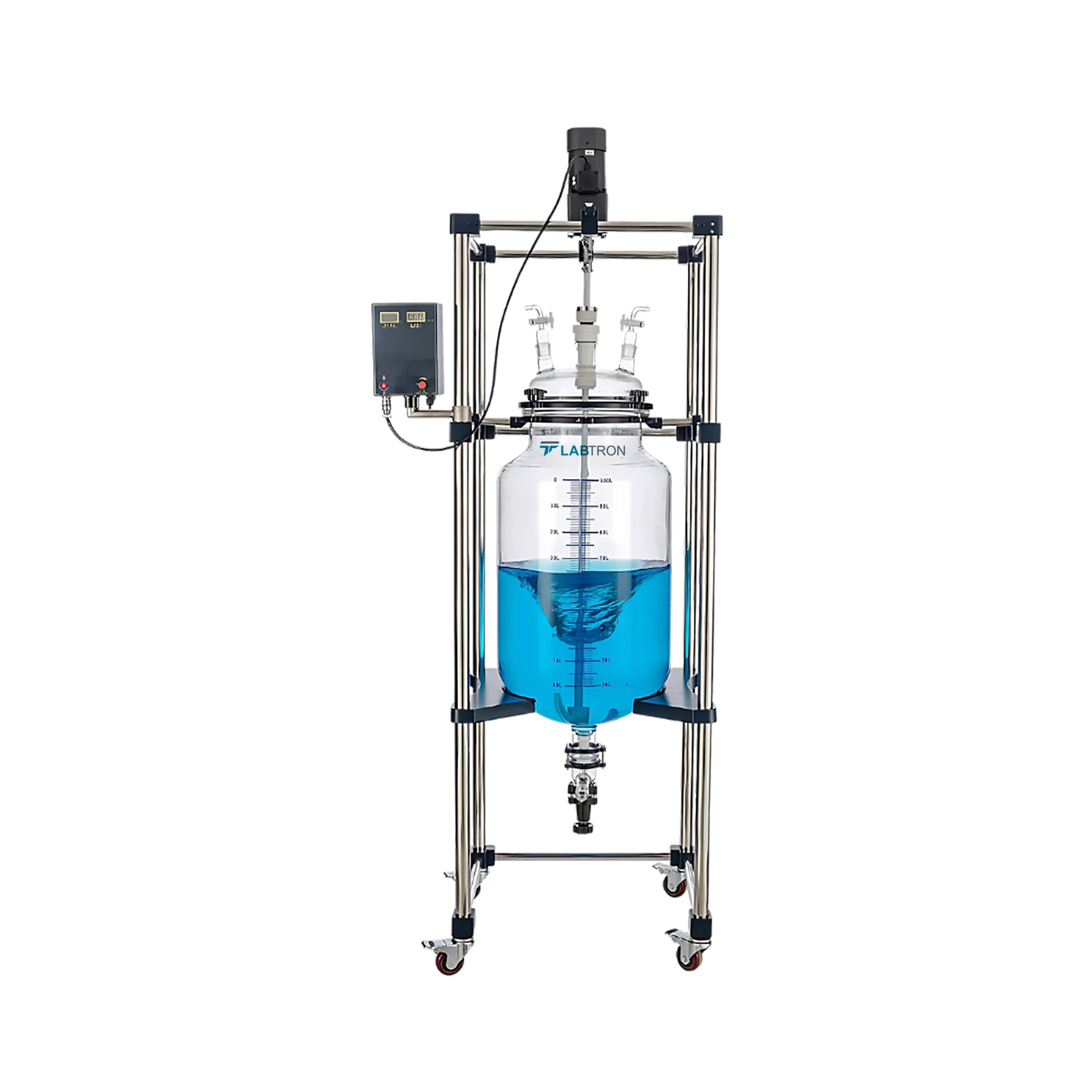


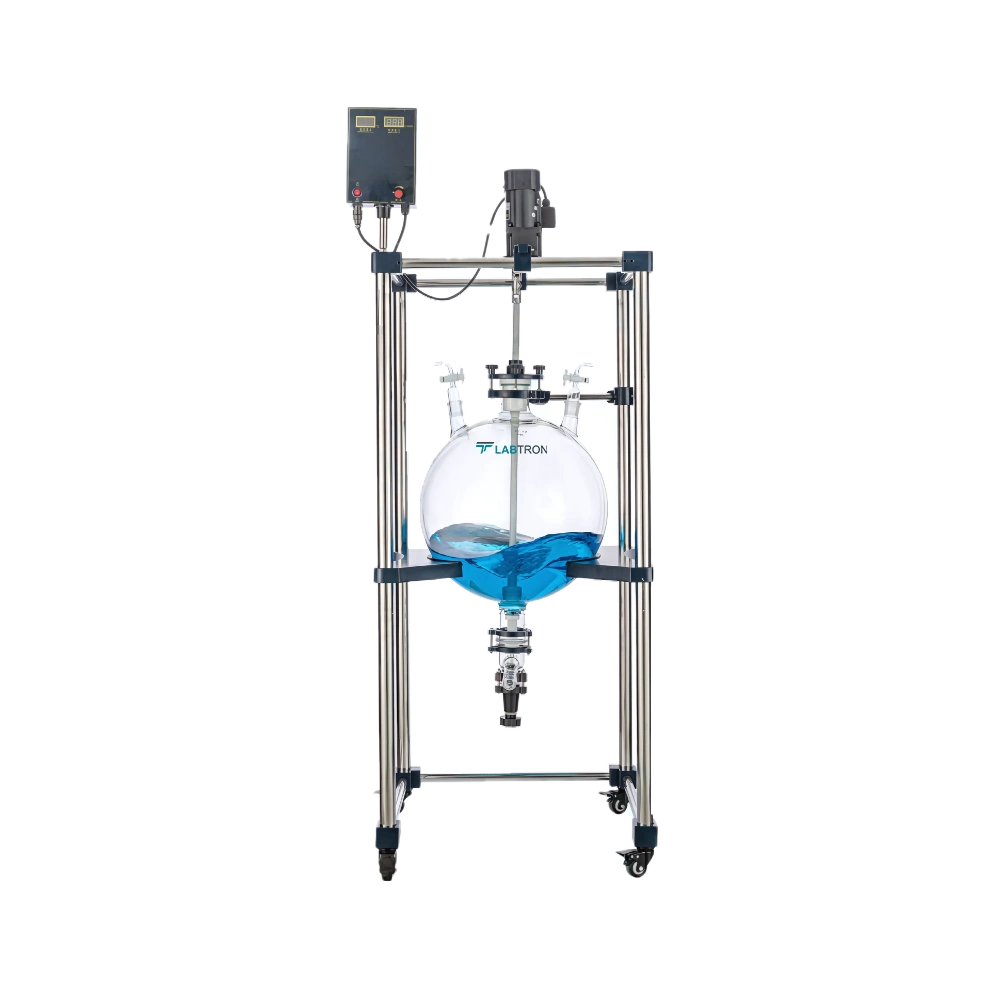
Our Glass Liquid Separator LGLS-A12 is designed to maintain stability during immiscible phase separation by minimizing internal turbulence during operation. The controlled agitation and adjustable outflow allow for accurate layering to remain intact while transferring fluids. This is especially useful when working with compounds where interface disturbance could alter outcomes. Its discharge setup is engineered to selectively release each phase without remixing. The phase interface remains visually accessible due to the clear borosilicate body. This helps operators intervene if needed during separation. Such clarity also aids in teaching and demonstration purposes. Overall, the unit ensures phase integrity is not compromised during extraction.
The Glass Liquid Separator LGLS-A12 incorporates an adaptable stirring feature to handle a wide range of liquid viscosities without causing mechanical stress. This capability enables users to mix thick organic layers or lighter solvents effectively without manual adjustment. The system’s motor maintains speed regulation across diverse sample densities. The uniform torque prevents slippage or irregular vortex formation. Users working in biochemical or petrochemical sectors benefit from this flexibility when working with complex mixtures. Its configuration avoids sediment accumulation in the corners during stirring. Whether dealing with plant-based extracts or petroleum fractions, the stirring remains balanced. The equipment adapts to extraction needs beyond standard lab solvents.
Labtron’s Glass Liquid Separator LGLS-A12 is equipped with structural components that prevent performance degradation over time. The ceramic bearings integrated into the drive mechanism are crafted to resist wear even during continuous stirring. This design supports uninterrupted runs required in multi-hour extractions or temperature-neutral reactions. High-strength joints eliminate leaks or seal fatigue under prolonged exposure. The Teflon-based outlet remains functional without clogging or stiffness during repeated discharge cycles. It performs consistently even in high-throughput laboratory environments. Users conducting repetitive studies or batch runs experience minimal downtime. The entire build resists corrosion even in acidic or reactive conditions, enhancing long-term usage.
The Glass Liquid Separator LGLS-A12 functions optimally in room-temperature scenarios, making it highly suitable for ambient separation tasks that do not require thermal conditioning. This eliminates the need for peripheral chilling equipment during typical usage. Its borosilicate construction maintains internal thermal stability, minimizing unintended temperature shifts. In setups involving slight exothermic reactions, the vessel naturally dissipates heat due to the thermal resistance of the materials used. Laboratory users do not need to incorporate water jackets or condensers unless external heating is introduced. This setup simplifies the overall experimental arrangement. It is ideal for standard separations without complex temperature control demands.
The design of the Glass Liquid Separator LGLS-A12 includes a compact footprint with an upright orientation, making it compatible with space-limited laboratory racks. It fits seamlessly into multi-level setups where multiple units are operated simultaneously. Its stable base ensures safe vertical alignment even when mounted on wheeled platforms. The height is optimized for accessibility without step ladders or extension tools. Additionally, the valve design allows front-facing drainage even when shelf-mounted. Research groups can operate parallel separations without spatial interference. This modular utility makes it suitable for labs that focus on high-throughput extraction and comparative batch reactions. The unit’s structure favours mobility and reconfiguration.
The Glass Liquid Separator LGLS-A12 offers an advanced discharge system that enables layer-by-layer outflow without disturbing underlying fluids. Its integrated Teflon and FV rubber cock ensures that flow can be initiated and stopped cleanly without leakage or back-siphoning. This structure allows collection of separated components at the exact interface height. Operators can monitor the visual layer formation through the transparent body and stop flow at the correct point. The discharge design ensures minimal turbulence when the valve is opened. This avoids remixing in systems where phase density difference is marginal. Users conducting fine-tuned separations, especially in analytical research, benefit from this granular control.
Post your question?
Our experts are here to help!
Labtron Equipment Ltd., Quatro House, Lyon Way, Camberley, Surrey GU16 7ER United Kingdom
Email: info@labtron.com Whatsapp: +44 73 4441 2688 Phone: +44 2080 043608
