info@labtron.com


| Wavelength Range | 400 to 700 nm |
| Optical Geometry | D/8 |
| Sphere Size | Φ40 mm |
| Wavelength Pitch | 10nm |
| Semiband Width | 10nm |
| Measuring Aperture | Single Aperture: MAV: Φ8mm / Φ10mm |
| Measured Reflectance Range | L: 0 to 120 Reflectivity: 0 to 200 % |
| Color Spaces | CIE LAB, XYZ, Yxy, LCh, CIE, S-RGB, βxy, Munsell (C/2) |
| Color Difference Formula | ΔE × ab, ΔE × 94, ΔE × cmc (2:1), ΔE ×cmc (1:1), ΔE × 00, DIN ΔE99 |
| Other Indices | WI (ASTM E313, CIE/ISO, AATCC, Hunter), YI (ASTM D1925, ASTM 313), MI |
| Illuminants | D 65, A, C, D50, F2 (CWF), F7 (DLF), F10 (TPLF), F11(TL84) F12 (TL83/ U30) |
| Viewing Angle | 2°/10° |
| Measurement Time | 1.5s |
| Repeatability | Chromaticity Value: MAV/SCI, ΔE × ab 0.06 |
| Inter- Instrument Error | MAV/SCI, within ΔE × ab 0.3 |
| Displayed Accuracy | 0.01 |
| Measurement Mode | 2 to 99 times |
| Storage Capacity | 1000Pcs Standard, 20000 Pcs Sample |
| Operating Temperature | 0 to 40°C, 0 to 85% RH, Altitude<2000m |
| Storage Temperature | -20 to 50°C, 0 to 85% RH |
| Dimensions (L× W× H) | 81 × 71 × 214 mm |
| Weight | 460g |
Auto White Balance Settings
Firmware Upgrade Feature
Statistical Result Analysis Tools
High-Contrast LCD Screen
3D Texture Recognition
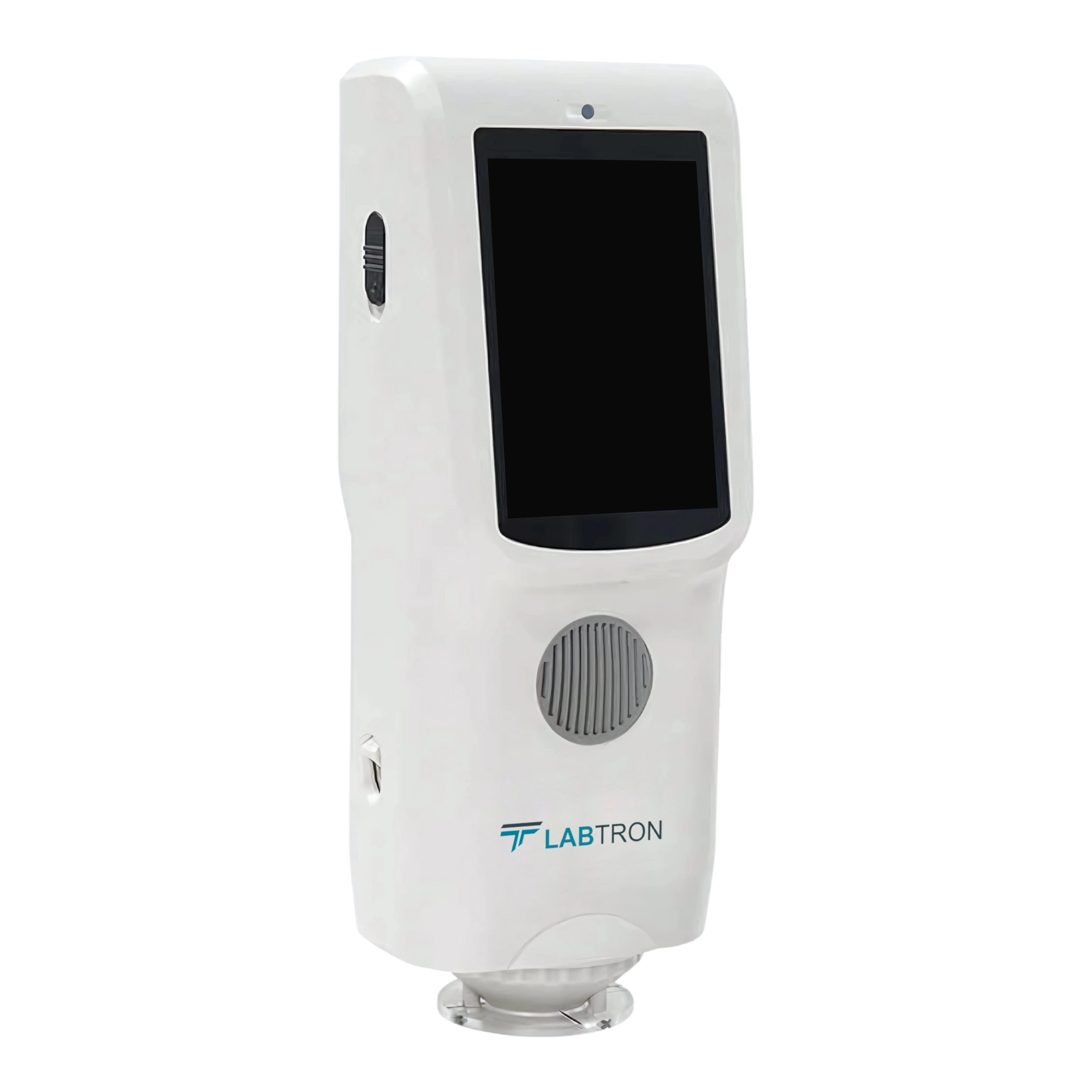
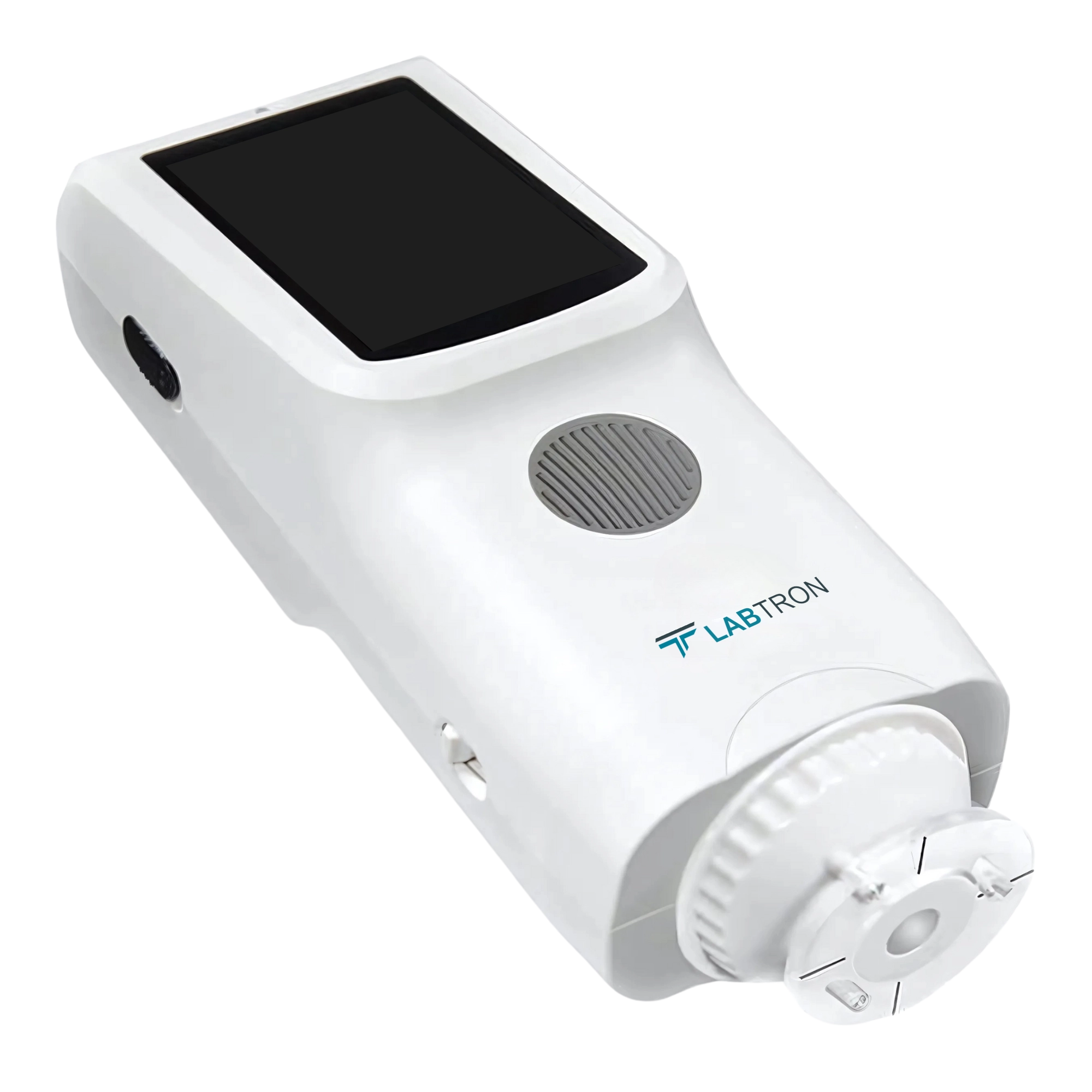
Spectral Colorimeter LCS-B15 evaluates color by separating light into its spectral components for precise color matching. It is utilized in ceramic and paint industry for accurate color matching and maintaining uniformity in the ceramic tiles and paint products.
Accessories Name | Quantity |
White and Black Calibration Board | 1 |
Wrist Strap | 1 |
8mm Flat Aperture | 1 |
8mm Tip Aperture | 1 |
Download catalog for
Spectral Colorimeter LCS-B15 Catalog
Labtron Spectral Colorimeter offer sleek designs and smooth surfaces to ensure comfortable handling and reliable results. They are equipped with a range of light sources and diffusion illumination systems. These guarantee consistent and accurate measurements. We provide colorimeters with patented stability technology assuring dependable performance. Our Spectral Colorimeters have high-capacity storage, USB interfaces and portable designs which gives convenient and efficient analysis.


Labtron supplies premium spectral colorimeter. Environmental factors like temperature, humidity, dust, and ambient light can impact the accuracy and stability of spectral colorimeter readings. High humidity may affect electronic components and optics, while temperature fluctuations can cause internal drift, leading to calibration errors. Dust or contaminants on the sample port or calibration tile can introduce spectral noise or shading effects. Ambient light interference, especially in open-port designs, can skew readings unless the device has adequate shielding. Many advanced instruments have built-in temperature compensation or warning indicators when environmental conditions exceed optimal thresholds. For portable use, protective cases and onsite recalibration accessories are available. Maintaining stable environmental conditions enhances measurement repeatability and instrument lifespan.
Labtron’s spectral colorimeter have advanced features. Reflectance curves show how much light a material reflects at each wavelength across the visible spectrum, typically from 380 nm to 780 nm. By comparing the curves of two samples, users can detect differences in material composition, surface treatment, or dye formulations. Reflectance curves are also crucial in identifying metamerism, evaluating translucency, or predicting color changes under various illuminants. Spectral colorimeters generate these curves automatically during measurement, and advanced software can overlay, compare, or export them for documentation. Curve shape and slope often indicate specific pigment or dye characteristics, providing a fingerprint of the material’s color.
Labtron offers advanced models of Spectral Colorimeter. Aperture size defines the area of the sample that is measured and can significantly impact accuracy, especially on non-uniform or textured surfaces. A small aperture (e.g., 4 mm) is ideal for small samples or detailed areas but may be sensitive to local variations in color or texture. Larger apertures (e.g., 10–25 mm) provide averaged data across a broader area, reducing the impact of irregularities but requiring a larger, flat sample surface. The choice of aperture must match the sample type and application-fine textiles, printed labels, or plastics may each require different sizes. Always ensure that aperture size is documented and standardized in your measurement protocol for reliable, repeatable results.
Yes, spectral colorimeters can be integrated with 3D imaging or other visual inspection systems to provide a more comprehensive analysis of color and surface characteristics. By combining color measurement with 3D data, manufacturers can assess how light interacts with both the color and the texture of a surface. For example, 3D imaging systems capture the surface contours and variations, while the spectral colorimeter measures the color consistency across those contours. This integration is particularly beneficial for complex geometries like automotive parts, packaging, and molded products, where the color appearance can vary based on surface irregularities. The combined data allows for more accurate quality control and ensures that both color and texture meet the required standards, improving overall product quality and reducing defects.
Labtron’s spectral colorimeter have advanced features. Measuring semi-transparent or translucent materials presents challenges, as light passes through the sample and scatters in multiple directions. Standard reflectance-based colorimeters may not fully capture the transmitted color or depth-related optical effects. To address this, some spectral colorimeters offer transmittance modes, where the light source and detector are positioned on opposite sides of the sample. This setup allows accurate evaluation of color as it appears when backlit or layered. Integrating spheres are useful in such cases because they collect diffused light evenly, reducing directional errors. Consistent backing (e.g., white or black) and sample thickness must be standardized for reliable comparisons. Industries like plastics, films, glass, and food packaging rely on this functionality to assess clarity, tint, and overall visual uniformity. Without correct configuration, semi-transparency can introduce large variations in color data.
Post your question?
Our experts are here to help!
Labtron Equipment Ltd., Quatro House, Lyon Way, Camberley, Surrey GU16 7ER United Kingdom
Email: info@labtron.com Whatsapp: +44 73 4441 2688 Phone: +44 2080 043608