 info@labtron.com

| Measuring Range | 2000.0 mV to +2000.0 Mv -20.000 pH to +20.000 pH |
| Measurement Resolution | 0.1 mV |
| Measurement Precision | 0.1 mV ± 0.03% |
| Measurement Mode | MEAS: Measuring pH / mV/T CAL: pH correction (multi-point) SET Setting end-point mode MET Equivalent titrating DET Dynamic titrating |
| pH Resolution | 0.001 pH |
| pH Precision | 0.003 pH |
| Titrating Volume Accuracy | 0.001ml |
| Titrating Method | Acid-base titration, redox titration, precipitation titration, complexation titration, non-water titration |
| Titrating Cup Capacity | 250 ml |
| Temperature Measurement Range | -5 to 120° C |
| Temperature Resolution | 0.01° C |
| Temperature Measurement Accuracy | ±0.1° C |
| Communication Mode | 1 USB, 232 serial port, ethernet |
| Fluid Adding Unit | Built-in liquid-adding unit |
| Liquid-Adding Module Unit | Contains 2 sets of built-in titration liquid-adding channel. |
| Number of liquid-adding channels | 8 channels |
| Burette Model | 1ml, 5ml, 10ml, 25ml, 50ml (10ml standard) |
| Burette Resolution | 1/48000 |
| Time of Replenishing Liquid | 10 sec |
| Control Unit | PC including software |
| Automatic Sampler | It is compatible with GT robot injection system for mass sample analysis. |
| Self -Checking Function | Power-on to automatically check the instrument status. |
| Calibration Function | Yes |
| Storage Space | > 300G (more than 10000 PCS) |
| Preset Method | >300G (more than 10000 PCS) |
| Pipelines | PTFE titration pipelines |
| PTFE Valve | Roof type spiral stirrer or magnetic stirring. |
| Microscale Detection Electrodes | Imported |
| Micro-Injection Pump | Imported |
| Packing Dimension | 750 × 560 × 420 mm |
| Gross Weight | 40 kg |
Interchangeable Burette System
High mV Resolution
Overhead Stirring Coil
Integrated Mixing Apparatus
Automatic Cleaning Operation
Automatic Potentiometric Titrator LPTT-A21 measures changes in the electrical potential to detect the endpoint. It is widely used in biochemical analysis, petrochemical analysis, electroplating and research laboratories for precise quantitative determinations.
Download catalog for
Automatic Potentiometric Titrator LPTT-A21 Catalog
Available Range :
Automatic Potentiometric Titrator LPTT-A16 : -2000.0 to +2000.0 mV,Labtron Automatic Potentiometric Titrator are designed for precise potential measurement in the range of -1800.0 mV to +2000.0 mV. They ensure rapid filling and accurate burette volume control for efficient operation. Their linear motor transmission offers precise and controlled titrant delivery. They facilitate the storage of numerous titration results and allow easy customizations. Our table-top Automatic Potentiometric Titrator provide high-precision and cost-effective analysis in less time.


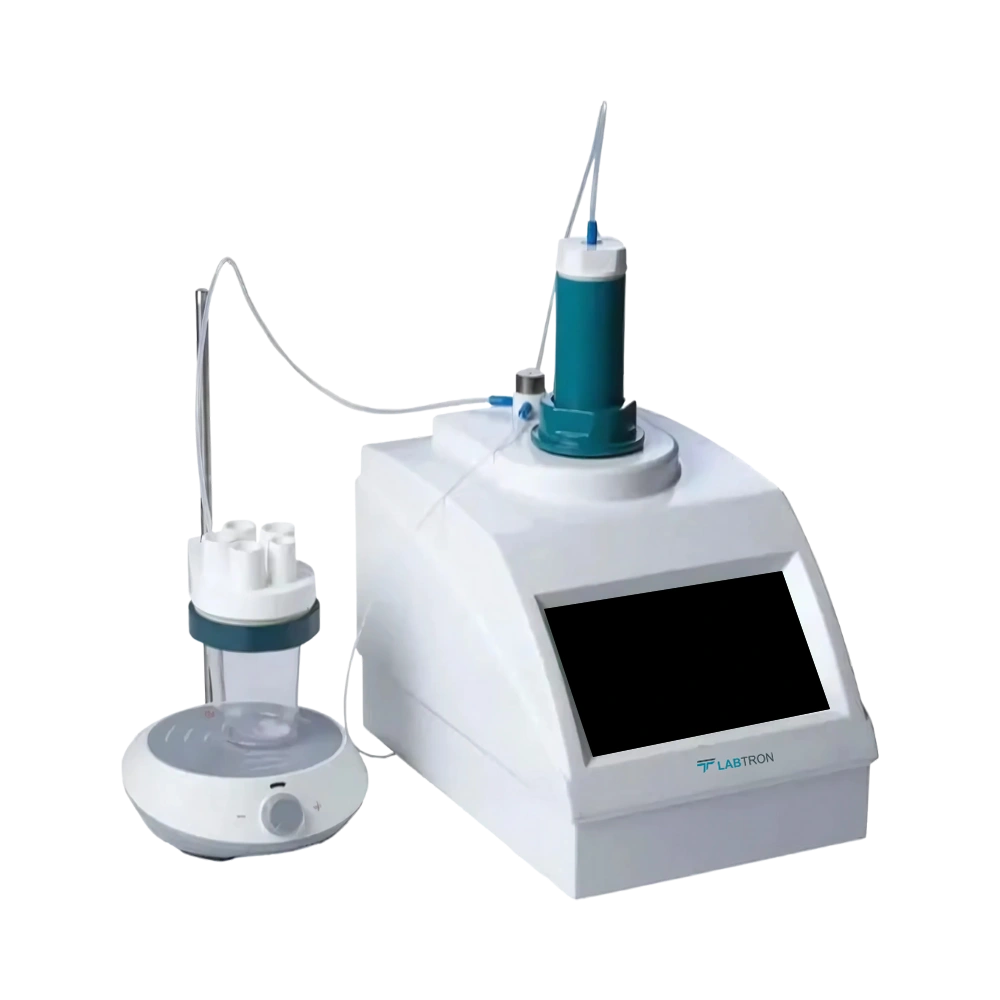

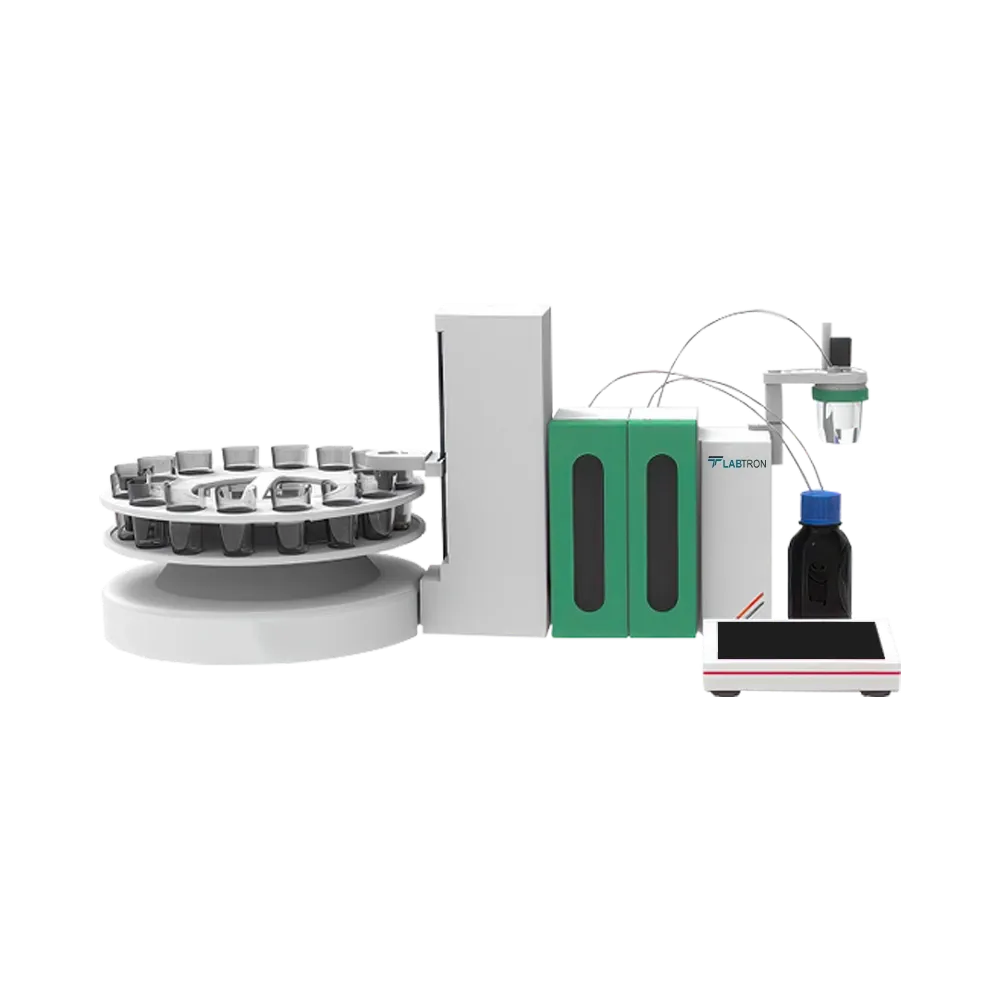


Labtron’s automatic potentiometric titrator LPTT-A21 improves accuracy by automating titrant addition, electrode potential measurement, and endpoint detection. Unlike manual titrations, it eliminates parallax errors and subjective color change judgments. This automation ensures that each titration is carried out with identical parameters, improving repeatability. Sophisticated microprocessors in the automatic potentiometric titrator analyze titration curves and calculate exact concentrations. Temperature compensation and calibration protocols further ensure analytical precision. The closed system prevents contamination and minimizes sample exposure. Built-in data logging also allows traceability and validation of results. This makes it suitable for critical applications requiring stringent quality control.
Labtron’s automatic potentiometric titrator LPTT-A21 supports a wide variety of titrations, including acid-base, redox, precipitation, and complexometric titrations. It can also be used for non-aqueous titrations, especially in pharmaceutical and petrochemical analysis. For redox titrations, it monitors potential shifts due to electron transfer reactions. In acid-base titrations, it detects sharp voltage changes around the equivalence point. The automatic potentiometric titrator is also compatible with ion-selective electrodes for specific ions. Its flexible programming allows multi-step titrations and derivative curve analysis. Each titration type benefits from the instrument’s high sensitivity and automated control. This versatility makes it an essential lab asset.
Labtron’s Automatic potentiometric titrators LPTT-A 21 are versatile instruments capable of performing a wide range of titration types. These include acid-base titrations, where pH changes are monitored to determine the endpoint. Redox titrations involve electron transfer reactions, with potential changes indicating the equivalence point. Complexometric titrations, often used for metal ion analysis, rely on the formation of complexes between the analyte and titrant. Precipitation titrations detect the formation of an insoluble compound during the reaction. Non-aqueous titrations are conducted in solvents other than water, suitable for substances insoluble or unstable in water. Ion-selective electrode (ISE) titrations target specific ions using selective membranes. This broad applicability makes automatic potentiometric titrators essential tools in various analytical laboratories.
Derivative titration methods calculate the slope (1st derivative) or curvature (2nd derivative) of the potential-volume curve to identify the sharpest change corresponding to the equivalence point. The 1st derivative is useful for single-endpoint titrations, where the inflection point yields maximum slope. The 2nd derivative flags multiple equivalence points or closely spaced endpoints by highlighting zero-crossings in the curvature plot. Users can set sensitivity thresholds to filter noise, avoiding false endpoints in low-signal titrations. Advanced software allows overlaying derivative curves in real time, enabling method developers to fine-tune dosing increments. Pre-titration smoothing algorithms (e.g., Savitzky–Golay filters) can be applied to raw data for cleaner derivative profiles. For complexometric titrations with gradual potential changes, derivative methods improve precision over fixed-pH endpoints. Documentation of derivative parameters ensures reproducibility across operators and shifts.
Complexometric titrations often suffer from metal-ion hydrolysis or slow complex formation, leading to endpoint overshoot if the dosing rate is too high. Slowing pump speed near the anticipated endpoint and using incremental dosing improves accuracy. Non-aqueous titrations can be affected by solvent moisture content; pre-dry solvents and titrants over molecular sieves for at least 24 hours. Use a non-aqueous reference electrode compatible with low-dielectric solvents to maintain stable potentials. Implement automatic solvent addition routines to keep the sample volume constant and minimize concentration drift. Complexometric buffers must be titrated for pH control; verify buffer capacity and adjust before sample analysis. Regularly inspect and replace sealing O-rings on burettes to prevent air ingress during slow titrations. Validate methods by performing spike-recovery tests to detect matrix interferences
Post your question?
Our experts are here to help!
Labtron Equipment Ltd., Quatro House, Lyon Way, Camberley, Surrey GU16 7ER United Kingdom
Email: info@labtron.com Whatsapp: +44 73 4441 2688 Phone: +44 2080 043608