 info@labtron.com

| Microplate types | 96/48 -well plate |
| Photodetector | Silicon Photodiode |
| Light source | 8V/50W Controlled tungsten halogen lamp or LED light |
| Wavelength range | 400nm to 800nm |
| Standard filters | 405,450,492,630nm and 4 optional |
| Reading range | 0.000 to 4.000A |
| Resolution | 0.001A |
| Accuracy | ±0.008A |
| Reproducibility | ≤0.2% |
| Stability | ±0.003A |
| Reading speed | Single wavelength ≤ 3s, double wavelength ≤ 6s |
| Shaking | Linear Shaking, 3 speeds |
| Printer | Built-in thermal printer, optional external printer |
| Interface connections | DVI, VGA, network interface, audio interface, USB, RS232 |
| Power supply | 100 to 240V, 50 to 60Hz |
Our Microplate Reader suits diagnostic and pharmaceutical labs, supporting nucleic acid quantification, enzyme assays, vaccine development, toxicity testing, and food analysis, streamlining workflows with flexible plate formats and evaluation tools.


Labtron Microplate Readers have multiple wells (commonly 48, 96, 384, or 1536) that serve as small test tubes. These are used to detect biological, chemical, or physical events in samples within microtiter plates. Our advanced models offer a range of wavelengths, allowing users to customize the absorbance or fluorescence measurements according to specific requirements. With their high sensitivity and dynamic range, they are capable of detecting very low and high signals. They come with specialized software for controlling the reader, setting up protocols, and analyzing the collected data. To ensure that reagents and samples are well-mixed before measurement, our microplate readers include shaking or stirring functions.


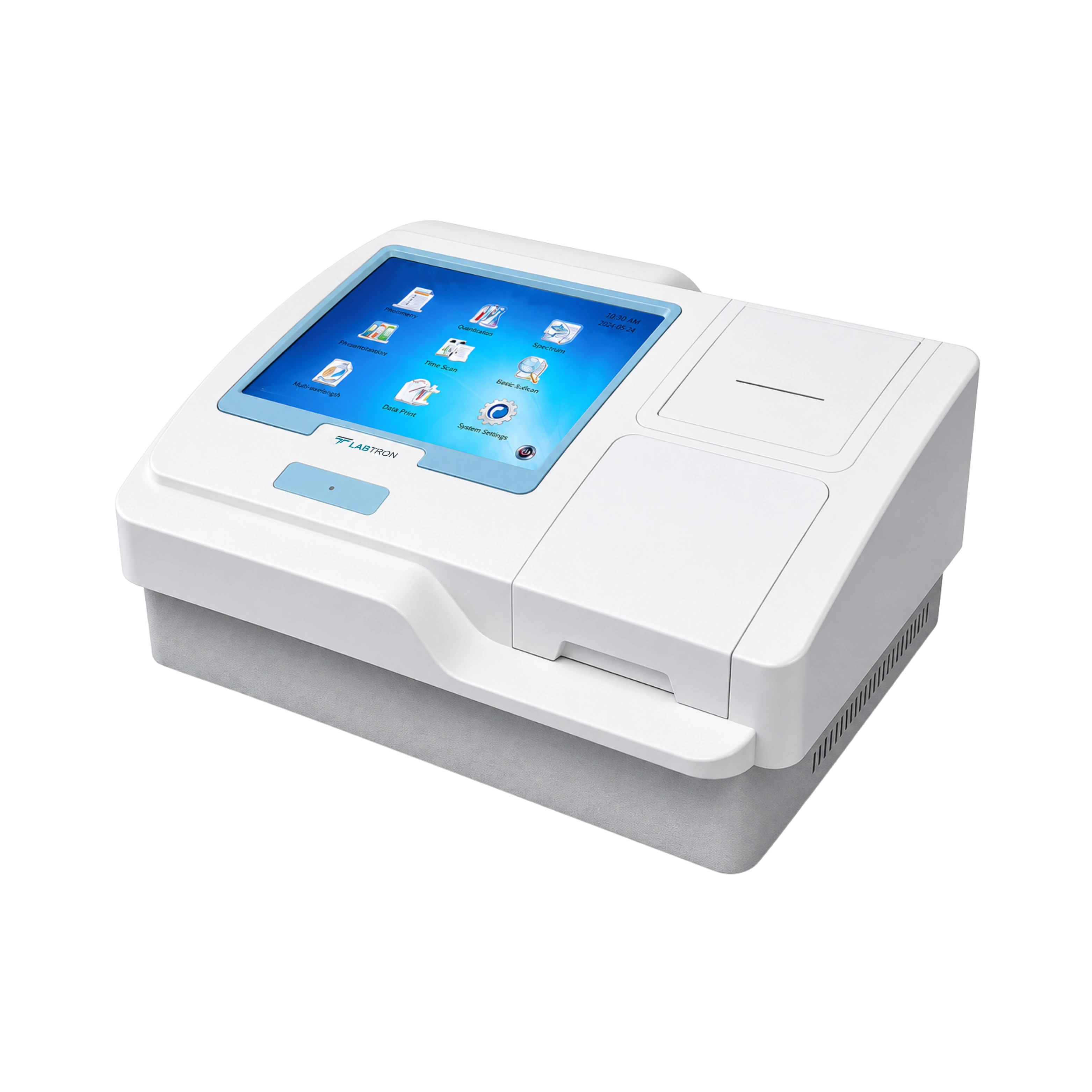

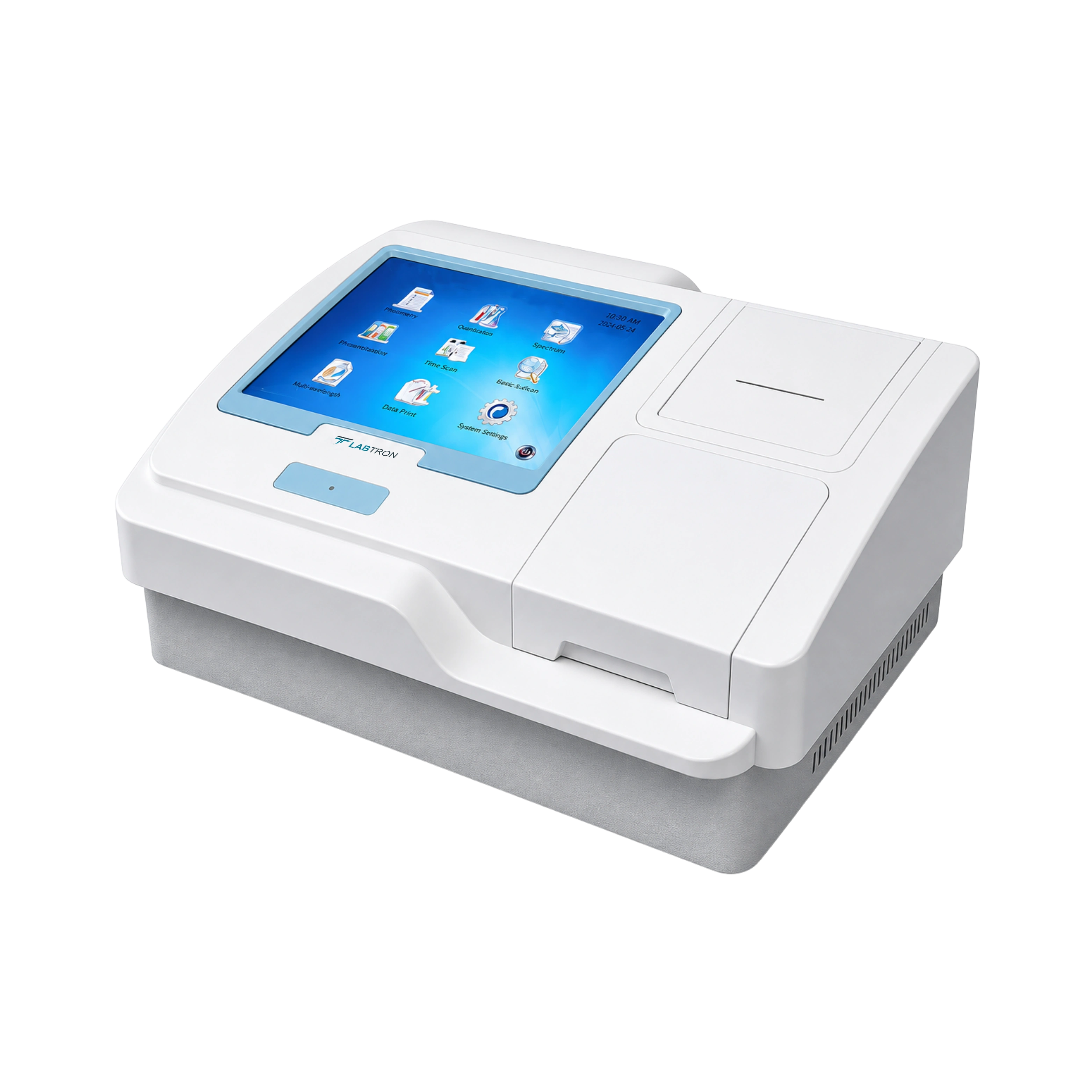

It features a high-resolution 10.4-inch color LCD for clear visual output during testing. The large screen ensures easy operation and intuitive navigation. Users can view detailed test results and settings clearly. This display enhances user experience and reduces errors during operation. It supports touch functionality for quick access to features. The vibrant color and high resolution improve visibility even in bright lab environments.
Yes, it offers both single and dual wavelength modes for accurate analysis. Dual wavelength mode helps correct background noise for more reliable results. This flexibility allows adaptation to various assay requirements. It enhances precision in complex sample measurements. The reader supports fast switching between modes to increase throughput. These features make it suitable for diverse laboratory applications.
It includes linear shaking with three adjustable speeds for efficient sample mixing. This improves assay consistency by ensuring uniform reagent distribution. The shaking function can be customized based on the assay requirements. It helps enhance sensitivity and reproducibility of results. The user-friendly controls make it easy to select the desired shaking speed. This feature supports a wide range of microplate assays for better performance.
A Microplate Reader, commonly called as plate reader or plate spectrophotometer, is an analytical instrument that reads or detects the physical, chemical, and biological events of the analyte, within the wells of the plate. It has numerous tiny wells where the sample analyte is introduced for analysis.
A standard spectrophotometer measures the absorbance of one sample at a time. The sample is typically placed in a cuvette through which light is sent horizontally. An absorbance plate reader offers higher throughput and can measure the absorbance of samples in microplates (typically 96-well or even 384-well) by sending light through each well vertically.
Microplate-based measurements detect light signals produced by a sample, converted by a sample, or transmitted through a sample. In the plate reader, the signal is measured by a detector, usually a photomultiplier tube (PMT). PMTs convert photons into electricity that is then quantified by the microplate reader. The output of this process is numbers by which a sample is quantified.
Tungsten-halogen or xenon flash lamps are generally used. LEDs have also come into the picture in some modern readers.
The detection technology can be of 3 types- Monochromator based detection which provides flexibility, convenience, and spectral scanning; Filter based detection which enables rapid switch between different wavelengths; Hybrid detection which has dual technological advantage of both flexibility and sensitivity.
Post your question?
Our experts are here to help!
Labtron Equipment Ltd., Quatro House, Lyon Way, Camberley, Surrey GU16 7ER United Kingdom
Email: info@labtron.com Whatsapp: +44 73 4441 2688 Phone: +44 2080 043608

