 info@labtron.com

| Measuring Range | 2000.0 mV to +2000.0 mV -20.000 pH to +20.000 pH |
| Measurement Resolution | 0.1 mV |
| Measurement Precision | 0.1 mV ± 0.03% |
| Measurement Mode | MEAS: Measuring pH / mV/T CAL: pH correction (multi-point) SET Setting end-point mode MET Equivalent titrating DET Dynamic titrating |
| pH Resolution | 0.001 pH |
| pH Precision | 0.003 pH |
| Titrating Volume Accuracy | 0.001ml |
| Titrating Method | Acid-base titration, redox titration, precipitation titration, complexation titration, non-water titration |
| Titrating Cup Capacity | 250 ml |
| Temperature Measurement Range | -5 to 120° C |
| Temperature Resolution | 0.01° C |
| Temperature Measurement Accuracy | ±0.1° C |
| Communication Mode | 1 USB, 232 serial port, ethernet |
| Fluid Adding Unit | Built-in liquid-adding unit |
| Liquid-Adding Module Unit | Contains 2 sets of built-in titration liquid-adding channel. |
| Number of liquid-adding channels | 8 channels |
| Burette Volume | 1ml, 5ml, 10ml, 25ml, 50ml (10ml standard) |
| Burette Resolution | 1/48000 |
| Time of Replenishing Liquid | 10 sec |
| Control Unit | PC including software |
| Automatic Sampler | It is compatible with GT robot injection system for mass sample analysis. |
| Self -Checking Function | Power-on to automatically check the instrument status. |
| Calibration Function | Yes |
| Storage Space | >300G (more than 10000 PCS) |
| Preset Method | >300G (more than 10000 PCS) |
| Pipelines | PTFE titration pipelines |
| PTFE Valve | Roof type spiral stirrer or magnetic stirring. |
| Microscale Detection Electrodes | Imported |
| Micro-Injection Pump | Imported |
Automated Cleaning Function
Chemically Resistant Tubing
Integrated Endpoint Detection
High mV Resolution
Wide pH Range
Automatic Potentiometric Titrator LPTT-A19 calculates concentration endpoint with high reproducibility. It plays a key role in food and beverages, metal, plating, lubricants and petroleum for measuring acidity or alkalinity in different materials.
Download catalog for
Automatic Potentiometric Titrator LPTT-A19 Catalog
Available Range :
Automatic Potentiometric Titrator LPTT-A16 : -2000.0 to +2000.0 mV,Labtron Automatic Potentiometric Titrator are designed for precise potential measurement in the range of -1800.0 mV to +2000.0 mV. They ensure rapid filling and accurate burette volume control for efficient operation. Their linear motor transmission offers precise and controlled titrant delivery. They facilitate the storage of numerous titration results and allow easy customizations. Our table-top Automatic Potentiometric Titrator provide high-precision and cost-effective analysis in less time.


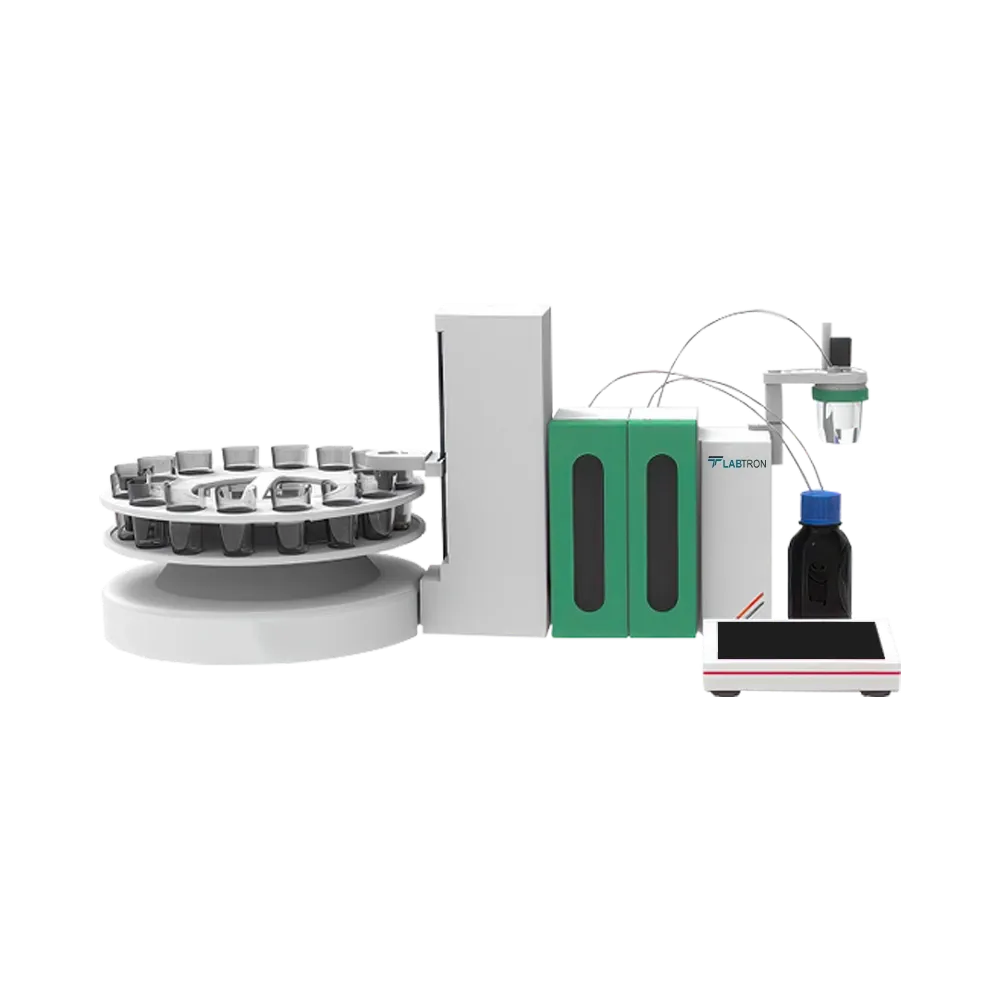
Labtron’s automatic potentiometric titrator LPTT-A19 ensures compliance with regulations like GLP, GMP, and 21 CFR due to its traceable and reproducible performance. It automates data logging, user authentication, and audit trail creation. The instrument supports secure method validation and electronic signatures. In pharmaceutical, food, and environmental testing industries, accuracy and documentation are critical. The automatic potentiometric titrator simplifies method standardization across labs, ensuring uniformity. Its integration with quality control systems reduces manual data entry errors. Routine calibration and system suitability checks ensure regulatory compliance. The automated and validated process builds trust in analytical results.
To optimize performance, ensure proper electrode maintenance, regular calibration, and appropriate titrant standardization. Sample preparation must be consistent, with stable temperature and pH conditions. The automatic potentiometric titrator should be operated in a clean, vibration-free environment. Choosing the right electrode type and titration method for your application improves accuracy. The software settings should be fine-tuned to optimize titrant delivery rate and endpoint sensitivity. Periodic performance verification using known standards ensures continued accuracy. Training operators on standard operating procedures prevents misuse. Proper optimization extends equipment life and improves analytical reliability.
Labtron’s supplies premium automatic potentiometric titrator LPTT-A19, consider the types of titrations required, sample throughput, and automation level. Look for compatibility with specific electrodes and titrants used in your lab processes. The accuracy, resolution, and sensitivity of mV readings are crucial for detecting endpoints. Evaluate the software’s user interface, data management capabilities, and regulatory compliance features. Also, consider maintenance requirements, electrode lifespan, and reagent handling safety. Some models offer multi-channel operation for simultaneous titrations. Budget constraints and brand reliability are practical factors. A well-chosen automatic potentiometric titrator enhances workflow efficiency and result consistency.
Labtron’s Automatic potentiometric titrators LPTT-A19 are versatile instruments capable of performing a wide range of titration types. These include acid-base titrations, where pH changes are monitored to determine the endpoint. Redox titrations involve electron transfer reactions, with potential changes indicating the equivalence point. Complexometric titrations, often used for metal ion analysis, rely on the formation of complexes between the analyte and titrant. Precipitation titrations detect the formation of an insoluble compound during the reaction. Non-aqueous titrations are conducted in solvents other than water, suitable for substances insoluble or unstable in water. Ion-selective electrode (ISE) titrations target specific ions using selective membranes. This broad applicability makes automatic potentiometric titrators essential tools in various analytical laboratories.
Regular maintenance and calibration are crucial for the optimal performance of automatic potentiometric titrators LPTT-A19. Electrodes should be cleaned, stored properly, and calibrated using standard solutions to maintain accuracy. The burette and dosing system require periodic checks for leaks or blockages, ensuring precise titrant delivery. Software updates and system diagnostics help identify and rectify potential issues promptly. Routine calibration using certified reference materials validates the instrument's accuracy. Environmental factors, such as temperature and humidity, should be monitored, as they can affect measurements. Documentation of maintenance and calibration activities supports compliance with quality assurance protocols. Adhering to a regular maintenance schedule prolongs the instrument's lifespan and ensures consistent analytical results.
Post your question?
Our experts are here to help!
Labtron Equipment Ltd., Quatro House, Lyon Way, Camberley, Surrey GU16 7ER United Kingdom
Email: info@labtron.com Whatsapp: +44 73 4441 2688 Phone: +44 2080 043608