 info@labtron.com

| Wavelength Range | 340 to 750 nm |
| Filter Bandwidth | 8 to 10 nm |
| Wavelength Accuracy | Less than or equal to ±2 nm |
| Absorbance Range | 0 to 4.000Abs |
| Incubation Temperature Range | R.T. +4°C to 65°C |
| Temperature Accuracy at 37°C | ± 0.5°C |
| Temperature Uniformity at 37°C | ± 0.5°C |
| Sensitivity | Greater than 0.01Abs |
| Detector | Photodiode |
| Measuring Speed Fast Mode | 5 seconds per 96-well plate |
| Single wavelength | 7 seconds per 96 wells |
| Dual wavelength | 15 seconds per 96 wells |
| Absorbance Repeatability | 0 to 3 Abs: CV less than or equal to 0.3% |
| Absorbance Accuracy (450nm) | [0.000 to 2.000Abs] ≤ ±0.005Abs [3.000 to 4.000Abs] ≤ ±1.5% [2.000 to 3.000Abs] ≤ ±1% |
| Linear Range | R² greater than or equal to 0.995 (0.000 to 3.000Abs) |
| Number of Program Storage | 5000 |
| Interface USB | Connecting the printer and USB drive |
| Display | 10-inch high-resolution touch screen |
| Light Source | 6V 10W halogen lamp |
| Fuse | 250V, 2A Ф 5 ×20 |
| Power Consumption | 200W |
| Power Supply | 100 to 240VAC 2.3A 50/60Hz |
| Dimension (W×D×H) | 300 × 430 × 232 mm |
| Weight | 10 kg |
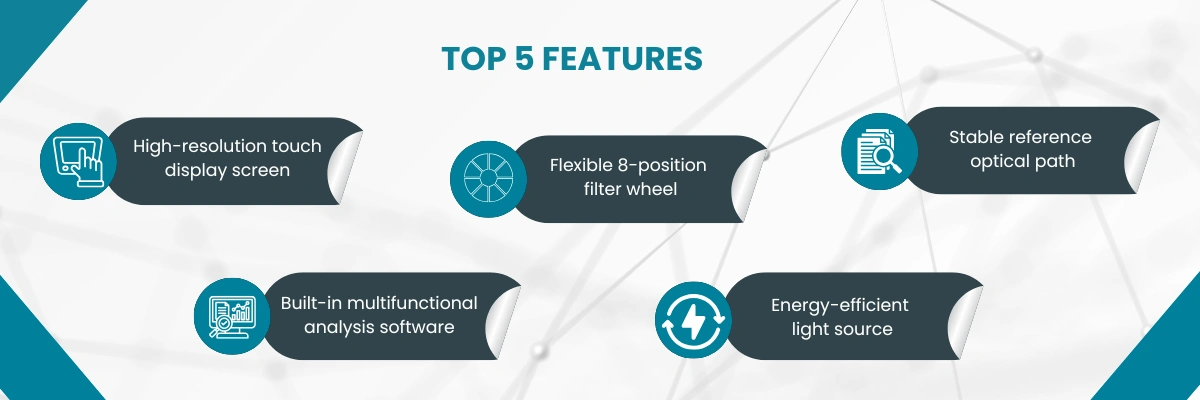
High-resolution touch display screen
Flexible 8-position filter wheel
Stable reference optical path
Built-in multifunctional analysis software
Energy-efficient light source
Microplate Reader LMPR-C10 is used to measure absorbance in ELISA, enzyme activity, and protein quantification assays. It is widely applied in clinical diagnostics, pharmaceutical labs, research institutions, and biotechnology industries.
| Name | Quantity |
| Filter 405nm | 1 piece |
| Filter 450nm | 1 piece |
| Filter 492nm | 1 piece |
| Filter 630nm | 1 piece |
| Filter 415nm | 1 piece |
| Filter 470nm | 1 piece |
| Filter 510nm | 1 piece |
| Filter 520nm | 1 piece |
| Filter 532nm | 1 piece |
| Filter 540nm | 1 piece |
| Filter 546nm | 1 piece |
| Filter 570nm | 1 piece |
| Filter 578nm | 1 piece |
| Filter 595nm | 1 piece |
| Filter 620nm | 1 piece |
| Filter 650nm | 1 piece |
| Filter 660nm | 1 piece |
| Filter 690nm | 1 piece |
| Filter 700nm | 1 piece |
| Filter 750nm | 1 piece |
Download catalog for
Microplate Reader LMPR-C10 Catalog
Available Range :
Microplate Reader LMPR-A14 : 200 nm to 1000 nm with 1 nm steps Microplate Reader LMPR-B10 : 200 to 1000 nm Microplate Reader LMPR-C10 : 340 to 750 nm Microplate Reader LMPR-A12 : 400 nm to 800 nm Microplate Reader LMPR-A13 : 400 nm to 850 nm Microplate Reader LMPR-A10 : 400 to 750 nm Microplate Reader LMPR-A20 : 400 to 850 nm Microplate Reader LMPR-A30 : 400-850 nm Microplate Reader LMPR-A16 : 400nm to 800nm Microplate Reader LMPR-A15 : 400nm~800nm
Labtron Microplate Readers have multiple wells (commonly 48, 96, 384, or 1536) that serve as small test tubes. These are used to detect biological, chemical, or physical events in samples within microtiter plates. Our advanced models offer a range of wavelengths, allowing users to customize the absorbance or fluorescence measurements according to specific requirements. With their high sensitivity and dynamic range, they are capable of detecting very low and high signals. They come with specialized software for controlling the reader, setting up protocols, and analyzing the collected data. To ensure that reagents and samples are well-mixed before measurement, our microplate readers include shaking or stirring functions.


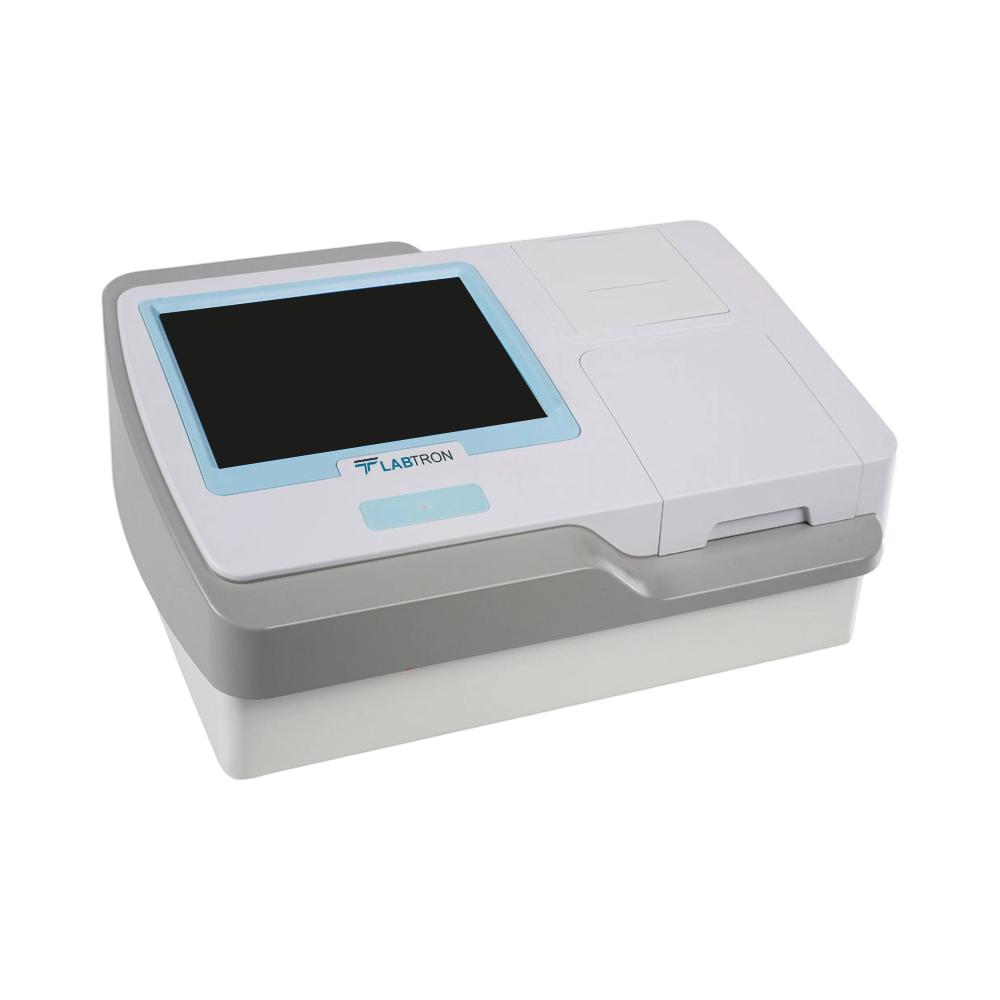


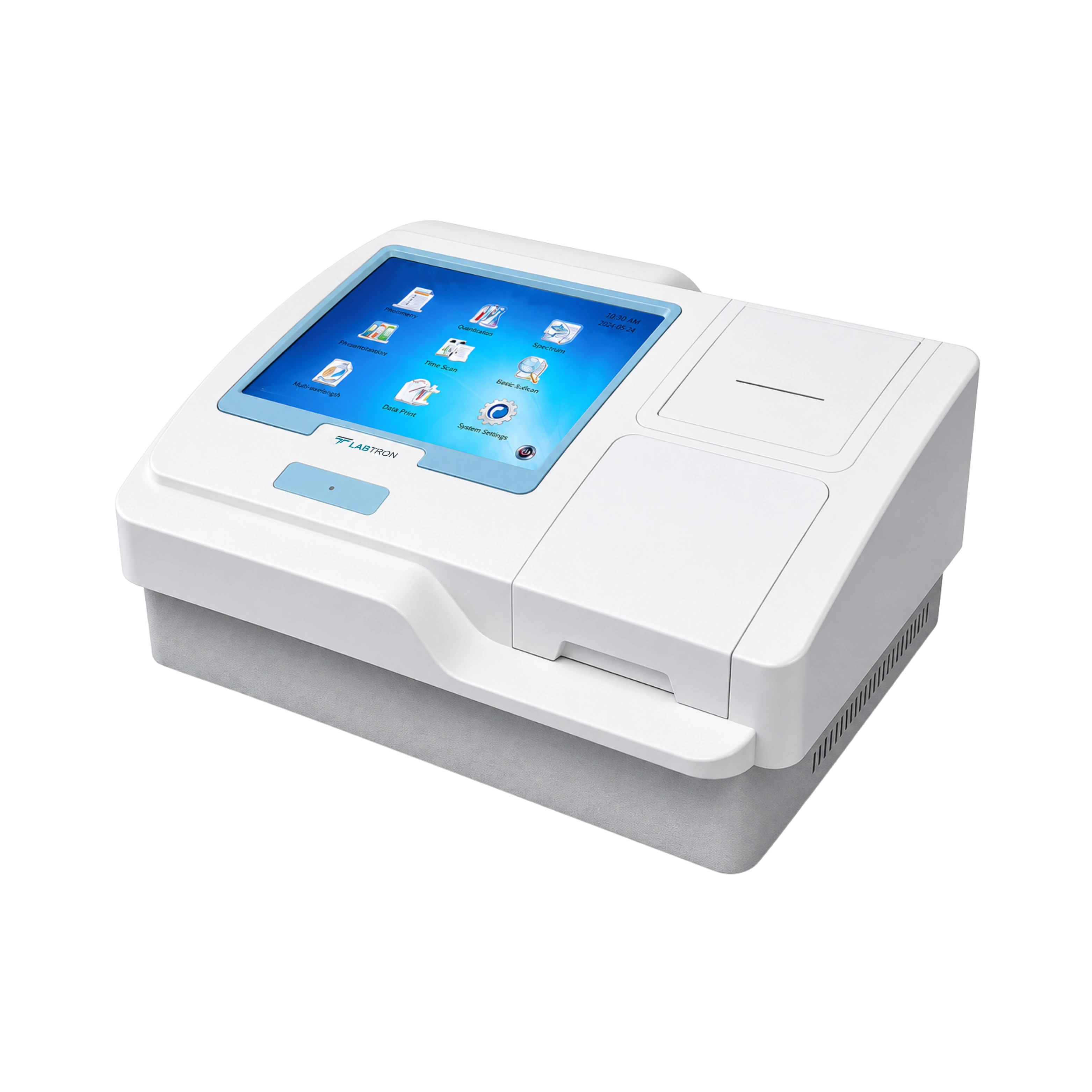
The Microplate Reader LMPR-C10 is designed for ease of use with modern lab workflows. It features a large 10-inch capacitive touch screen for simple navigation. Users can visually assign blanks, controls, and samples using an intuitive layout. No external keyboard or mouse is required, reducing clutter and setup time. The software supports program storage, data review, and curve generation. It allows direct USB data export and printer connection for report generation. Self-check diagnostics help users quickly identify and fix operational issues. Overall, the Microplate Reader streamlines the reading process for both new and experienced users.
The Microplate Reader LMPR-C10 is designed to support a wide range of assays, including ELISA, protein quantification, enzyme kinetics, and endpoint assays. It is ideal for colorimetric analysis where absorbance detection is required. The Microplate Reader can measure samples in 96-well plates, making it suitable for high-throughput screening. Researchers commonly use it in diagnostic labs for detecting antibodies and antigens. It is also applied in pharmaceutical labs for drug screening and biochemical analysis. The device supports both single and dual-wavelength readings for versatile use. Kinetic analysis and quality control assessments can be easily performed. Overall, the Microplate Reader is a reliable tool across clinical, academic, and industrial research labs.
Our Microplate Reader LMPR-C10 offers high measurement accuracy and excellent sensitivity for low-concentration samples. It has an absorbance range of 0 to 4.000 Abs and sensitivity greater than 0.01 Abs. This allows detection of even trace amounts of biomolecules in complex assays. Absorbance accuracy is within ±0.005 Abs for 0 to 2.000 Abs, ensuring precise results. It also supports dual-wavelength readings to eliminate background interference. The optical system uses a 13-channel fiber design for accurate well-to-well reading. This ensures minimal variation and improved detection reliability. The Microplate Reader is ideal for assays requiring high analytical sensitivity.
Labtron’s Microplate Reader LMPR-C10 includes a built-in programmable incubation system. It allows temperature control from room temperature +4°C to 65°C. At 37°C, it provides a temperature accuracy and uniformity of ±0.5°C. This is crucial for assays like ELISA that require controlled incubation. Temperature stability ensures consistent reaction conditions and reliable results. Users can adjust incubation parameters directly through the touch screen. The Microplate Reader is ideal for temperature-sensitive reactions, such as enzyme-based assays. Its integrated heating system enhances reproducibility in research and clinical testing.
Engineered to support high-efficiency laboratory operations, the Microplate Reader LMPR-C10 delivers exceptional speed without compromising accuracy. It can process a full 96-well plate in just 5 seconds when operating in fast mode. For routine assays, it offers 7-second reads for single-wavelength and 15 seconds for dual-wavelength measurements. This performance is ideal for high-throughput settings such as clinical diagnostics and research screening labs. The Microplate Reader ensures consistent accuracy with low variation across all wells. It is especially well-suited for kinetic assays and time-sensitive applications. Faster reading speeds help improve productivity and minimize turnaround times. With a balance of speed and precision, the Microplate Reader meets the demands of modern labs.
Our Microplate Reader LMPR-C10 supports a wavelength range of 340 to 750 nm. This wide range enables the detection of various chromogenic substrates and indicators. It comes with a standard 8-position filter wheel and 4 installed filters. Additional filters can be added to expand detection options. Wavelength accuracy is maintained within ±2 nm for dependable results. This flexibility supports diverse assay types across clinical, biotech, and pharma labs. Whether performing immunoassays, enzyme reactions, or DNA quantification, it’s suitable. The Microplate Reader’s optical range provides users with broader experimental possibilities.
A Microplate Reader, commonly called as plate reader or plate spectrophotometer, is an analytical instrument that reads or detects the physical, chemical, and biological events of the analyte, within the wells of the plate. It has numerous tiny wells where the sample analyte is introduced for analysis.
A standard spectrophotometer measures the absorbance of one sample at a time. The sample is typically placed in a cuvette through which light is sent horizontally. An absorbance plate reader offers higher throughput and can measure the absorbance of samples in microplates (typically 96-well or even 384-well) by sending light through each well vertically.
Microplate-based measurements detect light signals produced by a sample, converted by a sample, or transmitted through a sample. In the plate reader, the signal is measured by a detector, usually a photomultiplier tube (PMT). PMTs convert photons into electricity that is then quantified by the microplate reader. The output of this process is numbers by which a sample is quantified.
Tungsten-halogen or xenon flash lamps are generally used. LEDs have also come into the picture in some modern readers.
The detection technology can be of 3 types- Monochromator based detection which provides flexibility, convenience, and spectral scanning; Filter based detection which enables rapid switch between different wavelengths; Hybrid detection which has dual technological advantage of both flexibility and sensitivity.
Post your question?
Our experts are here to help!
Labtron Equipment Ltd., Quatro House, Lyon Way, Camberley, Surrey GU16 7ER United Kingdom
Email: info@labtron.com Whatsapp: +44 73 4441 2688 Phone: +44 2080 043608


