 info@labtron.com

| Temperature Range | RT to -420°C |
| Detection Method | Fully automatic |
| Processing Capacity | 4 / batch |
| Temperature Resolution | 0.01°C |
| Warming Rate | 0.1°C to 20°C |
| Temperature Control Mode | PID temperature control furnace body fully sealed design |
| Heating Mode | Conduction fluid heating or hot block air heating |
| Accuracy | ± 0.2°C (< 200° C) ± 0.4°C (>200° C) |
| Repeatability | ± 0.1°C at 0.1°C / Min |
| Video Function | Take pictures and Videos |
| Video Playback | Have a time watermark |
| Magnification | 20 |
| User Management | More than 200 level management |
| Data Storage | 64 Hard Drive, 22GB Memory |
| Atlas Storage Capacity | 600 |
| Experimental Method Storage | 500 sets |
| Display Mode | 10’HD Color Screen |
| Data Interface | USB, network wifi interface, RS 232 |
| Standard Capillary Size | Outer diameter 1.4mm, inner diameter 41.0 mm |
| Power Supply | 110 to 220 V 50 Hz / 60 Hz |
| Power Consumption | 120 W |
Cool Touch Exterior
Auto Validation Routines
Magnetic Stirrer Motor Control
Real Time Monitoring
Rapid Reset Cycles
Melting Point Apparatus LDMP-A34 is used for identifying substances and assessing purity via their melting behaviour It plays a key role in quality control laboratories, forensic sciences and material sciences for quality control and studying thermal properties.
Download catalog for
Melting Point Apparatus LDMP-A34 Catalog
Available Range :
Melting Point Apparatus LDMP-A31 : 10°C to - 400°C Melting Point Apparatus LDMP-A23 : 10°C to 100°C Melting Point Apparatus LDMP-A20 : Room temperature to 350 ℃ Melting Point Apparatus LDMP-A21 : Room temperature to 360℃ Melting Point Apparatus LDMP-A33 : RT to -400°C Melting Point Apparatus LDMP-A34 : RT to -420°C Melting Point Apparatus LDMP-A12 : RT to 320°C Melting Point Apparatus LDMP-A22 : RT to 350°C Melting Point Apparatus LDMP-A13 : RT to 400°C

Labtron Touch Screen Melting Point Apparatus offers temperature upto 420℃ with touch display at which solid turns into liquid. They feature heating block that ensures uniform thermal distribution. Their construction includes capillary tube that holds sample in place for accurate determination. They include optical system to clearly observe transition of sample. Our Touch Screen Melting Point Apparatus is suitable for purity testing, compound characterization, environmental analysis and forensic analysis.


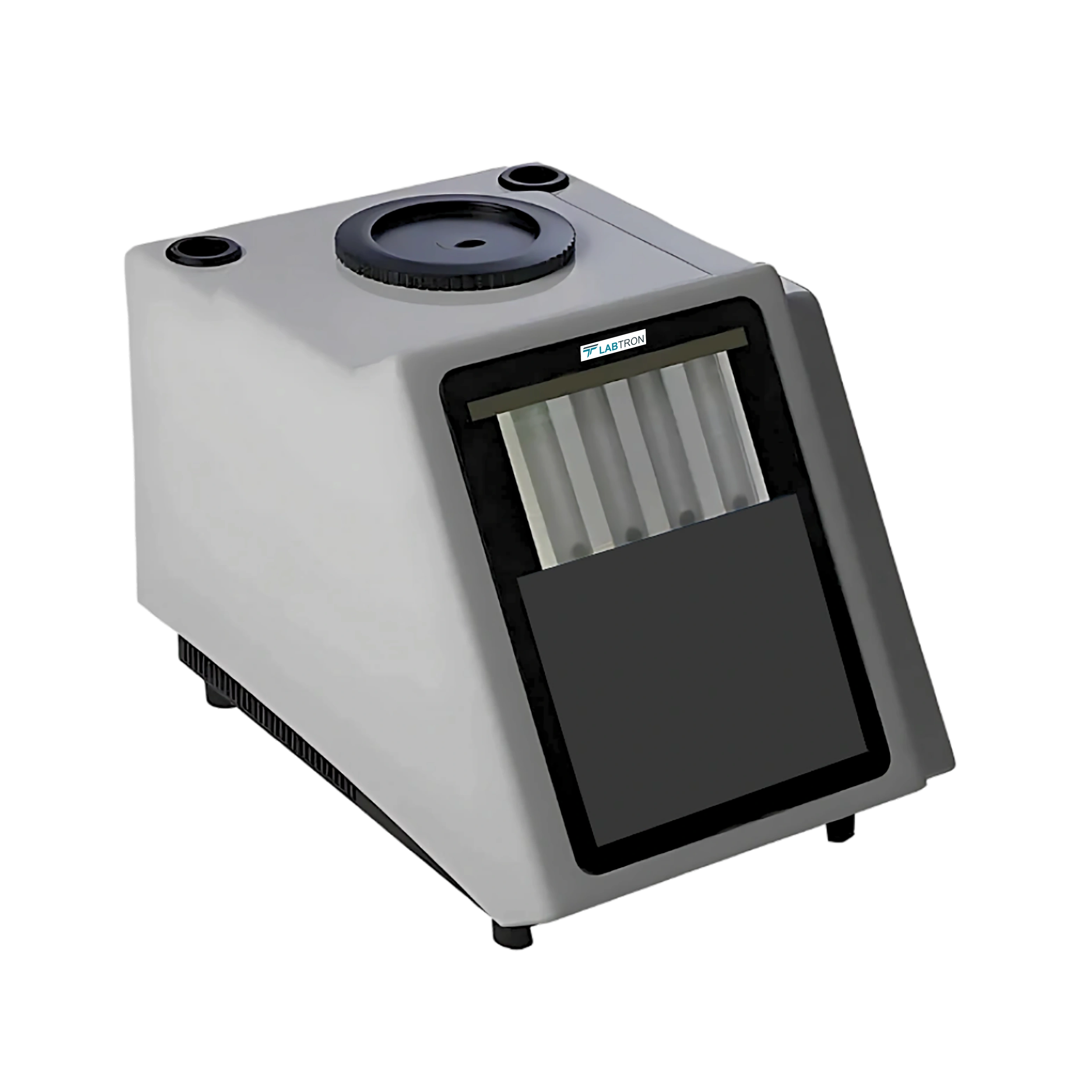


Labtron supplies premium melting point apparatus LDMP-A34.Incorporating optical systems such as cameras or sensors-enables automatic detection of the melting endpoint, replacing subjective visual assessments. These systems continuously monitor light transmission to determine when melting begins and finishes, facilitating multi-sample runs with consistent conditions. Automated capture of video, temperature curves, and timestamps ensures comprehensive documentation. This digital traceability supports audit requirements and quality assurance standards. Ultimately, automation improves measurement precision, throughput, and reduces operator variability.
Labtron supplies advanced models of melting point apparatus LDMP-A34. Heating a sample at a slow, controlled rate ensures thermal equilibrium within the sample and heating block, preventing misleading temperature readings due to thermal lag. This deliberate pace allows impurities to distribute evenly and dissolve prior to melting, producing a sharper, more precise result. If heated too quickly, parts of the sample may melt before the thermometer’s temperature catches up, resulting in an elevated apparent melting point. Controlled heating also reduces overshooting, ensuring the observed melting-onset and clear-end temperatures accurately reflect the substance’s true melting behaviour. By maintaining a steady, gradual temperature rise during the phase transition, reproducibility and correlation with literature data are greatly improved. Ultimately, slow heating is essential for differentiating material purity and consistency in analytical comparisons.
No, Labtron’s melting-point apparatuses LDMP-A34 are designed explicitly for measuring the solid-to-liquid transition in crystalline solids and are not equipped to assess boiling behaviour. Boiling points require vapor-phase analysis under controlled pressure, typically performed using distillation or specialized boiling-point equipment. The temperature control and optical detection mechanisms of melting-point devices do not accommodate vaporization processes. Therefore, attempting to measure a boiling point with a melting-point apparatus would result in inaccurate data and possible equipment misuse. Laboratories requiring both melting and boiling point data usually maintain separate instruments optimized for each function. Proper instrumentation ensures correct application and reliable analytical results.
Labtron’s Melting point apparatus LDMP-A34 are specifically engineered for observing solid-to-liquid transitions, not boiling or vaporization of liquids. Boiling-point determination requires controlled-pressure setups like distillation apparatus or dedicated boiling-point equipment. Melting-point devices lack the necessary pressure control and vapor-phase containment for accurate boiling measurements. Some models offer a “boiling mode” with separate inserts, but these are optimized for low-pressure vaporization, not full boiling-point accuracy. Misusing the apparatus for boiling can damage its optical systems and produce misleading data. For labs needing both measurements, it's best to maintain separate, purpose-designed instruments. Ensuring correct equipment use enhances data reliability and instrument longevity.
Labtron’s melting point apparatus LDMP-A34 have proper operation starts with clean, dry capillaries, the outer surfaces must be wiped to avoid contamination. Tubes should be gently tapped to pack the sample evenly, avoiding overfilling which can lead to inaccurate melting ranges. The heating unit must run in a ventilated, dust-free space to prevent overheating or fluid degradation. Users should wait for the block to reach stable baseline temperature before insertion and cool down between runs to maintain calibration. Avoid forcing capillaries in or out to prevent breakage and injury. Regular checks are essential to ensure secure electrical connections and proper light alignment. Following these precautions promotes accuracy and enhances operator safety.
Post your question?
Our experts are here to help!
Labtron Equipment Ltd., Quatro House, Lyon Way, Camberley, Surrey GU16 7ER United Kingdom
Email: info@labtron.com Whatsapp: +44 73 4441 2688 Phone: +44 2080 043608
