 info@labtron.com

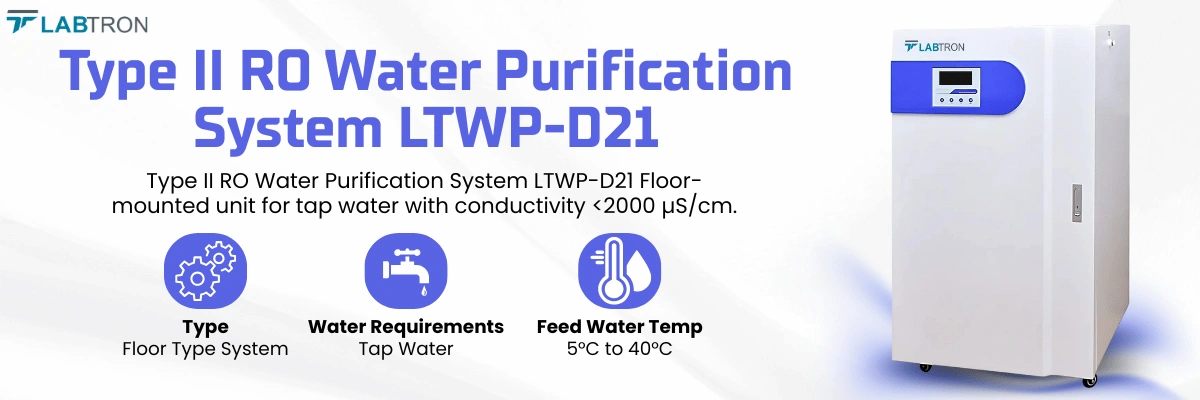
| Type | Floor Type System |
| Water Requirements | Tap Water |
| Feed Water Conductivity | < 2000 µS/cm |
| Feed Water Hardness | < 450 ppm as CaCO3 |
| Feed Water Temperature | 5°C to 40°C |
| Water Inlet Pressure | 0.1 to 4 MPa |
| Ion Rejection Rate | > 95% |
| Bacterial Rejection | > 99% |
| Water Conductivity | < 1 to 20 µS/cm |
| Productivity Rate | 200 L/h |
| Power Supply | 110 V to 220 V / 50 HZ to 60 HZ ± 10% |
| Dimensions (Main Unit) | 650 × 660 × 1260 mm |
| Net Weight (Main Unit) | 76 Kg |
Leak Detection and Alert System
Energy-Efficient Pump Mechanism
User-Friendly Control Panel
Automatic System Flushing
Built-In Pretreatment Filters
Our Type II RO system is well-suited for microbiology and life sciences, aiding in media preparation, sample handling, buffer solution formulation, other routine laboratory processes that require reliable, high-purity water.
Pretreatment cartridge
High pressure pump
Reverse osmosis module
254 nm UV lamp
Microfilter (0.2 µm)
350L PE cone low with liquid, water pump, base
Air vent for water tank
Water leakage detector
Pretreatment module
Purification cartridge dual column
Ultra-purification cartridge dual column
Ultra-purification cartridge single column
Point-of-use filter (General)
Point-of-use filter
Point-of-use bio filter
30L multifunctional water tank with integrated UV lamp & air vent
60L multifunctional water tank integrated UV lamp & air vent
Strengthened pretreatment module
Strengthened pretreatment cartridge column PP cotton
Strengthened pretreatment cartridge column active carbon
Air vent for water tank
Micro filter (General)
Micro filter (0.2 µm)
1/2" Pre-filter
400 GPD RO
24V UV sterilization lamp for water tank
254/185nm dual wavelength UV lamp
100G Reverse osmosis module
200G Reverse osmosis module

Labtron Type II RO Water Purification System offers a reliable output of pure water, rangingfrom ≥ 10 to ≥ 50 L/hr. Utilizing cutting-edge single and double pass RO processes, thesedeliver ultrapure water at rates of ≥1-1.5 L/min. They feature tank capacities of 30 or 80 L toeffectively accommodate your operational requirements. With TOC under 20 ppb and heavymetals below 0.01 ppm, they ensure exceptional purity. Our Water Purification System areavailable in both benchtop and floor-standing configurations for optimal performance.


The Type II RO Water Purification System LTWP-D21 is specifically engineered to work with tap water that meets certain quality parameters, particularly with conductivity under 2000 µS/cm and moderate hardness. This ensures optimal protection and performance of the reverse osmosis membrane. Using poor-quality feed water with high levels of suspended solids, chlorine, or hardness can reduce the lifespan of the internal components. The system includes a built-in pretreatment stage to handle common impurities but relies on reasonably clean tap water as input. For areas with very hard or contaminated water, an external pre-filtration setup may be recommended. Ensuring appropriate feed water quality also helps maintain the purity of the output water over time. Regular monitoring of feed water conditions is important for consistent system efficiency.
Yes, the Type II RO Water Purification System LTWP-D21 is designed to be flexible and compatible with various laboratory setups, including external storage tanks and water distribution systems. It can easily be connected to auxiliary tanks with level sensors to manage water output without manual intervention. This is especially useful in labs that require a steady supply of Type II water across multiple workstations. The system supports automatic filling and shuts-off functions when integrated with compatible storage units. Additionally, its compact floor-mounted design makes it convenient to place beside or beneath shelving systems or storage setups. When used with a recirculation loop or pressure pump, it can also deliver water to distant points of use. This adaptability makes it suitable for both centralized and decentralized lab water supply needs.
Maintaining the Type II RO Water Purification System LTWP-D21 involves a few regular tasks to ensure long-term, efficient performance. The most crucial include periodic replacement of consumables such as pretreatment filters, RO membranes, and other cartridges based on usage and water quality. Users should also inspect the system for any signs of leakage or unusual pressure changes, which may indicate filter clogging or pump issues. The control panel usually provides visual cues or alerts for maintenance needs. Regular system flushing—either automatic or manual—helps prevent membrane fouling and extends service life. Cleaning or sanitizing the internal lines periodically is also advisable, especially in high-demand environments. Overall, the system is designed for low maintenance, but routine checks can significantly enhance its longevity and performance consistency.
The Type II RO Water Purification System LTWP-D21 employs a multi-stage purification process, starting with pretreatment filters that remove particulates and chlorine, followed by advanced RO membranes that eliminate dissolved solids and organic matter. It continuously monitors output conductivity to verify that the water meets Type II standards. Any deviation in performance is flagged by the system’s built-in sensors, ensuring that maintenance can be performed promptly. Additionally, the system can be programmed to perform automatic flushing, which helps maintain membrane cleanliness and reduce microbial growth. Its sealed internal design minimizes contamination risks during operation. Consistent calibration and real-time monitoring contribute to maintaining high-quality water output over extended periods.
Yes, the Type II RO Water Purification System LTWP-D21 is built to handle moderate fluctuations in inlet water pressure, making it suitable for laboratories in regions with less stable plumbing systems. It includes internal pressure-regulating components that help maintain consistent flow through the RO membrane. However, it is recommended to stay within the specified pressure range to avoid performance drops or damage to sensitive components. In cases of extreme pressure variability, installing an external pressure stabilizer or booster pump can enhance reliability. The system's alert mechanism also notifies users of abnormal inlet pressure, ensuring prompt action. This pressure-tolerant design helps maintain steady water output even in less predictable water supply conditions.
Post your question?
Our experts are here to help!
Labtron Equipment Ltd., Quatro House, Lyon Way, Camberley, Surrey GU16 7ER United Kingdom
Email: info@labtron.com Whatsapp: +44 73 4441 2688 Phone: +44 2080 043608