 info@labtron.com

| Graduated flasks | 100 ml |
| Scale division of graduated flask | 1ml |
| Distillation flask | 125 ml |
| Ambient temperature | ≤ 35 °C |
| Relative humidity | ≤ 85 % |
| Temperature controlling accuracy | ± 0.5 °C |
| Temperature range air bath | Room temperature+ 10 °C to 60 °C |
| Thermometer | (-2 )°C to 300 ℃ and (-2) °C to 400 ℃ |
| Inner diameter of electric furnace | φ32 mm, φ38 mm |
| Outer diameter of electric furnace | φ50 mm |
| Dimension | 830 x 610 x 870 mm |
| Heating power system | 1000 W × 2 |
| Total power consumption | ≤ 2500 W |
| Power supply | AC 220 V ± 10 %, 50 Hz |
It is used determine distillation characteristics of natural gasoline, vehicle gasoline, aviation gasoline, jet fuels, special boiling point solvent, distillate and similar petroleum products.
Download catalog for
Distillation Tester Dual Units LDT-A15 Catalog
Download manual for
Distillation Tester Dual Units LDT-A15 Manual
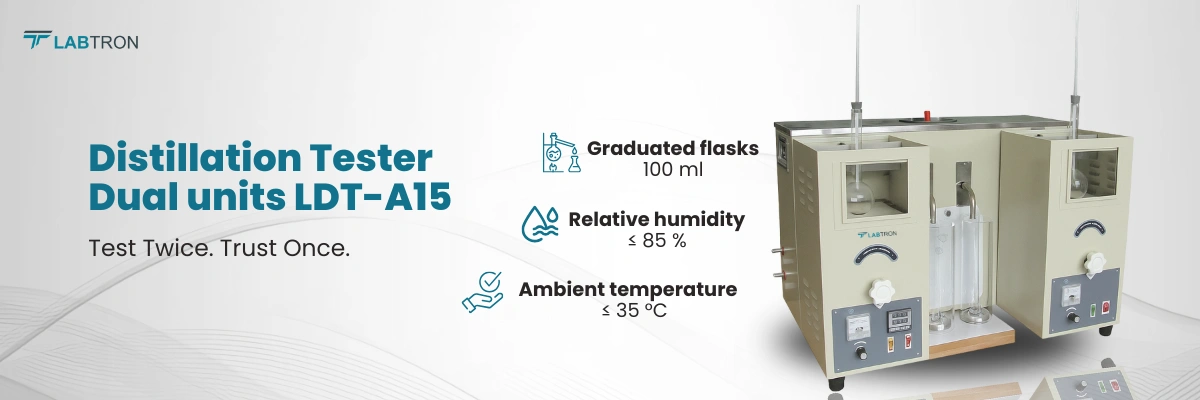
Labtron Distillation Tester determine boiling point characteristics for analyzing purity and composition of substance. Their high-quality glass components ensure visibility while withstanding rigors of use. They utilize energy-efficient heating elements to minimize power consumption during lengthy processing. Their innovative design minimizes cross-contamination risks between different fractions, ensuring purity. Our Distillation Tester is suitable for oil and gas industry to assess crude oil fractions and in pharmaceuticals to check solvent purity.


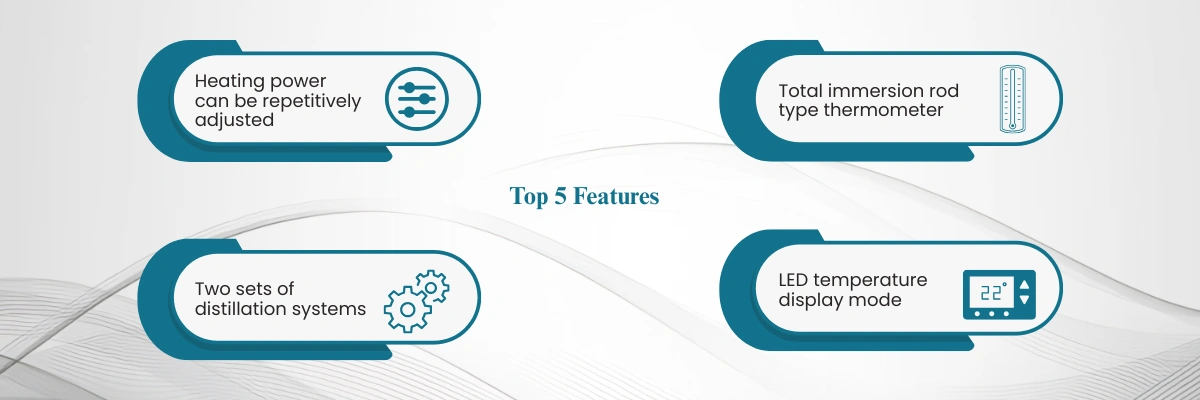
The Distillation Tester Dual Units LDT-A15 includes two fully independent distillation setups in one chassis, which significantly enhances throughput without requiring twice the lab space. This configuration is especially advantageous in QA/QC environments or petrochemical labs where parallel analysis is routine. Both units can operate simultaneously, with independent controls and displays, allowing users to test different products or replicate tests for comparative accuracy. This built-in scalability enables labs to save time and reduce turnaround without needing multiple standalone units.
The Distillation Tester Dual Units LDT-A15 is not a fully automated unit with digital data logging, it can support manual or semi-digital batch documentation practices. Distillation curves (temperature vs. volume) can be plotted using readings at specified intervals, which are then archived as part of batch records. Some labs integrate the unit with external data loggers or thermocouple interfaces to digitally capture results. These outputs support process control documentation, fuel grade validation, and batch release QA workflows. With proper protocol, the LDT-A15 can serve as a reliable, traceable testing node within a broader quality system.
Our Distillation Tester Dual Units LDT-A15’s integrated air bath surrounds the distillation flask to provide uniform, low-level thermal insulation that helps stabilize the surrounding environment. This reduces heat loss and protects the sample from abrupt environmental changes, ensuring a steady distillation rate. It also minimizes local condensation or draft effects that can interfere with vapor behavior. As a result, the air bath contributes to more consistent boiling curves and tighter repeatability, especially in labs with variable airflow or minor ambient fluctuations.
The Distillation Tester Dual Units LDT-A15 is not equipped with fully automated alarms like some high-end models, it is designed with protective features such as thermal insulation, fuse-protected heating circuits, and manual power controls. If abnormal behavior (e.g., no heating, temperature spike, or unstable LED display) is detected, the operator can immediately power down the unit. A thermal cut-off may be triggered in case of severe overheating. Operators are encouraged to monitor closely, and we can provide optional enhancements like external over-temp alarms.
Labtron’s Distillation Tester Dual Units LDT-A15 features thermometer clamps and flask supports that align with ASTM D86 specifications, minimizing the risk of thermal shock or mechanical damage during setup. All glass components are held in reinforced fixtures or lined cavities that absorb minor vibration or shock. During operation, heat is distributed evenly to prevent thermal stress that could crack glass. Additionally, the outer frame shields these components from accidental bumps, making the system safer and more durable in multi-user labs.
Post your question?
Our experts are here to help!
Labtron Equipment Ltd., Quatro House, Lyon Way, Camberley, Surrey GU16 7ER United Kingdom
Email: info@labtron.com Whatsapp: +44 73 4441 2688 Phone: +44 2080 043608