 info@labtron.com

| Ambient temperature | -10°C to 35°C |
| Relative humidity | ≤ 85 % |
| Thermometer | Each one for 70°C to 90°C , 100°C to120°C , and 125°C to 150°C |
| Scale division | 0.1 ℃ |
| Total length | 8000 mm |
| Water cooling tube | 4500 mm |
| Heating power system | 1000 W |
| Total power consumption | ≤ 1100 W |
| Power supply | AC 220 V ± 10 %, 50 Hz |
It is used for determining the boiling points of gasoline, aviation gasoline, jet fuel vapor, distillate fuel, and diesel oil.
Download catalog for
Benzene Distillation Tester (Low Temperature) LDT-A11 Catalog
Available Range :
Distillation Tester LDT-A10 : (-10) °C ~ 35 °C Benzene Distillation Tester (Low Temperature) LDT-A11 : -10°C to 35°C Vacuum Distillation Tester LDT-A13 : 5 °C to 35 ℃ Distillation Tester Front Type LDT-A14 : Room temperature to 35°C Distillation Tester LDT-A17 : ≤ 30 °C Distillation Tester Dual Units LDT-A15 : ≤ 35 °C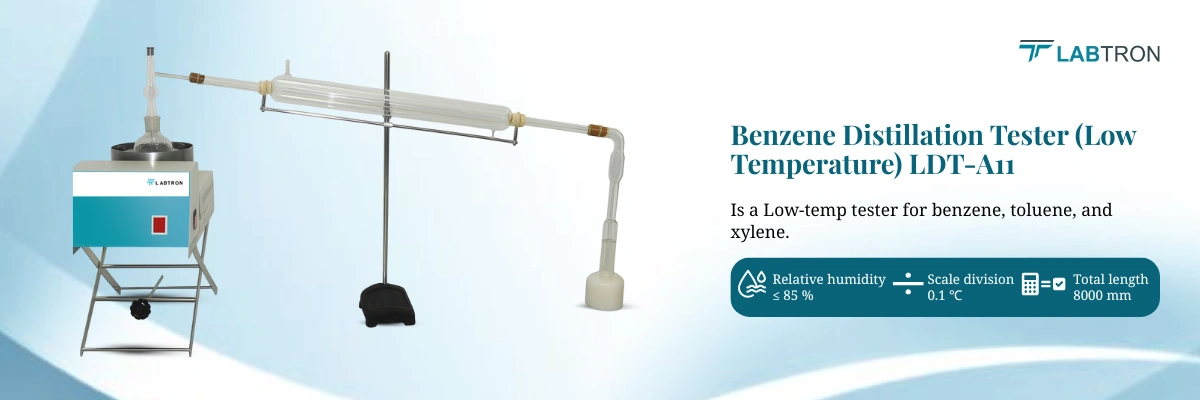
Labtron Distillation Tester determine boiling point characteristics for analyzing purity and composition of substance. Their high-quality glass components ensure visibility while withstanding rigors of use. They utilize energy-efficient heating elements to minimize power consumption during lengthy processing. Their innovative design minimizes cross-contamination risks between different fractions, ensuring purity. Our Distillation Tester is suitable for oil and gas industry to assess crude oil fractions and in pharmaceuticals to check solvent purity.


The Benzene Distillation Tester (Low Temperature) LDT-A11 features an extended water-cooled condenser, approximately 4.5 meters in length, designed to rapidly condense vapors back into liquid without significant temperature rebound. This length ensures complete vapor capture even when dealing with highly volatile compounds like benzene. Our condenser system helps avoid vapor loss, prevents pressure buildup, and supports smooth liquid collection, contributing directly to consistent volume measurements. Proper water flow through the condenser must be maintained throughout the test for optimal performance.
The Benzene Distillation Tester (Low Temperature) LDT-A11 captures the exact temperature points at which vaporization begins and ends, helping define the distillation range of a given sample. Pure aromatic compounds like benzene typically exhibit a sharp, narrow boiling range, while blended or adulterated samples show broader or irregular patterns. Even small additions of other hydrocarbons shift the temperature profile, which becomes immediately visible during testing. Our system makes it easy to verify substance identity and detect both intentional and accidental blending in commercial products.
Our Benzene Distillation Tester (Low Temperature) LDT-A11 is effective for identifying chemical degradation, as aged aromatic samples often undergo oxidation, polymerization, or contamination altering their boiling point behavior. By comparing fresh and stored samples, users can detect broadened curves, increased final boiling points, or unexpected plateaus. Our unit proves valuable in shelf-life studies, storage validation, and quality monitoring across supply chains. Early detection of such shifts helps prevent downstream quality issues or unsafe usage.
The Benzene Distillation Tester (Low Temperature) LDT-A11 enables detection of contamination through abnormal distillation curves such as widened boiling ranges, temperature spikes, or early vaporization. This equipment allows users to observe and compare these anomalies against standard benchmarks. For example, residual solvents or unauthorized blending agents may disrupt the expected boiling profile. By analyzing the full distillation curve, users can infer the presence and likely nature of the contaminant, whether it’s a lighter compound like hexane or a heavier residue.
Labtron's Benzene Distillation Tester (Low Temperature) LDT-A11 should be inspected regularly to ensure that all glassware components are in optimal condition, particularly for microfractures, discoloration, or etching caused by repeated use or exposure to cleaning agents. If the condenser shows signs of scale buildup, internal cloudiness, or reduced cooling efficiency, it should be replaced promptly to preserve testing accuracy. The distillation flask must also remain free of stubborn residues or surface roughness that could interfere with uniform heating. Using worn or compromised glassware with the LDT-A11 can lead to inconsistent results, contamination, or even breakage during operation, posing risks to both data quality and safety.
Post your question?
Our experts are here to help!
Labtron Equipment Ltd., Quatro House, Lyon Way, Camberley, Surrey GU16 7ER United Kingdom
Email: info@labtron.com Whatsapp: +44 73 4441 2688 Phone: +44 2080 043608