info@labtron.com

| Testing Elements | K, Na, Li |
| Data Range | 0.000 to 999.9 |
| Channel Quantity | 3 |
| Range | K: 40 to 100 ppm Na: 0 to 160 ppm Li: 0 to 100 ppm |
| LOD | K: 0.01ppm Na: 0.01ppm Li: 0.1 ppm |
| Linear error | K: 0.195 Na: 0.69 Li: 0.15 |
| Response Time | < 8 s |
| Sample Uptake | < 6 ml / min |
| Stability | <3% drift over 15s when continuously aspirating |
| Reproducibility | <3% coefficient of variation for 7 consecutive samples |
| Curve Graph | Display |
| Printer | Optional build-in thermal printer |
| COM | USB |
| Fuel | LPG |
| Power Supply | AC 220 V±22 V 50 Hz ±1Hz |
| Power Consumption | 250 W |
| Packaging Size | 570 mm × 530 mm × 400 mm |
| Weight | 18 kg |
Real Time Value Display
7- Inch Color Touch- Screen
Calibration Curve Functionality
Automatic Correlation Calculation
LPG Based Operations
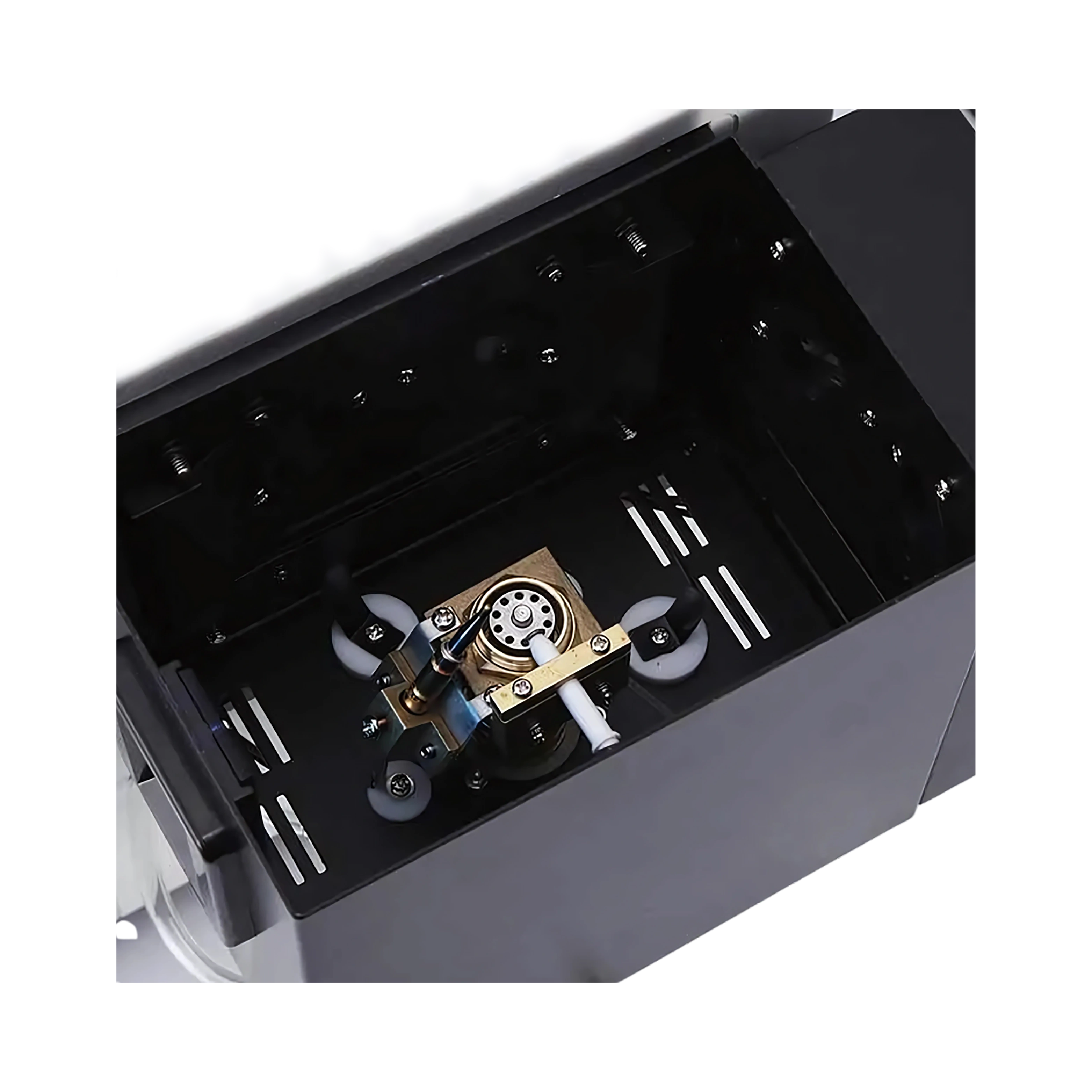
Flame Photometer LFP-B21 excites alkali and alkaline‑earth metal ions in a flame and quantifies their presence by measuring emitted light intensity. It is widely used in industrial / material processing, geological research and clinical chemistry.
Download catalog for
Flame Photometer LFP-B21 Catalog
Labtron Flame Photometers serve to measure the amount of metal ions in test materials, including K, Na, Li, Ca, and Ba. This has USB ports for data transfer in addition to a color touchscreen display. They have air compressors to maintain steady flame conditions and flameout prevention systems. These provide the option to choose various concentration units and enable the pre-selection of frame sizes. We provide photometers that compute test sample correlation automatically. Our flame photometers are perfect for accurate and dependable metal ion analysis because of their sophisticated features and user-friendly design.


Labtron supplies premium flame photometer FLP-B21.Despite its benefits, flame photometry has certain limitations. It is primarily restricted to the analysis of alkali and alkaline earth metals, limiting its applicability to other elements. The technique can be susceptible to interferences from other ions or substances present in the sample, potentially affecting accuracy. Sample preparation can be time-consuming, especially when dealing with complex matrices. Additionally, the method does not provide information about the molecular structure of compounds, focusing solely on elemental concentrations.
Labtron supplies advanced flame photometer LFP-B21.While both flame photometry and atomic absorption spectroscopy (AAS) are used for elemental analysis, they operate on different principles. Flame photometry measures the light emitted by excited atoms in a flame, whereas AAS measures the absorption of light by ground-state atoms. AAS generally offers higher sensitivity and can detect a broader range of elements, including transition metals. However, flame photometry is simpler, faster, and more cost-effective, making it suitable for routine analysis of specific metals like sodium and potassium.
Labtron supplies premium models like flame photometer LFP-B21. Several factors can influence the accuracy of flame photometric readings. Flame stability is crucial; fluctuations in flame temperature or composition can lead to inconsistent excitation of atoms. The presence of interfering substances in the sample can cause spectral interferences or ionization effects, skewing results. Proper calibration is essential; using outdated or improperly prepared standards can lead to errors. Additionally, instrument maintenance, such as cleaning burners and ensuring consistent gas flow rates, is vital for reliable measurements.
Labtron’s flame photometer LFP-B21 comprises several essential components. The nebulizer converts the liquid sample into a fine aerosol, which is then introduced into the flame. The burner provides a stable flame for atomizing the sample. Optical filters or monochromators isolate specific wavelengths of emitted light corresponding to different elements. Photodetectors measure the intensity of this light, and the signal is processed and displayed by the readout system. Each component plays a critical role in ensuring accurate and reliable measurements.
Labtron supplies advanced models of flame photometer LFP-B21. Regular maintenance of a flame photometer is essential for consistent and accurate results. This includes routine cleaning of the burner and nebulizer to prevent blockages and residue buildup. Gas supplies should be checked for purity and consistent flow rates. Calibration should be performed regularly using fresh standard solutions to account for any instrumental drift. Periodic checks of the optical components, such as filters and detectors, ensure they are functioning correctly. Adhering to the manufacturer's maintenance guidelines helps prolong the instrument's lifespan and reliability.
Post your question?
Our experts are here to help!
Labtron Equipment Ltd., Quatro House, Lyon Way, Camberley, Surrey GU16 7ER United Kingdom
Email: info@labtron.com Whatsapp: +44 73 4441 2688 Phone: +44 2080 043608