info@labtron.com

| Temperature Range | –30 to 5°C |
| Temperature Control Accuracy | ±2°C |
| Ambient Temperature | 5 to 35°C |
| Cooling Method | Air cooling |
| Cooling Capacity at 0°C | 1750 W |
| Cooling Capacity at –10°C | 1100 W |
| Cooling Capacity at –20°C | 700 W |
| Cooling Capacity at –25°C | 300 W |
| Rated Pump Flow Rate | 20 L/min |
| Rated Pump Power | 0.4 bar |
| Outer Circulation Interface Size | Rc 1/2 |
| Reservoir Capacity | 17 L |
| Protection Grade | IP20 |
| Power Supply | 220 to 240 V, 50 Hz |
| Power Consumption | 1480 W |
| Dimensions (W×D×H) | 465 × 690 × 820 mm |
| Net Weight | 80 kg |
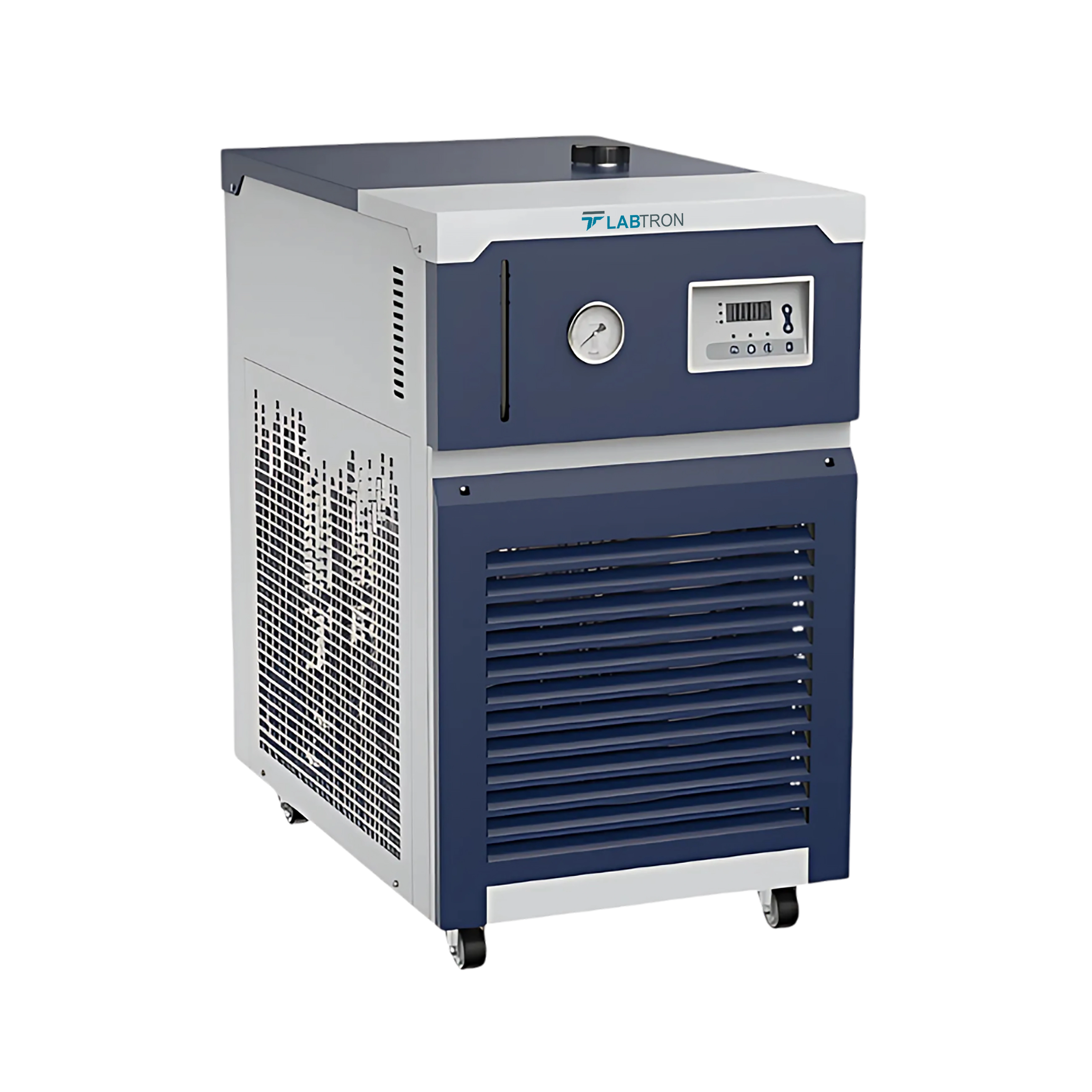
Angled user interface design
Scratch-resistant exterior coating
Airflow-optimized vent slots
Quick-latch reservoir cover
Integrated cable positioning groove
Recirculating Chillers LRC-L13 functions as a dedicated cooling source for external laboratory and process equipment. This ensures temperature stability during operations involving rotary evaporation, bioreactor control, and material testing systems.
Download catalog for
Recirculating Chillers LRC-L13 Catalog
Available Range :
Recirculating Chiller LRC-F10 : -100°C to 90°C Recirculating Chiller LRC-A12 : -20 ℃ to RT Recirculating Chiller LRC-L10 : -20°C to RT Recirculating Chiller LRC-A11 : -20℃ to RT Recirculating Chiller LRC-C10 : -25°C to 90°C Recirculating Chiller LRC-D10 : -45°C to 90°C Recirculating Chiller LRC-E10 : -80°C to 90°C Recirculating Chiller LRC-B10 : 5°C to 90°C Recirculating Chiller LRC-A10 : 5˚C to 40˚C Recirculating Chillers LRC-L11 : –20 to 25°C Recirculating Chillers LRC-L12 : –30 to 5°CLabtron Recirculating Chiller provide cooling of fluids from -5℃ to 40℃ by circulating them through system to remove heat. They include evaporators to absorb thermal energy from liquid ensuring temperature control. Their expansion valves control flow of refrigerant and regulate freezing capacity of system. They feature filtration system to remove particulates and impurities from solution. Our Recirculating Chiller is applicable for automotive testing, electronics, medical and pharmaceutical equipment.


Our Recirculating Chillers LRC-L16 is engineered to remain consistent under varying ambient temperatures, ensuring thermal stability despite surrounding fluctuations. This is valuable in labs lacking strict climate control where room temperature may rise during equipment use. Its internal regulation helps manage internal load without interruption. Researchers working across multiple shifts experience reliable cooling without degradation in output. Temperature drifts in the room don’t result in performance compromise. Instruments relying on fixed thermal supply stay unaffected by workspace changes. Its build reduces overheating risk in shared or high-traffic setups. Continuous functioning is ensured without environmental dependency.
The Recirculating Chillers LRC-L13 is constructed to support placement in confined lab spaces where airflow clearance is often limited. Its vent layout directs heat away from critical zones, helping prevent thermal buildup when situated under or beside benchtop surfaces. The unit maintains cooling performance without requiring overhead clearance or external ducting. This form factor suits shared lab environments where equipment footprint is tightly managed. Side and rear ventilation maintain system stability during prolonged use. Its design discourages airflow blockage from nearby objects or equipment. This flexibility makes it ideal for modular lab layouts. The housing also supports easy repositioning during setup changes.
Our Recirculating Chillers LRC-L13 is designed with a combination of thermal, current, and delay-based safeguards that actively protect internal systems during prolonged operation. The built-in overload response helps prevent overheating and damage to electrical components. A timed compressor start delay prevents system strain from rapid cycling. The chiller monitors pressure changes to reduce risk of internal fluid imbalance. In the event of system blockage or flow interruptions, protective logic slows down the system safely. These embedded protections allow the unit to handle high-duty workloads without frequent resets. This enables dependable use across longer laboratory cycles. Overall reliability is enhanced through layered operational control.
Labtron’s Recirculating Chillers LRC-L13 is engineered to limit electromagnetic noise and vibration, making it suitable for operation beside sensitive analytical systems. It maintains a low-interference profile, which is important in labs using instruments like mass spectrometers, ICP units, and chromatographs. Its electrical layout includes isolation of high-load components to reduce feedback and noise. The unit’s base dampens physical vibration to avoid affecting equipment placed nearby. This is especially helpful in high-precision analytical workflows that demand a quiet environment. Power management is structured to avoid surges or fluctuations. Researchers can position it confidently near test benches. No separate shielding is required during integration.
Our Recirculating Chillers LRC-L13 supports both rapid cooling tasks and extended operational sessions without performance drop-off. The system’s thermal stability remains consistent whether used briefly for quick tests or during prolonged experiments. Its insulated design minimizes recovery delays between uses. This allows researchers to alternate between short-term and high demand cooling without manual reconfiguration. It suits workflows that fluctuate in duration or cooling intensity. The internal logic adjusts to shifting thermal loads smoothly. This flexibility eliminates the need for multiple chillers across different timelines. It simplifies lab operation planning across various application scales.
The Recirculating Chillers LRC-L13 is compatible with widely used laboratory cooling fluids that are chemically stable and non-corrosive. It supports both glycol-based and alcohol-based formulations intended for closed-loop systems. The tubing and internal circulation materials resist degradation and clogging when proper fluids are used. This preserves long-term reliability across multiple operating cycles. Fluid selection can be adjusted based on the application’s temperature and chemical profile. The system performs best with clean, filtered liquids free from particles or reactive substances. It supports various coolant types used in academic, pharmaceutical, and industrial research settings. Fluid recommendations can be adapted to lab-specific protocols.
The Recirculating Chillers LRC-L13 uses a closed-loop circulation system that minimizes fluid loss through evaporation or contamination. During extended use, the sealed structure helps retain coolant volume and reduces exposure to ambient air. This limits the need for frequent top-ups, especially in humidity-sensitive environments. The system supports uninterrupted workflows for longer cooling durations. Its design also prevents external debris from entering the circulation path. This protects internal components and preserves fluid composition over time. Laboratories benefit from reduced maintenance interruptions. It contributes to smooth operation during demanding cooling applications.
Post your question?
Our experts are here to help!
Labtron Equipment Ltd., Quatro House, Lyon Way, Camberley, Surrey GU16 7ER United Kingdom
Email: info@labtron.com Whatsapp: +44 73 4441 2688 Phone: +44 2080 043608