info@labtron.com

| Glass Plate Dimensions | 216 × 220 mm |
| Gel Dimensions | 186 × 205 mm |
| Gel Thickness | 1.0 mm |
| Number of Gels | 1 to 2 pcs |
| Maximum Buffer Volume | 3500 ml |
| Sample Throughput | 25 to 104 |
| Dimension (L × W × H) | 290 × 170 × 250 mm |
| Weight | 6.2 kg |
Fast Gel Plate Installation
Secure Lid Button Design
Consistent Cooling and pH
High-Resolution Gel Separation
Multi-Gel Preparation Capability
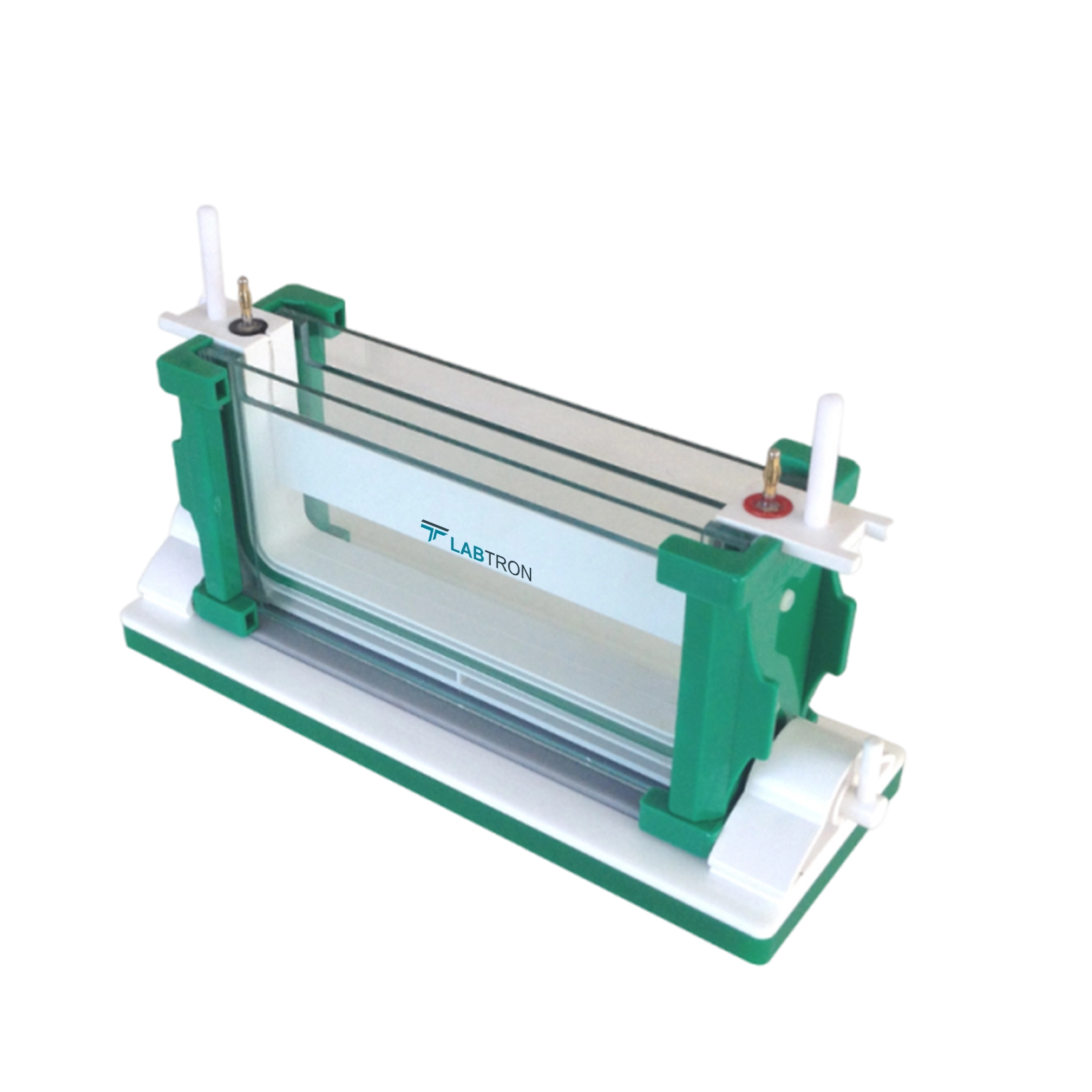
Vertical Electrophoresis System LVES-B11 is used to separate proteins or nucleic acids based on their size and charge through a vertical gel matrix. It is used in molecular biology, and clinical research for protein analysis, DNA/RNA separation, and genetic studies.
Download catalog for
Vertical Electrophoresis System LVES-B11 Catalog
Labtron Vertical Electrophoresis System integrates advanced cooling system for optimal separation of large number of samples. Their buffer tanks maintain pH and conductivity essential for efficient procedure. They feature combs that create wells for sample loading in gel matrix. Their temperature control mechanisms prevent overheating during prolonged runs. Our Vertical Electrophoresis System is preferred for protein separation, western blotting and genetic fingerprinting.


.webp "Vertical Electrophoresis System LVES-A10")


Yes, Labtron’s Vertical Electrophoresis System supports the use of gradient gels, which provide superior resolution for complex protein mixtures by offering a gradual change in polyacrylamide concentration. Gradient gels allow for the separation of proteins over a wide molecular weight range, enhancing the resolution of closely migrating bands. Labtron offers high-quality gel casting accessories that enable users to create custom gradient gels with precision and consistency.
Labtron’s Real-Time PCR System is compatible with a wide range of fluorescent dyes and probes commonly used in qPCR applications. These include SYBR Green, TaqMan probes, EvaGreen, and other intercalating dyes or hydrolysis probes. Labtron’s system is equipped with advanced optical detection technology that ensures high sensitivity and accuracy across multiple fluorescence channels. The system supports multiplexing capabilities, allowing researchers to detect and quantify multiple targets simultaneously within the same reaction, thereby increasing experimental efficiency.
Yes, Labtron’s Real-Time PCR System is specifically designed to handle multiplex PCR reactions, enabling the simultaneous detection of multiple target sequences in a single reaction. The system’s high-resolution optical detection allows for discrimination between different fluorophores, ensuring accurate quantification even in complex samples. Labtron’s software also provides tools for optimizing primer-probe designs and analyzing multiplex reactions, making it easier for researchers to perform high-throughput assays efficiently.
Labtron’s Real-Time PCR System is designed with advanced contamination control mechanisms to minimize the risk of cross-contamination. The system’s enclosed design, combined with a sealed reaction environment, prevents aerosol or sample carryover between runs. Additionally, Labtron recommends using UNG (Uracil-N-Glycosylase) to degrade any previously amplified DNA that may contaminate the reaction mix, further reducing the possibility of false positives.
When designing primers and probes for Labtron’s Real-Time PCR System, it is essential to consider melting temperature (Tm), GC content, amplicon length, and specificity to ensure efficient and accurate amplification. Primers should have a Tm between 55°C and 65°C, with a GC content of 40-60%, while amplicon lengths should ideally range between 80-200 bp for optimal performance. Labtron provides detailed guidelines and software tools to assist in designing high-quality primers and probes, ensuring minimal non-specific amplification and maximum efficiency.
Labtron’s Real-Time PCR System uses advanced Peltier heating and cooling technology to ensure precise and uniform temperature distribution across all wells during qPCR runs. The system’s thermal block design minimizes temperature variation, ensuring consistent amplification and reliable quantification of target sequences. Labtron’s real-time temperature monitoring further guarantees that the system maintains optimal conditions throughout the entire reaction, reducing variability between runs.
Yes, Labtron’s Real-Time PCR System supports gradient PCR functionality, allowing users to optimize reaction conditions by testing different annealing temperatures simultaneously. Gradient PCR is particularly useful for primer optimization and troubleshooting of non-specific amplification. Labtron’s intuitive software provides easy-to-use controls for setting gradient ranges and analyzing results, enabling researchers to fine-tune their protocols for maximum efficiency.
Post your question?
Our experts are here to help!
Labtron Equipment Ltd., Quatro House, Lyon Way, Camberley, Surrey GU16 7ER United Kingdom
Email: info@labtron.com Whatsapp: +44 73 4441 2688 Phone: +44 2080 043608