 info@labtron.com

| Capacity (MAX) | 5KN (10N, 20N, 50N, 100N, 200N, 500N, 1KN, 2KN, 5KN sensors available) |
| Control Method | Full computer control mode, powerful software |
| Unit of Force | N, kN, gf, kgf, lbf, kP, tf(SI), tf (long)... |
| Unit of Length | mm, cm, Inch, m, km, um.. |
| Force Resolution | 1/1,000,000 |
| Sensor Accuracy | 3/1000,000 |
| Machine Accuracy | Level 5 |
| Stroke Resolution | 1/1,000,000 mm |
| Effective Stroke | 700 mm |
| Speed Range | 0.01~500 mm/min; (Customizable) |
| Test Space Diameter | Φ140 mm |
| Shutdown Mode | Overload stop, emergency stop key, automatic stop for test piece destruction, automatic stop for upper and lower limit setting |
| Machine Power | Servo motor drive |
| Dimensions | 85× 60 × 135 cm |
| Machine Net Weight | 50 KG |
| Power | 400W |
| Power Supply | 220V 50 ~ 60HZ |
| Machine Accessories | 1 USB communication cable, 1 software |
| Optional Accessories | Tensile jig, compression jig, etc.; (according to different test standards to buy different jigs) |
Heavy base
Adjustable modes
Wide range functional modes
User-friendly
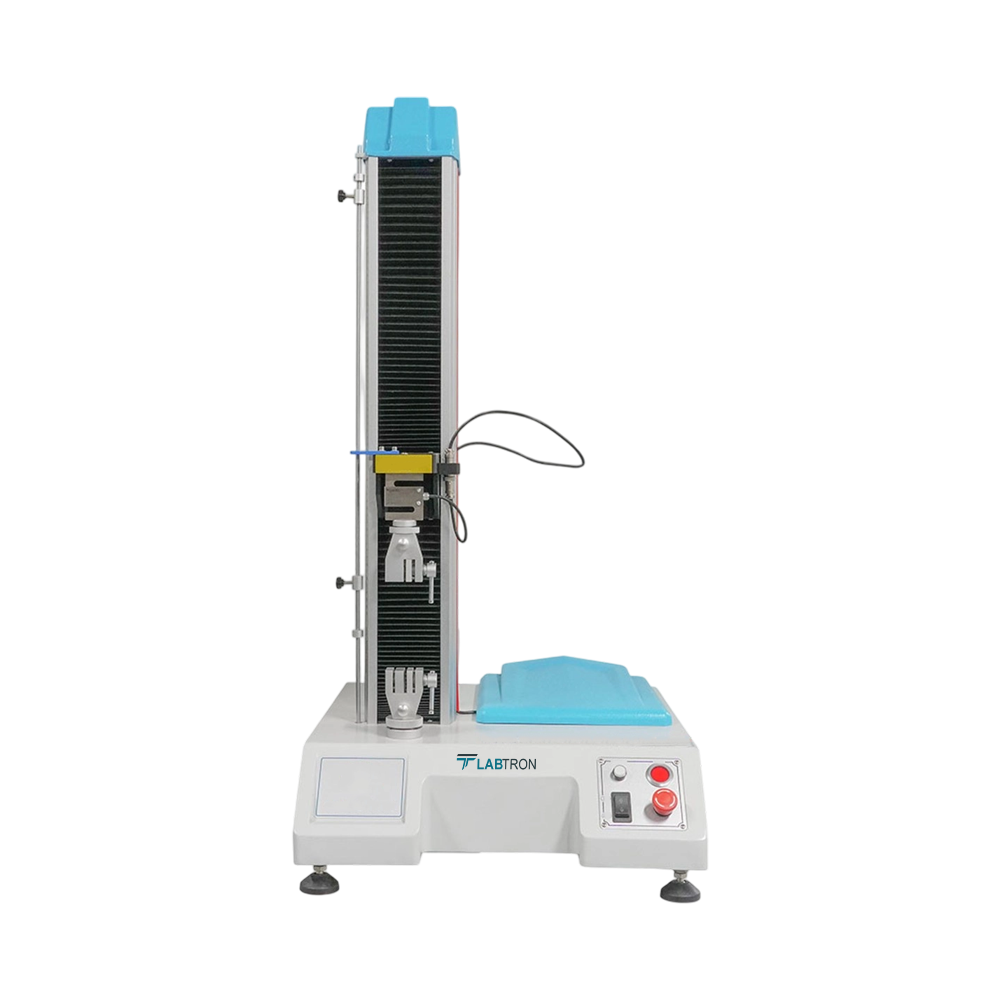
Our Vertical Tensile Tester LVTT-D11 is built for the test of tensile strength of various materials like metal, rubber, plastic, leather, paper, composite materials, etc. Our tensile tester mainly measures tensile, compression, adhesion, peeling, and tearing.
Labtron Paper Testing Instruments requires air supply for automatic clamping, ensuring smooth and secure operation. These provide real-time pressure curve displays, allowing users to monitor pressure changes instantly. Their over-range reset function protects the sensor by automatically adjusting it in case of excessive readings. They measure ink absorption values, useful for quality control in printing processes. Our paper testing instruments measure WH Hunter whiteness, YI yellowness, and CIE whiteness for precise color and whiteness evaluations for various applications.
.webp "Electronic Tearing tester TP-J21")
.webp "COBB sample cutter TP-C30")




Various grip types are available, including wedge grips for rigid samples, pneumatic grips for delicate materials, and capstan or bollard grips for yarns and wires. The choice depends on the sample material and dimensions. For irregular or thin samples, specialized grips with adjustable pressure may be necessary to prevent slippage or tearing. Always ensure the grip’s load rating matches or exceeds the expected test force.
Yes, many Vertical Tensile Testers support cyclic or fatigue testing if equipped with suitable software and servo-motor control. These tests involve repeated loading and unloading to study the material’s behavior under cyclic stress. Before attempting such tests, verify that your model supports dynamic testing and that the grips and load cell are rated for repeated use. Consult the manual for setting cycle parameters.
Yes, most digital Vertical Tensile Testers come with USB or LAN ports that allow exporting test data to external storage or PCs. Some models have built-in memory for data storage, while others require direct connection to software installed on a computer. Exported data can include test parameters, force-extension curves, and detailed analysis reports, depending on the software used.
Safety features generally include overload protection, emergency stop buttons, limit switches to prevent over-travel, and protective covers for moving parts. These features ensure operator safety and prevent damage to the machine. Additionally, some models feature auto-stop functions that halt testing when sample break is detected or when preset force/displacement limits are exceeded.
A standard tensile test cycle may take anywhere from 30 seconds to several minutes, depending on the material, test speed, and elongation. Thin films and soft materials generally test quicker, while tougher materials may require slower speeds for accurate data capture. Test duration also depends on whether pre-load, hold time, or other conditions are part of the test protocol.
Post your question?
Our experts are here to help!
Labtron Equipment Ltd., Quatro House, Lyon Way, Camberley, Surrey GU16 7ER United Kingdom
Email: info@labtron.com Whatsapp: +44 73 4441 2688 Phone: +44 2080 043608