 info@labtron.com

| Test Angle | 20° 60° 85° |
| Test Range | 20°: 0 to 2000 GU 60°: 0 to 1000 GU 85°: 0 to 160 GU |
| Resolution | 0.1 GU |
| Test Modes | Basic Mode Static Mode Continuous Mode QC Mode:10000 |
| Repeatability | 0 to 100 GU: ±0.2GU 100 to 2000GU: ±0.2%GU |
| Test Time | 0.5 s |
| Auto Power-off Time | 30 s to 120 s |
| Working Temperature | 0 to 40°C |
| Storage Temperature | -20 to 50°C |
| Working Humidity Range | < 85 % RH |
| PC Software | GQC6 QC Software |
| Power Supply | 1 pc Dry-Cell Battery |
| Dimensions (L× W× H) | 160× 52 × 84mm |
| Weight | 300g |
Continuous Measurement Mode
Auto Power-off Function
Large Memory Capacity
Wide Temperature Tolerance
Humidity-Resistant Design
Benchtop Gloss Meter-A11 is a stationary device used to precisely measure the gloss level of surfaces by analyzing reflected light at fixed angles. It is widely used in ceramics and tiles for ensuring glaze quality, verifying the uniformity and in quality control.
Accessories Name | Quantity |
Calibration Plate | 1 |
Download catalog for
Benchtop Gloss Meter LBGM-A11 Catalog
Download manual for
Benchtop Gloss Meter LBGM-A11 Manual
Available Range :
Benchtop Gloss Meter LBGM-B10 : 20° / 60° / 85° Benchtop Gloss Meter LBGM-A11 : 20° 60° 85° Benchtop Gloss Meter LBGM-A10 : 20°, 60°, 85° Benchtop Gloss Meter LBGM-A15 : 45° Benchtop Gloss Meter LBGM-A14 : 45° and 75° Benchtop gloss meter TBGM-A10 : 60° Benchtop Gloss Meter LBGM-A16 : 75°

Labtron Gloss Meter measures gloss at different angles for a wide measurement range. They provide precise gloss readings on various surfaces. Their compact design features a user-friendly interface and a high-resolution display. They include built-in memory with USB or Bluetooth data transfer. These meters come with calibration standards for accuracy and consistency. Our gloss meters are ideal for industries like automotive, paint, plastics, and coatings.


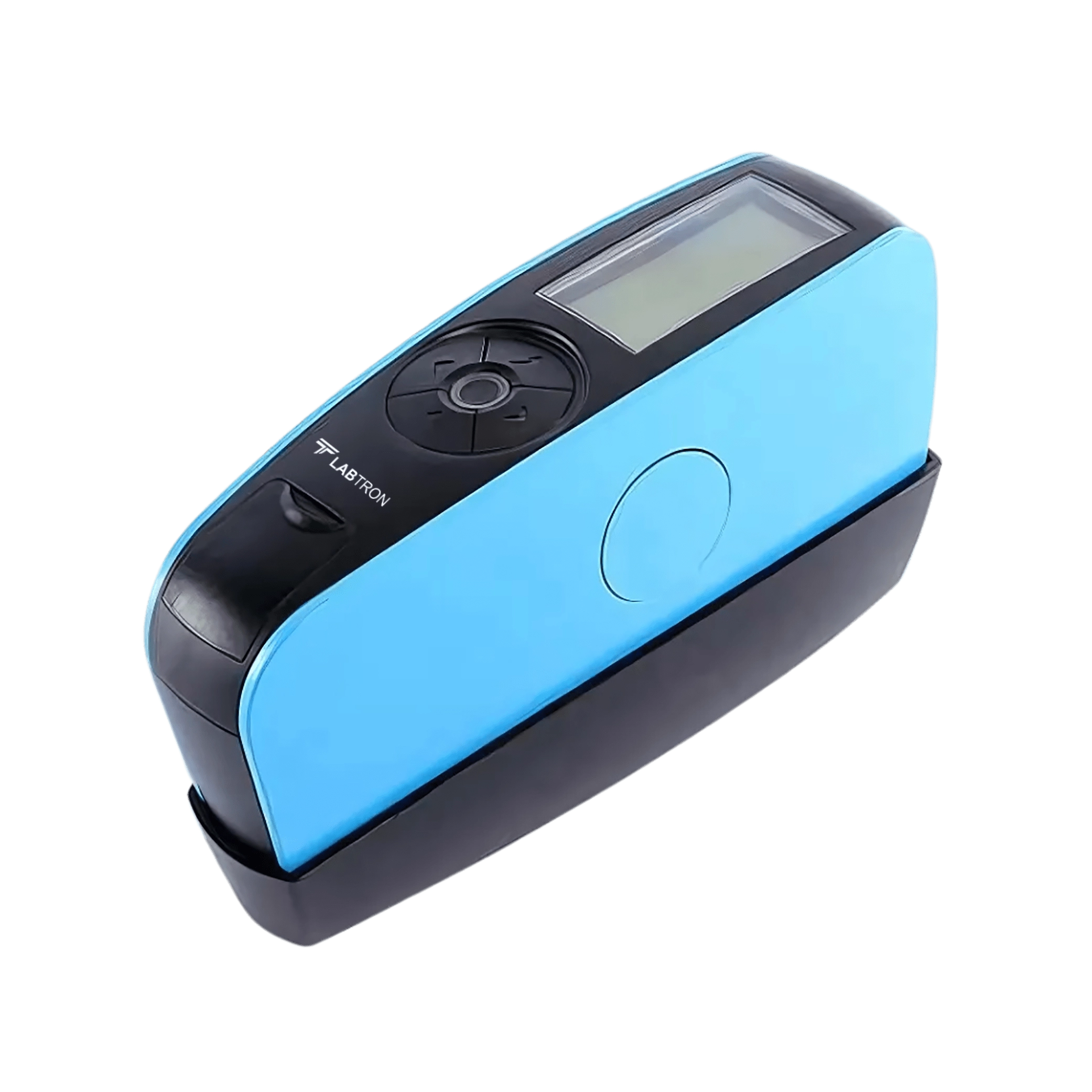


Labtron’s benchtop gloss meter ensures accuracy by using standardized test angles, typically 20°, 60°, and 85° to various surface reflectivity levels. It performs automatic calibration using certified gloss standard plates before each session. Equipped with advanced optical sensors and environmental compensation features, the device adjusts for temperature and humidity variations in real-time. High repeatability ensures minimal variation between tests, while the solid, vibration-resistant housing further supports consistent, reliable results. Users can choose the most suitable measurement angle based on the surface type, ensuring precise evaluation across matte, semi-gloss, and high-gloss finishes.
Yes, Labtron’s gloss meter can indirectly indicate surface defects or contamination through unexpected variations in gloss readings. Substances like oil, dust, or uneven coatings can scatter or absorb light, resulting in lower or inconsistent gloss values. Taking multiple measurements across the sample surface helps identify non-uniform areas. High-resolution models and gloss mapping software can provide detailed gloss distribution, flagging potential defects. However, a gloss meter cannot specify the exact nature of a defect. It should be used in conjunction with visual inspection or surface analysis tools for comprehensive evaluation.
Labtron supplies premium gloss meters. Temperature, humidity, and ambient light can influence gloss readings by altering light intensity and detector sensitivity. High-end gloss meter includes sensors to monitor environmental conditions and apply compensation algorithms. Enclosed measurement chambers or shields help block ambient light. Regular warm-up time and stable lab conditions also improve reliability. Some instruments log environmental data alongside measurements for traceability. Frequent recalibration in changing environments is recommended. For critical applications, controlled lab conditions are ideal to maintain precision and comparability over time.
Labtron’s Benchtop Gloss meters use optical geometries based on precise angle control and sensor alignment. Dual-beam or reference-beam designs improve long-term stability by compensating for light source drift. High-quality lenses, coated optics, and LED light sources enhance measurement accuracy and lifespan. Some benchtop models incorporate auto-alignment or autofocus systems to reduce operator error. Optical components must be protected from dust and vibration to prevent degradation. Superior optical design results in lower maintenance needs and more consistent performance, even under heavy use.
Labtron’s Benchtop Gloss Meter have advanced features. Gloss measurement on transparent or semi-transparent surfaces presents unique challenges because light passes through the material, rather than just reflecting off the surface. In these cases, the gloss meter may capture less accurate readings, as the light may be absorbed or refracted, depending on the material's thickness and refractive index. However, some advanced gloss meters are equipped with specialized features that allow for better measurement of gloss on these surfaces, such as light angle adjustments or compensation algorithms. In some cases, gloss readings may also be influenced by the substrate material beneath the transparent surface, which can affect the total reflection. Calibration and sample preparation become especially critical when measuring gloss on transparent materials to ensure that the measurement truly reflects the coating’s quality.
Post your question?
Our experts are here to help!
Labtron Equipment Ltd., Quatro House, Lyon Way, Camberley, Surrey GU16 7ER United Kingdom
Email: info@labtron.com Whatsapp: +44 73 4441 2688 Phone: +44 2080 043608

