 info@labtron.com

| Test Angle | 45° |
| Testing Spot | 45°: 10 × 13 |
| Test Range | 45°: 0 to 800 GU |
| Resolution | 0 to 100 GU: 0.1 GU 100 to 800 GU: 1 GU |
| Test Modes | Basic Mode, Statistical Mode, Continuous Mode, Quality Control Mode |
| Repeatability | 0 to 100 GU: ±0.5GU 100 to 800GU: ±0.5%GU |
| Test Time | 0.5 s |
| Auto Shut-off Time | 30 to 120 s |
| Data Storage | 35000 (15000 in Basic and Continuous Mode, 10000 in Quality Control Mode, 10000 in Statistical Mode) |
| Working Temperature | 0°C to 40°C |
| Storage Temperature | -20°C to 50°C |
| Working Humidity Range | < 85 % RH |
| Power Supply | 1 AA Alkaline Battery or NiMH Rechargeable Battery |
| Dimensions (L× W× H) | 160× 52 × 84mm |
| Weight | 300g |
Spectral Reflectance Profiling
High Gloss Peak Tracking
Remote Measurement Access
Magnetic Base Attachment
Low Angle Optical Analysis
Benchtop Gloss Meter LBGM-A15 is a non-contact device used to determine gloss levels on flat or curved surfaces. It plays a key role in paper and packaging for assessing the gloss of printed material and packaging for branding and good visuals.
Accessories Name | Quantity |
Calibration Plate | 1 |
Download catalog for
Benchtop Gloss Meter LBGM-A15 Catalog
Available Range :
Benchtop Gloss Meter LBGM-B10 : 20° / 60° / 85° Benchtop Gloss Meter LBGM-A11 : 20° 60° 85° Benchtop Gloss Meter LBGM-A10 : 20°, 60°, 85° Benchtop Gloss Meter LBGM-A15 : 45° Benchtop Gloss Meter LBGM-A14 : 45° and 75° Benchtop gloss meter TBGM-A10 : 60° Benchtop Gloss Meter LBGM-A16 : 75°

Labtron Gloss Meter measures gloss at different angles for a wide measurement range. They provide precise gloss readings on various surfaces. Their compact design features a user-friendly interface and a high-resolution display. They include built-in memory with USB or Bluetooth data transfer. These meters come with calibration standards for accuracy and consistency. Our gloss meters are ideal for industries like automotive, paint, plastics, and coatings.


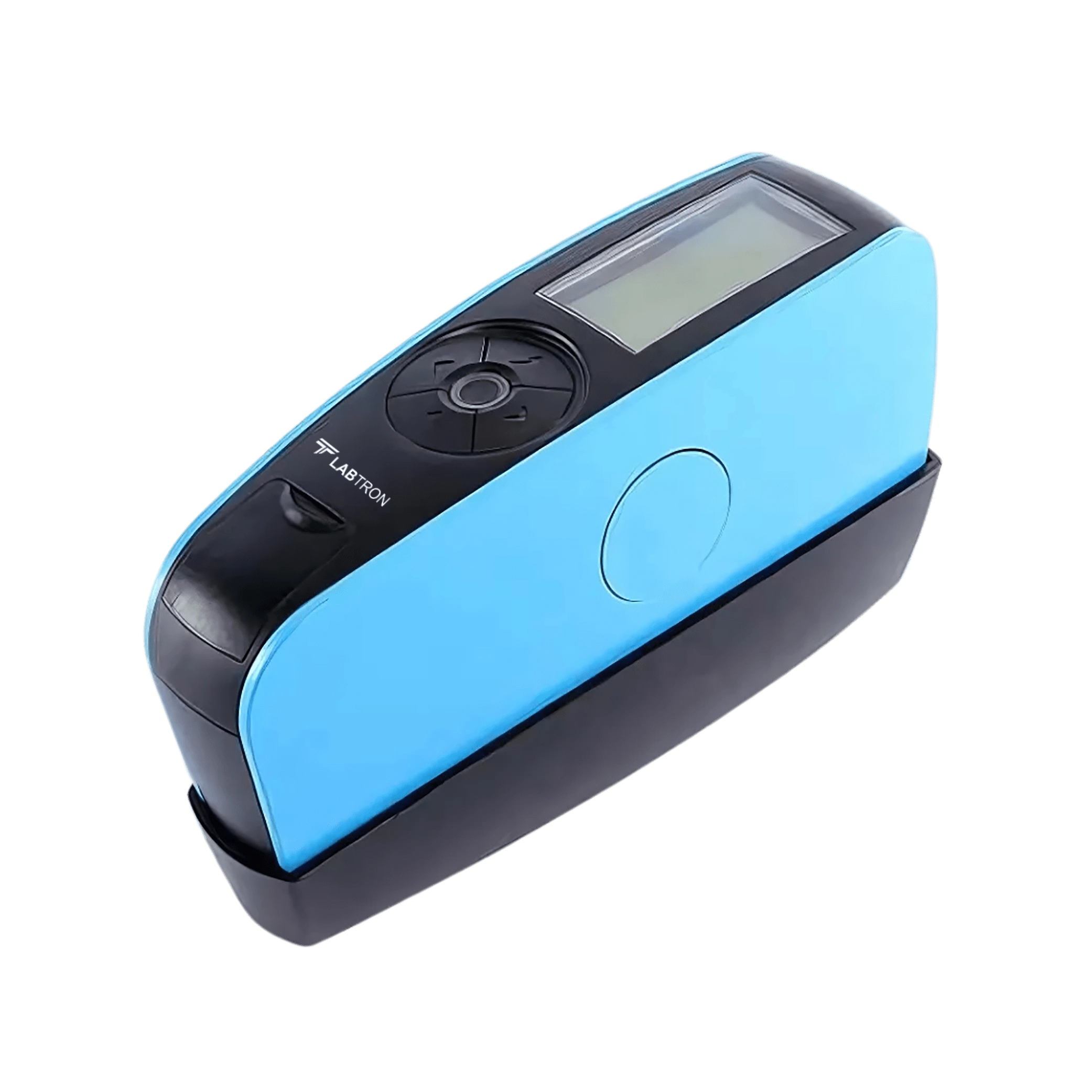


Labtron’s Benchtop Gloss Meter has ambient lighting which can interfere with gloss measurements by introducing stray light that disrupts the controlled reflection being measured by the sensor. Benchtop gloss meters are designed to minimize this impact using enclosed optical paths, filters, or shielding. However, excessive ambient light especially from reflective or variable sources like windows can still affect readings if the environment isn’t controlled. For best results, measurements should be taken in a consistent lighting environment or under controlled lab conditions. Some advanced models include auto-compensation features to reduce ambient influence. Proper sample placement and avoiding direct light sources are essential. A consistent testing setup enhances reliability and accuracy.
Labtron’s benchtop gloss meters with multiple test modes offer enhanced flexibility and better control over how data is gathered and analyzed. Common modes may include single-point measurement, continuous scanning, average mode, and statistical evaluation. Single-point mode is ideal for standard inspections, while continuous mode helps in detecting gloss variations across large surfaces. Average mode combines multiple readings for more reliable results, especially on inconsistent textures. Some advanced models even offer trend tracking or pass/fail evaluation based on preset thresholds. These features allow users to tailor the gloss testing process to different materials or standards. Multi-mode functionality enhances accuracy, efficiency, and decision-making in quality control.
Labtron supplies premium benchtop gloss meter. Consistent sample positioning is critical to ensure accurate and repeatable gloss readings. Even slight shifts in angle, height, or surface alignment can cause significant variations in results, especially on glossy or textured surfaces. Benchtop gloss meters help minimize this issue with fixed positioning platforms or guides. Some models include sample holders or clamps to maintain alignment. Users should place the sample flat against the measuring port, avoiding tilts or gaps. Repeatable positioning is essential when comparing multiple readings or conducting time-based studies. Consistency in placement reduces measurement error and improves data reliability across batches or production runs.
Labtron supplies advanced models of benchtop gloss meter. Absolute gloss measurement refers to the direct GU value obtained by the meter, based on comparison to a standard calibration surface. Relative gloss measurement, on the other hand, involves comparing the gloss of a test surface to a reference or control sample under identical conditions. Absolute measurements are used for compliance with standards, while relative measurements are useful in quality control to detect differences batch-to-batch. Both are valuable depending on the goal whether maintaining product consistency or meeting regulatory specifications. Benchtop gloss meters can be used for both, with high precision and repeatability. Understanding the context determines which method is more appropriate.
Labtron’s benchtop gloss meters are primarily designed to measure surface gloss, there is a correlation between gloss and coating thickness, especially for certain materials like paints or varnishes. Generally, a thicker coating results in higher gloss, although the relationship is not always linear. By combining gloss measurements with other testing methods, such as a coating thickness gauge, manufacturers can gain insights into the uniformity and quality of the coating process. Benchtop gloss meters allow for the assessment of coating application consistency, helping to optimize the amount of coating material used and avoid over or under application. This is particularly important for industries where coating durability and aesthetic appeal are critical.
Post your question?
Our experts are here to help!
Labtron Equipment Ltd., Quatro House, Lyon Way, Camberley, Surrey GU16 7ER United Kingdom
Email: info@labtron.com Whatsapp: +44 73 4441 2688 Phone: +44 2080 043608

