info@labtron.com

| Test Angle | 20° / 60° / 85° |
| Test Area | 20°: 10 × 10mm 60°: 9 × 15 mm 85°: 5 × 36mm |
| Test Range | 20°: 0 to 2000 GU 60°: 0 to 1000 GU 85°: 0 to 160 GU |
| Resolution | 0.1 GU |
| Measurement Range | 0 to 10 GU, 10 to 100 GU, 100 to 1000 GU |
| Test Modes | Basic Mode, Static Mode, Continuous Mode, QC Mode |
| Repeatability | ±0.1 GU, ±0.2GU, ±0.2%GU |
| Reproducibility | ±0.2GU, ±0.5GU, ±0.5%GU |
| Test Time | 0.1 s |
| Errors | ±1.5, ±1.5% |
| Data Storage | Basic Mode: 1000, Statistical Mode: 5000, Continuous Mode: 5000 |
| Working Temperature | 0 to 40°C |
| Storage Temperature | -20 to 50°C |
| Working Humidity Range | < 85 % RH |
| PC Software | GQC6 QC Software |
| Power Supply | 3200 mAh Li-ion Battery, > 10000 times |
| Dimensions (L× W× H) | 160× 75× 90mm |
| Weight | 350g |
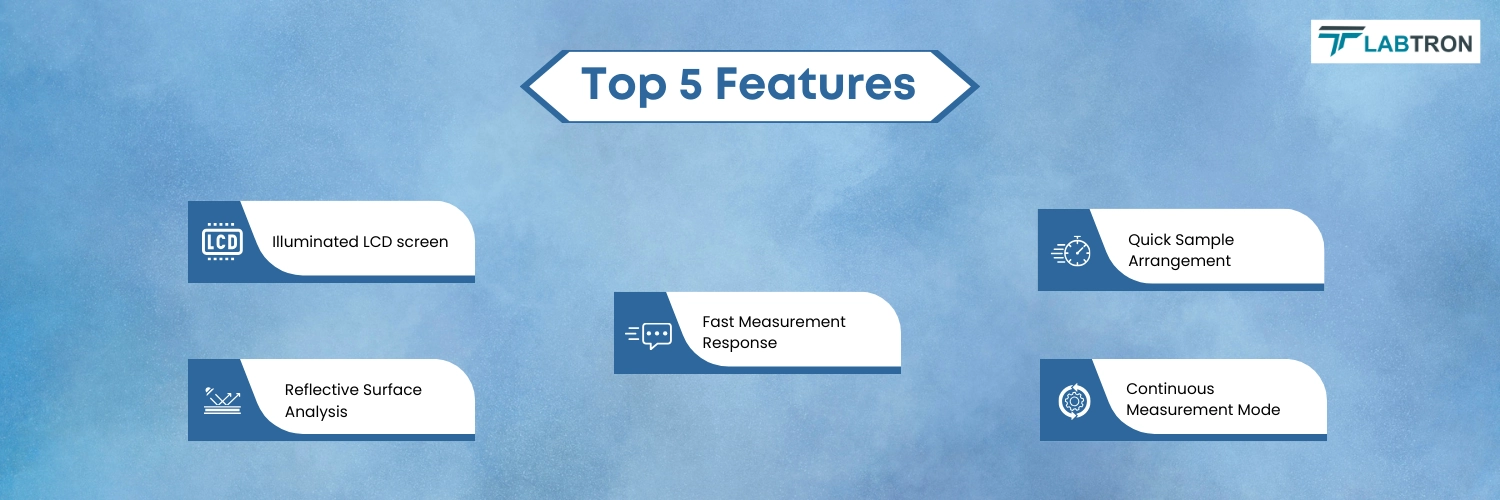
Illuminated LCD screen
Fast Measurement Response
Reflective Surface Analysis
Quick Sample Arrangement
Continuous Measurement Mode
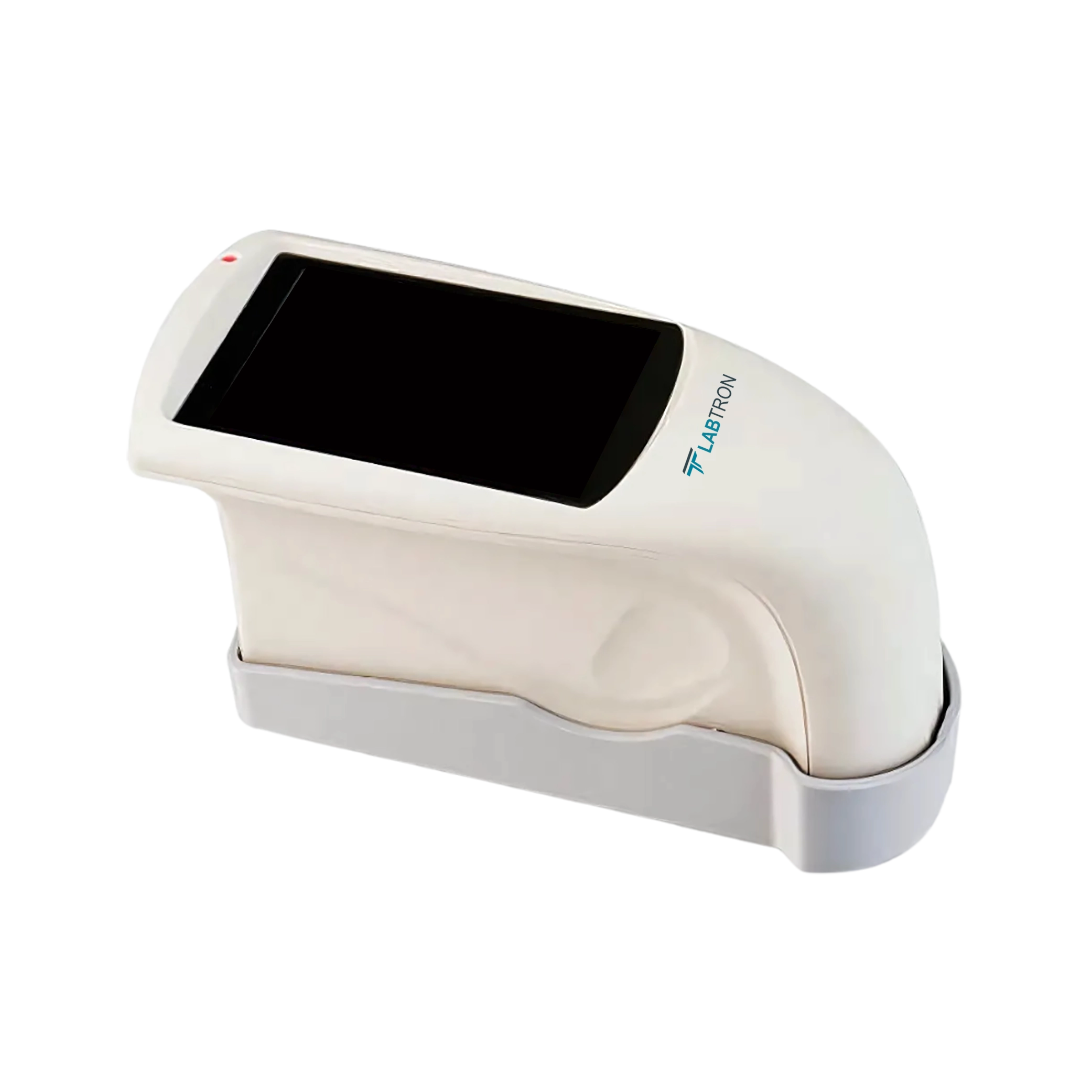
Benchtop Gloss Meter LBGM-B13 is a device that evaluates the gloss of various surfaces. It is applied in ink, furniture , hardware and marble industries for gloss measurement and gloss data transmission.
Accessories Name | Quantity |
Calibration Plate | 1 |
Download catalog for
Benchtop Gloss Meter LBGM-B13 Catalog
Available Range :
Benchtop Gloss Meter LBGM-B10 : 20° / 60° / 85° Benchtop Gloss Meter LBGM-A11 : 20° 60° 85° Benchtop Gloss Meter LBGM-A10 : 20°, 60°, 85° Benchtop Gloss Meter LBGM-A15 : 45° Benchtop Gloss Meter LBGM-A14 : 45° and 75° Benchtop gloss meter TBGM-A10 : 60° Benchtop Gloss Meter LBGM-A16 : 75°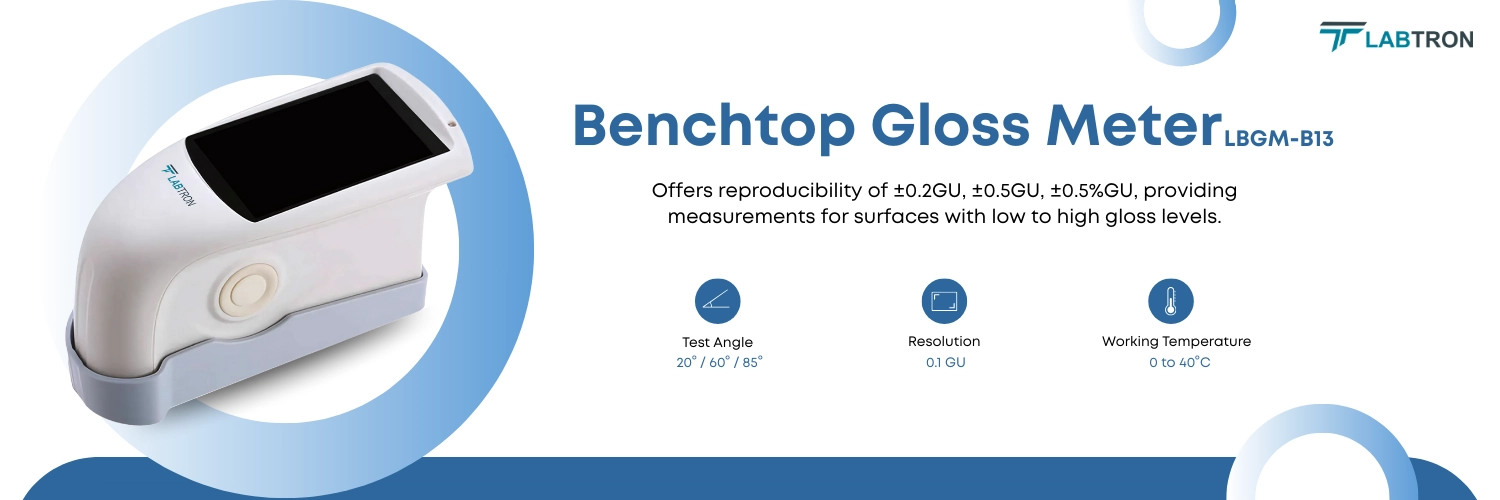
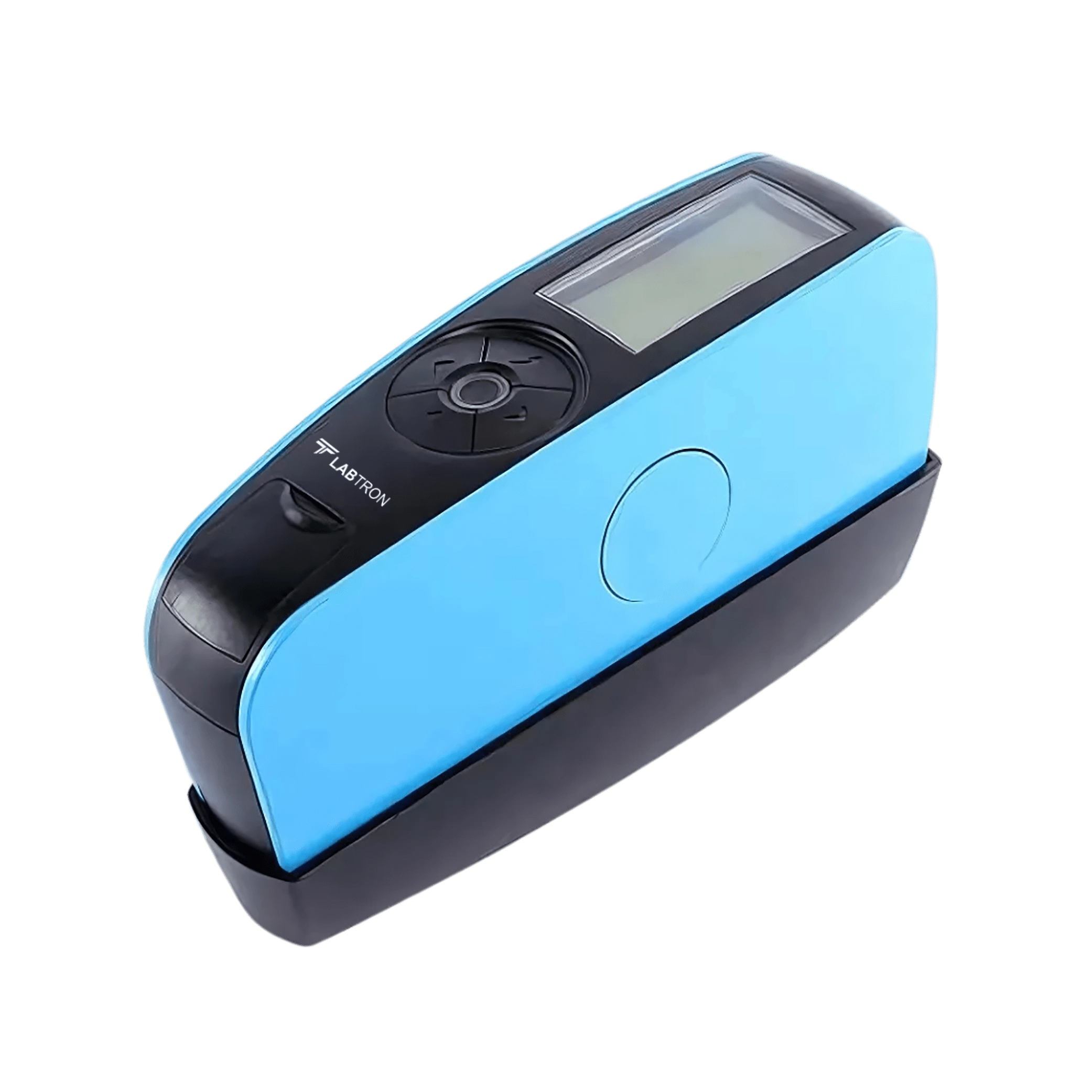
Labtron Gloss Meter measures gloss at different angles for a wide measurement range. They provide precise gloss readings on various surfaces. Their compact design features a user-friendly interface and a high-resolution display. They include built-in memory with USB or Bluetooth data transfer. These meters come with calibration standards for accuracy and consistency. Our gloss meters are ideal for industries like automotive, paint, plastics, and coatings.

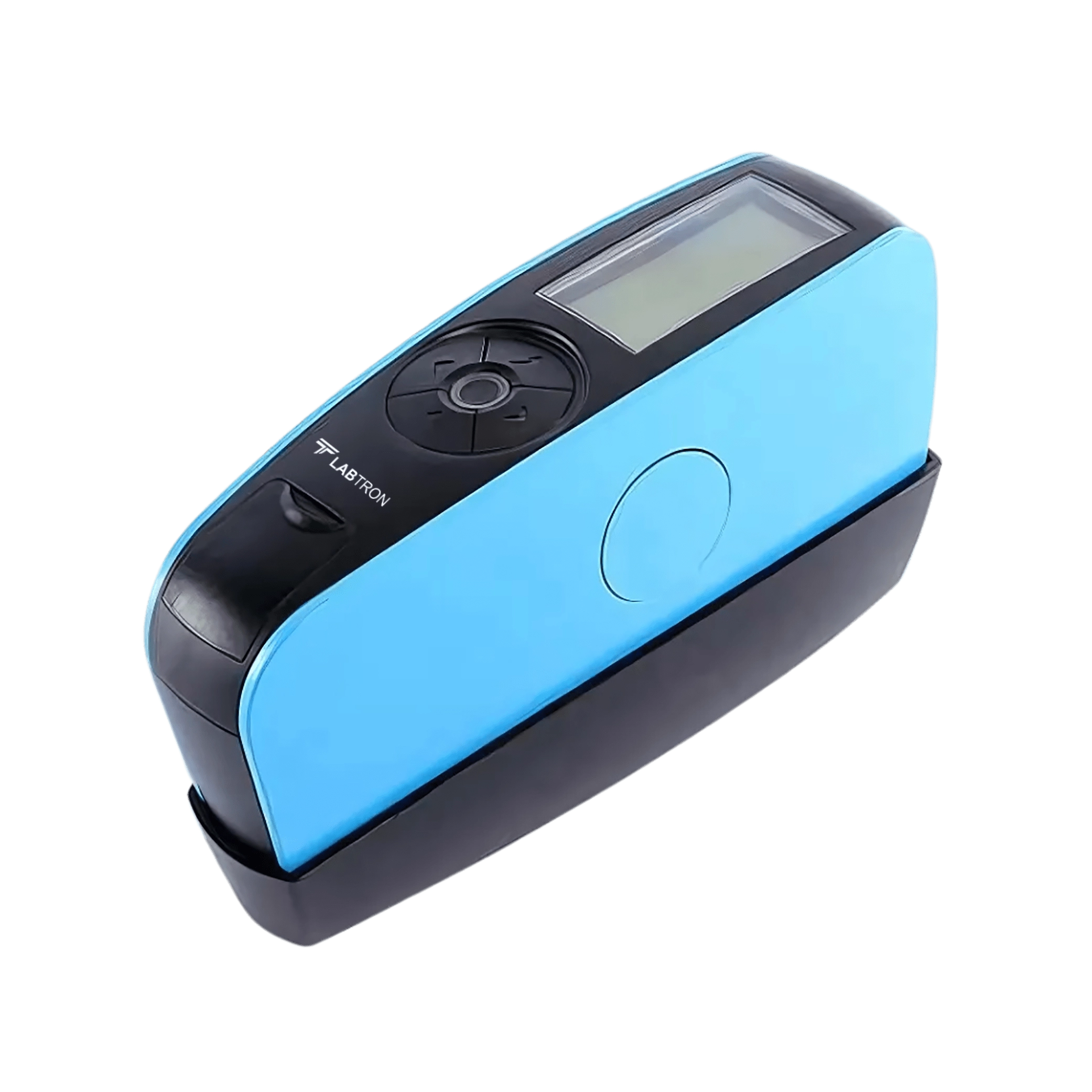


Labtron’s benchtop gloss meter have advance features. The precision of a benchtop gloss meter heavily depends on the quality and alignment of its internal optical components, including the light source, lenses, filters, and detector. High-quality optics ensure the light beam is focused accurately and that reflected light is captured consistently at the specified geometry. Any misalignment or degradation in these components (e.g., from aging or contamination) can lead to incorrect gloss values. Premium models use long-life, temperature-stable LEDs and precisely engineered optics to maintain consistent performance over time. Maintenance protocols may also include optical diagnostics or self-check routines to verify measurement integrity.
Yes, many benchtop gloss meters offer customization options to meet the unique needs of specific industries such as automotive, plastics, wood finishes, and printed packaging. Customizations may include interchangeable angle modules, specialized sample holders, advanced software features for statistical analysis, or integration with production systems. Some manufacturers provide industry-specific calibration standards or gloss scales that align with customer specifications. These tailored configurations help ensure the gloss meter delivers relevant and precise data for the particular materials, geometries, or finishes encountered in a specific production or R&D setting.
Labtron manufactures advance models of benchtop gloss meter. Angle selection is crucial because different gloss levels are better evaluated at different geometries. A 20° angle is used for high-gloss surfaces, 60° for medium-gloss, and 85° for matte finishes. Using the wrong angle can lead to inaccurate readings or poor differentiation between samples. For instance, very glossy surfaces measured at 60° might all return similar values, making it hard to detect variations. Choosing the appropriate angle ensures maximum sensitivity and accuracy in assessing a specific surface type. Many benchtop models allow multi-angle measurement, offering flexibility and detailed gloss profiles for complex surfaces.
Yes, Labtron’s benchtop gloss meter is an effective tool for detecting gloss degradation caused by UV exposure, moisture, or environmental aging. Over time, surfaces exposed to sunlight or harsh weather conditions may lose their shine and develop a duller appearance. Regular gloss measurements allow manufacturers to track this degradation and evaluate the durability of coatings or finishes. Gloss data can be used to compare treated versus untreated samples or to assess different materials under accelerated weathering tests. This helps in product development and quality assurance by confirming how well a material retains its visual appeal over time.
Labtron’s benchtop gloss meters are known for delivering high repeatability and precision, which are critical for consistent surface evaluation. Most high-quality instruments offer repeatability within ±0.2 gloss units, ensuring that repeated measurements on the same surface yield nearly identical results. This level of precision is made possible through stable light sources, finely tuned optics, and calibrated sensors. Accurate and repeatable measurements are essential in industries where even minor variations in surface finish can affect product appearance, functionality, or customer satisfaction. The reliability of these measurements enables manufacturers to maintain tight quality control standards and ensures that final products meet both internal and industry specifications.
Post your question?
Our experts are here to help!
Labtron Equipment Ltd., Quatro House, Lyon Way, Camberley, Surrey GU16 7ER United Kingdom
Email: info@labtron.com Whatsapp: +44 73 4441 2688 Phone: +44 2080 043608