 info@labtron.com

| Glass Vessel Volume | 50 L Cylindrical |
| Glass Vessel Lid Diameter | Φ 265 mm |
| Jacketed Volume | 7000 ml |
| Dropping Funnel | 1000 ml |
| Temperature Range | -80℃ to 250℃ |
| Temperature Measurement Accuracy | +/-1℃ |
| Stirring Speed | 0 to 1400 rpm |
| Vacuum Degree | 0.098 Mpa |
| Power Consumption | 120 W |
| Power Supply | 220V/50Hz |
| Condenser Dimension (D×H) | 100×600 mm |
| Dimensions (W×D×H) | 870×560×2270 mm |
| Weight | 71 kg |
Programmable temperature regulation system
Anti-splash stirring mechanism
Smooth torque stirring motor
Corrosion-proof motor housing
Automatic shutdown safety feature
Jacketed Glass Reactor LJGR-A32 supports synthesis, distillation, and concentration under controlled temperature conditions. This allows thermal regulation through fluid circulation in its dual-layered glass vessel.
Download catalog for
Jacketed Glass Reactor LJGR-A32 Catalog
Available Range :
Jacketed Glass Reactor LJGR-A10 : 1 L Cylindrical Jacketed Glass Reactor LJGR-B21 : 10 L Jacketed Glass Reactor LJGR-A22 : 10 L Cylindrical Jacketed Glass Reactor LJGR-B24 : 100 L Jacketed Glass Reactor LJGR-A26 : 100 L Cylindrical Jacketed Glass Reactor LJGR-B26 : 100L Jacketed Glass Reactor LJGR-A27 : 150 L Cylindrical Jacketed Glass Reactor LJGR-A11 : 2 L Cylindrical Jacketed Glass Reactor LJGR-B22 : 20 L Jacketed Glass Reactor LJGR-A23 : 20 L Cylindrical Jacketed Glass Reactor LJGR-B25 : 200 L Jacketed Glass Reactor LJGR-A28 : 200 L Cylindrical Jacketed Glass Reactor LJGR-A12 : 3 L Cylindrical Jacketed Glass Reactor LJGR-A24 : 30 L Cylindrical Jacketed Glass Reactor LJGR-B20 : 5 L Jacketed Glass Reactor LJGR-A50 : 5 L (Cylindrical) Jacketed Glass Reactor LJGR-A17 : 5 L Cylindrical Jacketed Glass Reactor LJGR-A13 : 5 L, Cylindrical Jacketed Glass Reactor LJGR-B23 : 50 L Jacketed Glass Reactor LJGR-A25 : 50 L CylindricalJacketed Glass Reactor supports controlled mixing with adjustable stirring speed, ensuring consistent reaction dynamics in varied experiments. They maintain thermal stability using a jacketed layer for fluid circulation without exposing the medium. Their borosilicate glass build withstands thermal stress and chemical exposure over time. These systems include a display panel for monitoring key parameters during operation. Our glass reactor is suited for synthesis, distillation, extraction, crystallization, and pharmaceutical development.
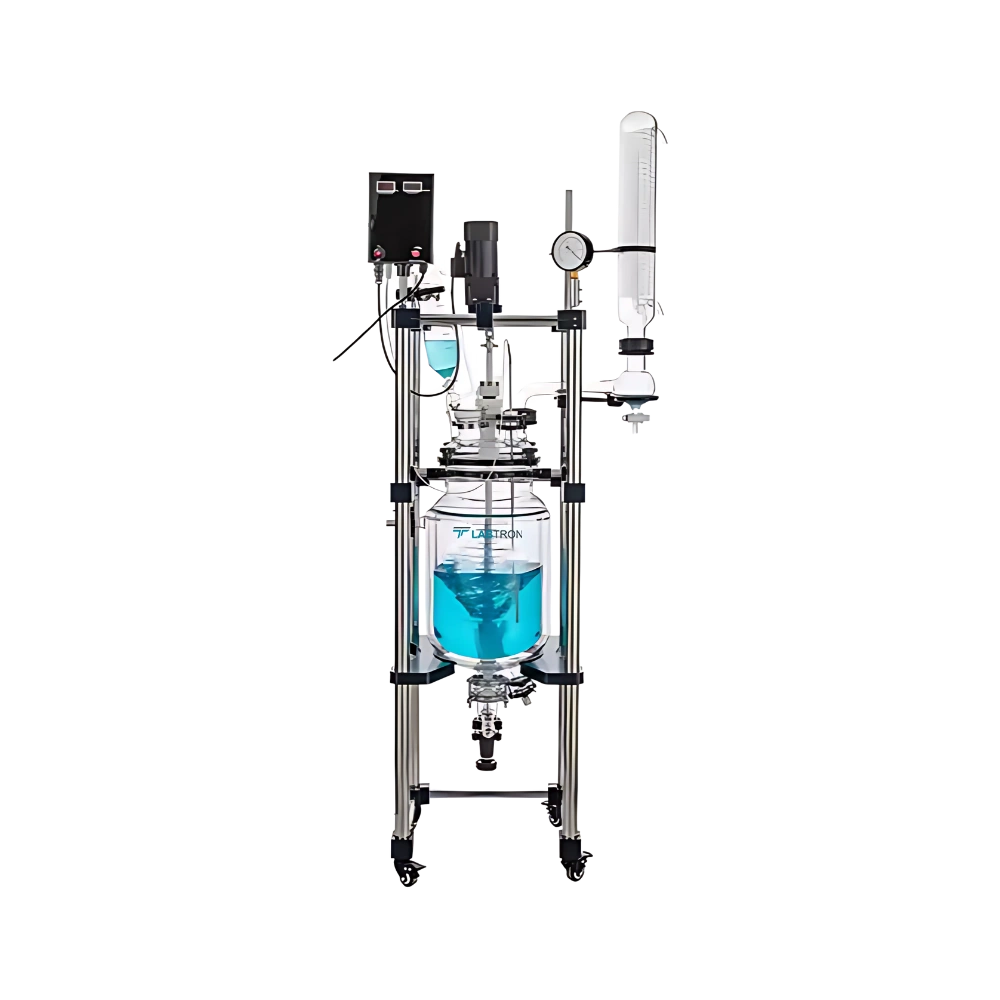


Our Jacketed Glass Reactor LJGR-A32 is equipped with a carefully engineered dropping funnel that allows reagents to be introduced gradually, preventing sudden changes in concentration or temperature inside the vessel. This controlled addition helps maintain the stability of stirring and temperature throughout the reaction process, which is crucial for sensitive experiments. The airtight connection between the funnel and reactor preserves vacuum conditions and reduces contamination risks. The funnel’s strategic placement avoids interference with mixing dynamics, ensuring uninterrupted agitation. By eliminating localized overheating or surges, the reactor enhances consistency in product formation. This control is especially vital in multi-step procedures requiring precise reagent delivery.
The Jacketed Glass Reactor LJGR-A32 utilizes high borosilicate glass with a low thermal expansion coefficient, allowing it to withstand extreme temperature shifts without cracking or stress-related damage. Its double-layered jacket is engineered to tolerate internal movement, absorbing expansion-related forces that occur during rapid heating or cooling. This prevents structural compromise and maintains safety in demanding environments. The sealing system ensures vacuum integrity even as the glass expands or contracts, which supports stable pressure conditions. Together, these features allow the reactor to operate efficiently across a broad temperature range without requiring frequent maintenance or replacements.
Labtron’s Jacketed Glass Reactor LJGR-A32 includes modular components that are easy to disassemble, enabling full access to internal surfaces for thorough cleaning between experimental cycles. Its borosilicate glass construction features smooth, non-porous surfaces that resist residue build-up and facilitate chemical removal. The PTFE and fluororubber dual-sealing system provides an effective barrier against leaks and cross-contamination. Isolated reagent pathways, such as the dedicated dropping funnel, limit chemical exposure to shared components. Regular maintenance and proper cleaning protocols specific to the setup further reduce contamination risks, supporting consistent results across varied applications and formulations.
The Jacketed Glass Reactor LJGR-A32 allows for scalable experimentation, but increases in volume can lead to mixing inefficiencies or uneven heat distribution if not properly managed. To address this, it provides adjustable stirring speed and optimized thermal transfer via its dual-jacketed design, supporting uniform conditions even at higher capacities. Gradual reagent addition using the built-in funnel prevents concentration spikes that could destabilize the process. Temperature and agitation must be continuously monitored and adjusted based on batch size. Following precise calibration procedures ensures reproducibility and consistent product quality across experimental batches.
Our Jacketed Glass Reactor LJGR-A32 relies on chemically resistant PTFE and fluororubber seals to maintain a stable vacuum environment even during long procedures. Over time, exposure to aggressive solvents or repeated heating cycles may degrade these materials. To maintain optimal sealing performance, routine inspection for wear, hardening, or cracks is critical. Prompt replacement of worn seals helps avoid vacuum loss that could compromise experimental results. An external loop buffer helps stabilize vacuum pressure during extended operations. Maintaining the system according to schedule enhances durability and prevents unplanned downtime caused by seal failure.
The Jacketed Glass Reactor LJGR-A32 requires careful coolant selection when operating at or near freezing points to avoid internal ice formation that can damage the glass jacket. A compatible antifreeze mixture should be used to prevent crystallization within the system. Additionally, gradual temperature transitions reduce thermal shock, minimizing the risk of microfractures. Seals should be inspected frequently to ensure they retain flexibility at low temperatures. Condensation control is also important to prevent corrosion on external fittings or nearby electrical systems. Adhering to cold-environment usage protocols preserves the system’s integrity and extends its service life.
Post your question?
Our experts are here to help!
Labtron Equipment Ltd., Quatro House, Lyon Way, Camberley, Surrey GU16 7ER United Kingdom
Email: info@labtron.com Whatsapp: +44 73 4441 2688 Phone: +44 2080 043608