 info@labtron.com

| Glass Vessel Volume | 5 L (Cylindrical) |
| Jacket Volume | 1.5 L |
| Glass Vessel Flange | Φ 170 mm |
| Glass Vessel Opening OD | Φ 215 mm |
| Glass Vessel Lid Openings | 5 |
| Center Opening of Lid | 50 mm |
| Side Opening of Lid | 24/29 × 3, 29/32, S35 |
| Seal Ring on Vessel Lid | Φ212 × Φ168 × 3 |
| Drain Port Ground Clearance | 400 mm |
| Glass Material | High borosilicate 3.3 |
| Stirring Port | 50# flange port |
| Sensor Port | 24 standard milling port |
| Condenser Connection Port | 35 standard ball port |
| Additional Port | 24standard milling port |
| Constant Pressure Funnel Port | 2# standard milling port |
| Volume | 500 ml |
| Interface | 29/32 |
| Condenser Area | 0.045 m² |
| Main Frame | SUS304 |
| Support Parts of Stirrer | PTFE, PEED, Glass |
| Working Temperature | -80 to 200 degree |
| Bearable Temperature Difference | ≤ 80 degree |
| Pressure in Vessel | -0.1 to 0.0 MPa |
| Pressure in Jacket | ≤ +0.03 MPa |
| Vacuum System Pressure Rise Rate | ≤ 2 kPa/h |
| Ambient Temperature | 5 to35 °C |
| Environment Relative Humidity | ≤ 65% |
| Stirring Paddle | Paddle type |
| Stirring Speed | 50 to 500 rpm |
| Speed Control | Frequency speed control |
| Explosion-Proof Motor Power | 180 W |
| Explosion-Proof Grade | ExdⅡBT4 |
| Support Parts for Stirrer | PTFE |
| Temperature Sensor | Pt100 |
| Temperature Display Accuracy | ±0.1 °C |
| Circulation Hose Port | Rc 3/4 |
| Jacket Interface | 35 mm |
| Power Consumption | 50 W |
| Power Supply | 220 to 240 V~, 50/60 Hz |
| Dimensions (W×D×H) | 660×530×1600 mm |
| Packing dimensions | 1530 × 680 × 740 mm |
| Net weight | 50kg |
| Gross Weight | 92kg |
Jacketed Glass Reactor LJGR-A50 is used for carrying out controlled chemical reactions, temperature-sensitive processes, and material synthesis under laboratory conditions. This setup allows users to regulate heat exchange using circulating fluids, making it suitable for distillation, crystallization, and pharmaceutical research.
Download catalog for
Jacketed Glass Reactor LJGR-A50 Catalog
Available Range :
Jacketed Glass Reactor LJGR-A10 : 1 L Cylindrical Jacketed Glass Reactor LJGR-B21 : 10 L Jacketed Glass Reactor LJGR-A22 : 10 L Cylindrical Jacketed Glass Reactor LJGR-B24 : 100 L Jacketed Glass Reactor LJGR-A26 : 100 L Cylindrical Jacketed Glass Reactor LJGR-B26 : 100L Jacketed Glass Reactor LJGR-A27 : 150 L Cylindrical Jacketed Glass Reactor LJGR-A11 : 2 L Cylindrical Jacketed Glass Reactor LJGR-B22 : 20 L Jacketed Glass Reactor LJGR-A23 : 20 L Cylindrical Jacketed Glass Reactor LJGR-B25 : 200 L Jacketed Glass Reactor LJGR-A28 : 200 L Cylindrical Jacketed Glass Reactor LJGR-A12 : 3 L Cylindrical Jacketed Glass Reactor LJGR-A24 : 30 L Cylindrical Jacketed Glass Reactor LJGR-B20 : 5 L Jacketed Glass Reactor LJGR-A50 : 5 L (Cylindrical) Jacketed Glass Reactor LJGR-A17 : 5 L Cylindrical Jacketed Glass Reactor LJGR-A13 : 5 L, Cylindrical Jacketed Glass Reactor LJGR-B23 : 50 L Jacketed Glass Reactor LJGR-A25 : 50 L CylindricalJacketed Glass Reactor supports controlled mixing with adjustable stirring speed, ensuring consistent reaction dynamics in varied experiments. They maintain thermal stability using a jacketed layer for fluid circulation without exposing the medium. Their borosilicate glass build withstands thermal stress and chemical exposure over time. These systems include a display panel for monitoring key parameters during operation. Our glass reactor is suited for synthesis, distillation, extraction, crystallization, and pharmaceutical development.
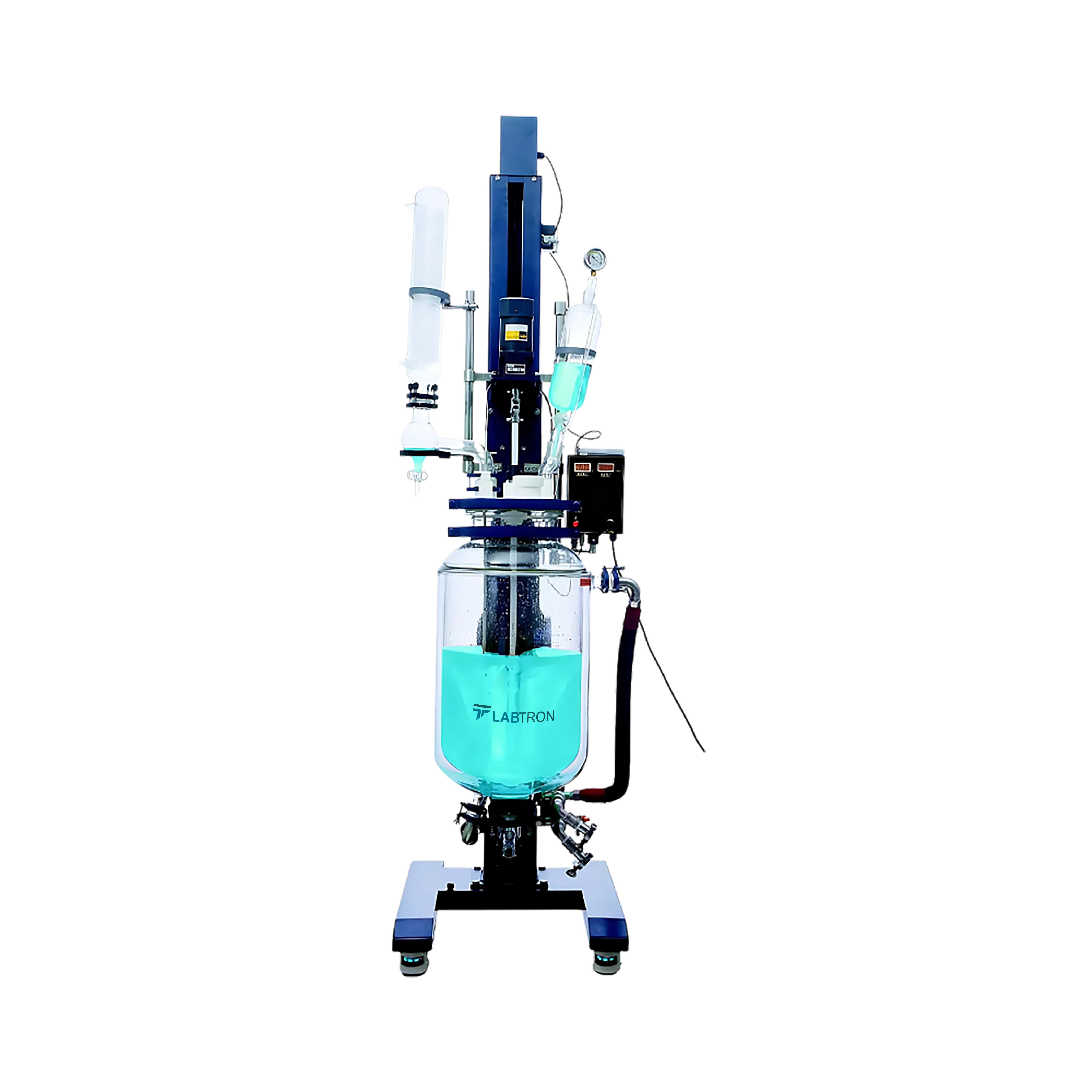


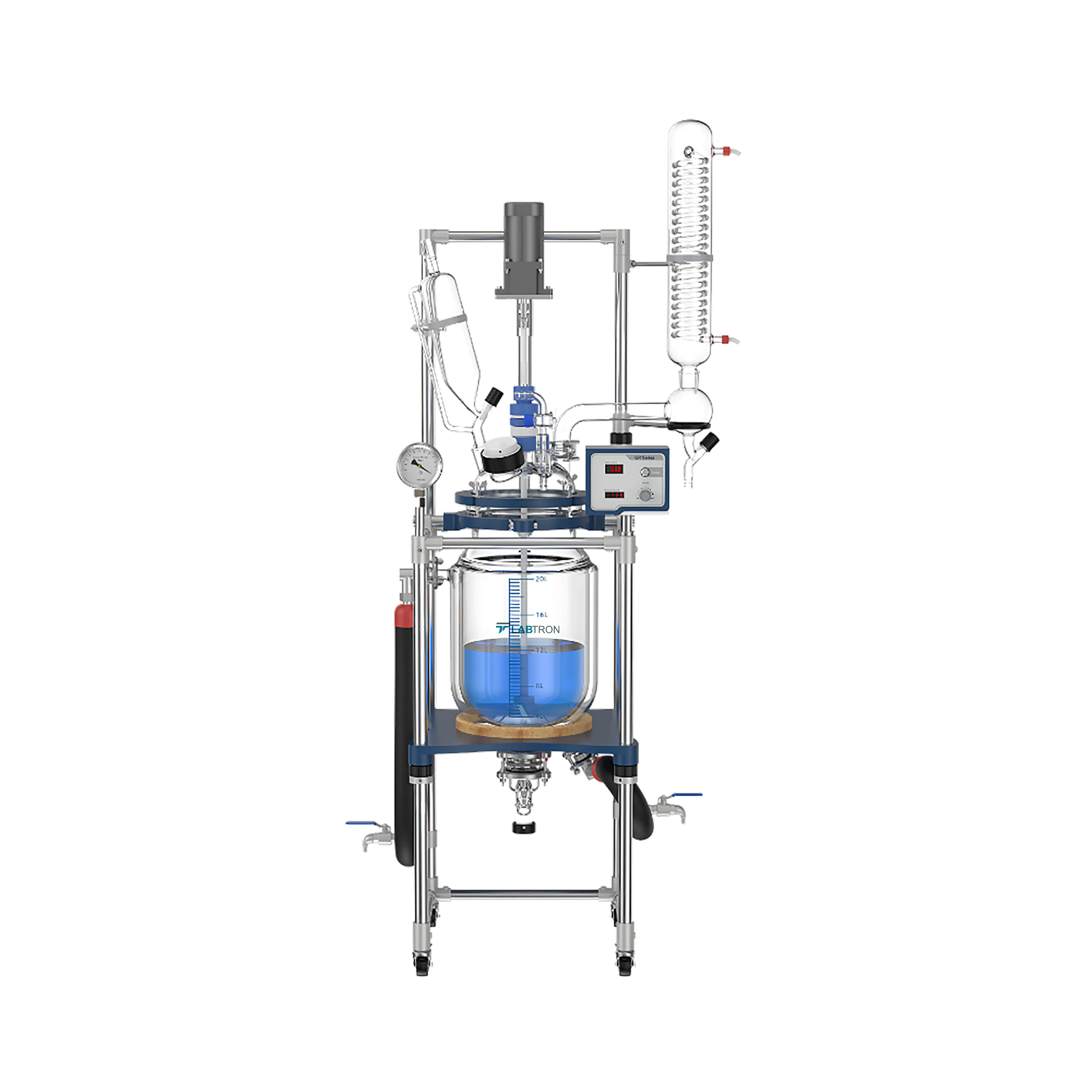
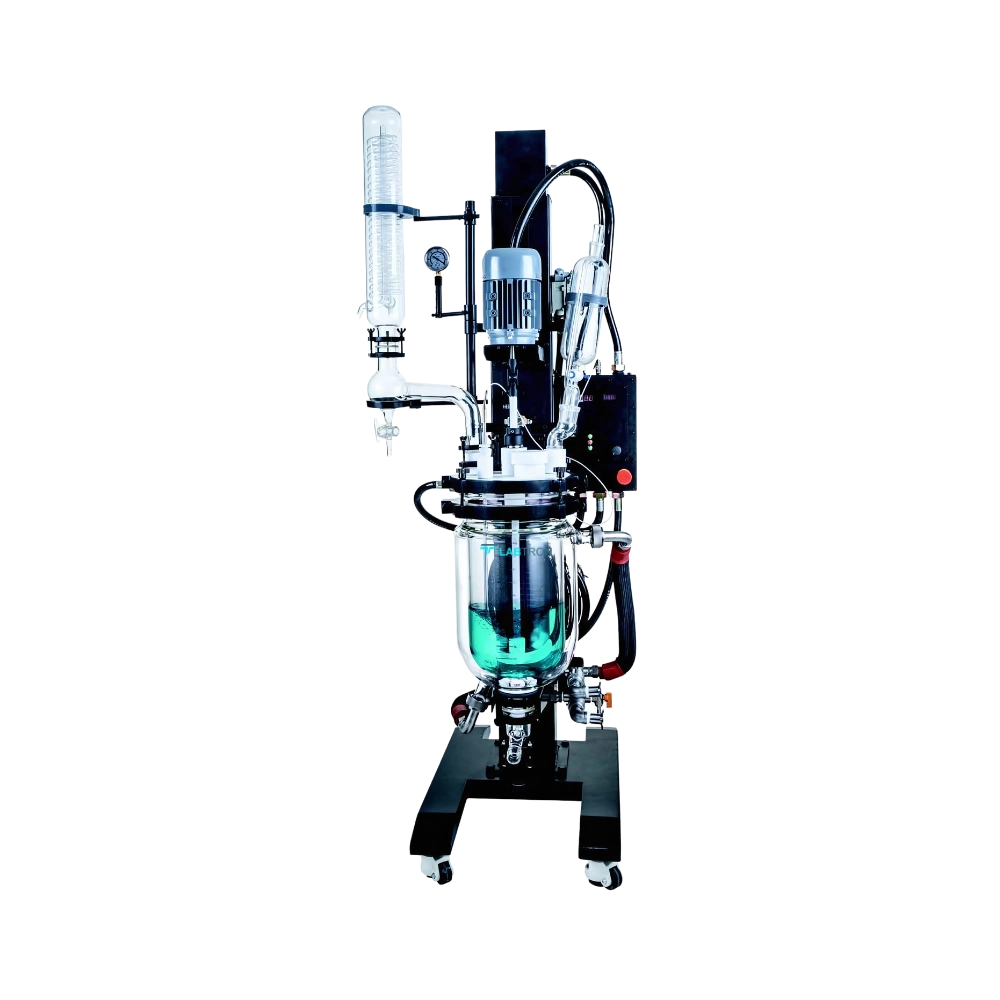

Our Jacketed Glass Reactor LJGR-A50 includes multiple lid openings designed to support staggered reagent addition throughout different stages of a chemical process. This functionality is critical for multistep reactions where the order and timing of component addition influence both yield and purity. The well-spaced ports prevent cross-interference, enabling simultaneous operation of multiple devices such as condensers, probes, or gas inlets. Researchers can maintain uninterrupted stirring and thermal conditions even while introducing new materials. It supports integration with peristaltic pumps or syringe injectors for controlled delivery. The design allows experiments requiring programmed dosing or stepwise mixing without opening the main chamber. Flexibility in configuration ensures better process control for dynamic or timed reactions. By reducing manual handling, it promotes better reproducibility across trials.
Labtron’s Jacketed Glass Reactor LJGR-A50 supports consistent thermal environments that are essential for reactions involving compounds with narrow stability margins. The outer jacket enables regulated heating or cooling through fluid circulation, avoiding the use of direct-contact heating elements that can cause localized degradation. This protects delicate intermediates that may decompose at varying temperatures and ensures that reaction profiles remain consistent across durations. Its closed-loop control compatibility allows for swift changes in thermal input without disturbing the internal reaction conditions. In pharmaceutical research, where temperature control affects the polymorphic outcome of active ingredients, this is particularly important. Temperature shifts can be gradual or sudden depending on the process requirement. Researchers also benefit from reduced energy loss due to efficient heat transfer design. This combination ensures material integrity across multiple synthesis runs.
The Jacketed Glass Reactor LJGR-A50 is engineered with a bottom discharge valve that minimizes residual material inside the vessel after completion of the process. Its drain position and smooth interior surface direct contents toward the outlet without requiring vessel tilting or scraping. This feature is especially advantageous for small-scale synthesis where recovery yield matters. The design ensures limited product hold-up, which reduces contamination risk between batches. Operators experience faster draining times with less mechanical effort. Its outlet geometry supports direct connection to filtration systems or containers without complex setup. Residue minimization shortens downtime between experiments and lowers cleaning effort. As a result, the unit improves laboratory productivity and resource efficiency during repeated workflows.
The Jacketed Glass Reactor LJGR-A50 is ideal for conducting reactions under controlled atmospheric conditions, such as inert nitrogen or argon environments. Its structural seals and joint integrity help prevent infiltration of ambient air, which is crucial when working with air-sensitive reagents. By connecting to a gas inlet port, users can maintain a dry and oxygen-free chamber during the entire process. This supports safe handling of pyrophoric, moisture-reactive, or highly unstable compounds. Port alignment is designed to isolate gas flow from mechanical agitation areas. Even when operated under low vacuum, the reactor maintains its seal, making it reliable for pressure-sensitive synthesis. Experiments involving catalysts or organometallic systems particularly benefit from this configuration. Researchers can set up purging cycles without needing to open the main chamber between steps.
Our Jacketed Glass Reactor LJGR-A50 enables non-disruptive sample collection through dedicated lid ports, allowing chemists to draw samples during a live reaction without halting the process. These ports accommodate standard lab tools such as septum-covered syringes, dip tubes, or micro-funnels. They help maintain a closed system, preventing contamination or reaction deviation due to external exposure. This is crucial for time-based studies where monitoring pH, turbidity, or intermediate yield at different intervals determines the next phase of synthesis. Real-time insights enhance process understanding and reduce the need for full replication. Researchers can modify parameters mid-run based on observed results. This makes it a preferred choice in kinetic research and validation trials. Additionally, the ports support clean sample withdrawal without excessive agitation.
The Jacketed Glass Reactor LJGR-A50 uses high-transparency borosilicate glass that enables constant observation of internal reaction dynamics, allowing visual confirmation of mixing uniformity, phase separation, or gas evolution. This eliminates the need to rely solely on sensor data during initial exploratory trials. For reactions involving changes in color, opacity, or bubble formation, the visual feedback can signal endpoints or deviations before instrumentation detects them. This is particularly useful for teaching environments or process troubleshooting. Clear sightlines also support observation of solid deposition or precipitation as they occur. The design accommodates external light sources, minimizing glare or distortion. Visibility remains unaffected even when using external fluid jackets or insulation sleeves. The glass structure is resistant to fogging, further aiding clarity during longer runs.
Our Jacketed Glass Reactor LJGR-A50 includes multiple lid openings designed to support staggered reagent addition throughout different stages of a chemical process. This functionality is critical for multistep reactions where the order and timing of component addition influence both yield and purity. The well-spaced ports prevent cross-interference, enabling simultaneous operation of multiple devices such as condensers, probes, or gas inlets. Researchers can maintain uninterrupted stirring and thermal conditions even while introducing new materials. It supports integration with peristaltic pumps or syringe injectors for controlled delivery. The design allows experiments requiring programmed dosing or stepwise mixing without opening the main chamber. Flexibility in configuration ensures better process control for dynamic or timed reactions. By reducing manual handling, it promotes better reproducibility across trials.
Labtron’s Jacketed Glass Reactor LJGR-A50 supports consistent thermal environments that are essential for reactions involving compounds with narrow stability margins. The outer jacket enables regulated heating or cooling through fluid circulation, avoiding the use of direct-contact heating elements that can cause localized degradation. This protects delicate intermediates that may decompose at varying temperatures and ensures that reaction profiles remain consistent across durations. Its closed-loop control compatibility allows for swift changes in thermal input without disturbing the internal reaction conditions. In pharmaceutical research, where temperature control affects the polymorphic outcome of active ingredients, this is particularly important. Temperature shifts can be gradual or sudden depending on the process requirement. Researchers also benefit from reduced energy loss due to efficient heat transfer design. This combination ensures material integrity across multiple synthesis runs.
The Jacketed Glass Reactor LJGR-A50 is engineered with a bottom discharge valve that minimizes residual material inside the vessel after completion of the process. Its drain position and smooth interior surface direct contents toward the outlet without requiring vessel tilting or scraping. This feature is especially advantageous for small-scale synthesis where recovery yield matters. The design ensures limited product hold-up, which reduces contamination risk between batches. Operators experience faster draining times with less mechanical effort. Its outlet geometry supports direct connection to filtration systems or containers without complex setup. Residue minimization shortens downtime between experiments and lowers cleaning effort. As a result, the unit improves laboratory productivity and resource efficiency during repeated workflows.
The Jacketed Glass Reactor LJGR-A50 is ideal for conducting reactions under controlled atmospheric conditions, such as inert nitrogen or argon environments. Its structural seals and joint integrity help prevent infiltration of ambient air, which is crucial when working with air-sensitive reagents. By connecting to a gas inlet port, users can maintain a dry and oxygen-free chamber during the entire process. This supports safe handling of pyrophoric, moisture-reactive, or highly unstable compounds. Port alignment is designed to isolate gas flow from mechanical agitation areas. Even when operated under low vacuum, the reactor maintains its seal, making it reliable for pressure-sensitive synthesis. Experiments involving catalysts or organometallic systems particularly benefit from this configuration. Researchers can set up purging cycles without needing to open the main chamber between steps.
Our Jacketed Glass Reactor LJGR-A50 enables non-disruptive sample collection through dedicated lid ports, allowing chemists to draw samples during a live reaction without halting the process. These ports accommodate standard lab tools such as septum-covered syringes, dip tubes, or micro-funnels. They help maintain a closed system, preventing contamination or reaction deviation due to external exposure. This is crucial for time-based studies where monitoring pH, turbidity, or intermediate yield at different intervals determines the next phase of synthesis. Real-time insights enhance process understanding and reduce the need for full replication. Researchers can modify parameters mid-run based on observed results. This makes it a preferred choice in kinetic research and validation trials. Additionally, the ports support clean sample withdrawal without excessive agitation.
The Jacketed Glass Reactor LJGR-A50 uses high-transparency borosilicate glass that enables constant observation of internal reaction dynamics, allowing visual confirmation of mixing uniformity, phase separation, or gas evolution. This eliminates the need to rely solely on sensor data during initial exploratory trials. For reactions involving changes in color, opacity, or bubble formation, the visual feedback can signal endpoints or deviations before instrumentation detects them. This is particularly useful for teaching environments or process troubleshooting. Clear sightlines also support observation of solid deposition or precipitation as they occur. The design accommodates external light sources, minimizing glare or distortion. Visibility remains unaffected even when using external fluid jackets or insulation sleeves. The glass structure is resistant to fogging, further aiding clarity during longer runs.
Post your question?
Our experts are here to help!
Labtron Equipment Ltd., Quatro House, Lyon Way, Camberley, Surrey GU16 7ER United Kingdom
Email: info@labtron.com Whatsapp: +44 73 4441 2688 Phone: +44 2080 043608
